
24/7 Customer Support

Free returns

Same-day & Next-day Delivery

Quality Guaranteed

Unlock Your Welcome Offers: FREE Delivery | Up to 80% OFF | Free 30-day JoyPlus trial
Download the APP
Freshly ground beans can improve the aroma and flavour of coffee, but choosing the right coffee grinder is not simply a matter of picking the model with the most settings. UK shoppers often pay for features that do not suit their brewing method, household routine or available storage space.
Before buying an electric coffee grinder, manual coffee grinder or portable coffee grinder, watch for these common pitfalls.
A high number of settings can provide useful control, but only if the adjustment mechanism is consistent and easy to repeat. A grinder with 60 settings may be helpful for switching between espresso and cafetière coffee, while a simpler model with 12 or 20 settings may be sufficient for one main brewing style.
Look for a clearly marked adjustment dial and check whether the product specifies its intended range, such as espresso, pour-over or French press.
Blade grinders chop beans rather than crushing them between two burrs. This can produce a mixture of fine particles and larger pieces, making it harder to achieve an even brew.
A burr coffee grinder uses rotating surfaces to break down the beans. Stainless steel or other durable burr materials are commonly used, while a conical burr grinder is often selected for its compact design and suitability across several brewing methods. Burr construction does not automatically guarantee uniform grounds, so adjustment quality and maintenance instructions still matter.
A large hopper may appear convenient, but storing beans in it for long periods can reduce freshness. Conversely, a small travel coffee grinder may require several grinding cycles when preparing coffee for multiple people.
Motor limits also matter. Some compact electric models require rest periods between batches to help prevent overheating. Check whether the instructions specify a maximum continuous operating time, and choose a grinder with removable or accessible parts if you want straightforward cleaning.
For espresso, look for a grinder that supports fine adjustment and can deliver grounds suitable for a portafilter or moka pot. For a coffee grinder for French press, coarse settings are important to reduce the amount of fine sediment in the cup.
A grinder suitable for both espresso and filter coffee should have adjustable grind settings covering fine, medium and coarse ranges. The number of settings is useful, but the practical spacing between each setting is equally important.
An electric coffee grinder is convenient for daily use and larger batches. A rechargeable coffee grinder may be more suitable for offices, caravans, camping or travel, provided you remember to charge it before leaving home.
A manual coffee grinder requires no electricity and can be useful in locations without reliable power. It is generally quieter, but grinding a large quantity of beans takes more physical effort and time.
For UK use, check the product listing for the supplied plug, charging method, voltage information and safety instructions. Battery-powered models should be kept dry, charged with the recommended cable and stored according to the manufacturer’s guidance.
A 20g capacity can suit one or two drinks, while a 50g travel grinder or 200g electric hopper is more practical for several cups. Consider where the grinder will live: measure the space beneath kitchen cupboards and check whether a portable model will fit inside your travel kit.
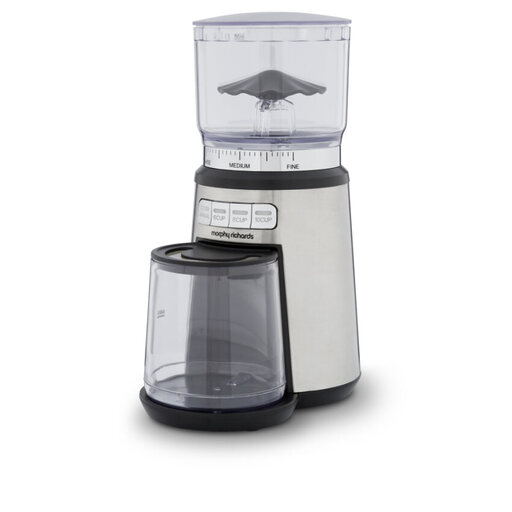
Why This Fits Their Persona: A practical kitchen option for UK households that want electric grinding, a sizeable hopper and simple controls without choosing a specialist espresso-focused appliance.
Its burr mechanism and selectable fine-to-coarse range avoid the uneven particle sizes associated with basic blade designs. The removable cup also makes routine cleaning more manageable.
200g bean capacity, 120W motor, removable grinding cup and a front quantity selector for 2 to 12 cups.
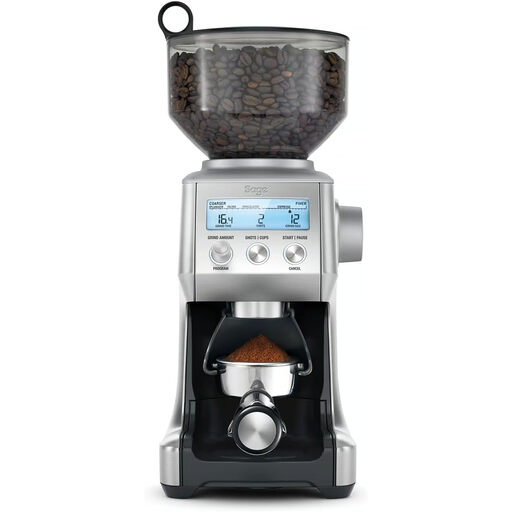
Why This Fits Their Persona: A strong match for home baristas who regularly alternate between espresso, filter coffee and French press and want repeatable digital dosing.
The LCD shows grind setting, grinding time and selected cups or shots, making the settings easier to monitor than an unmarked dial.
60 grind settings, 0.2-second dosing adjustment and direct grinding into a portafilter or airtight container.
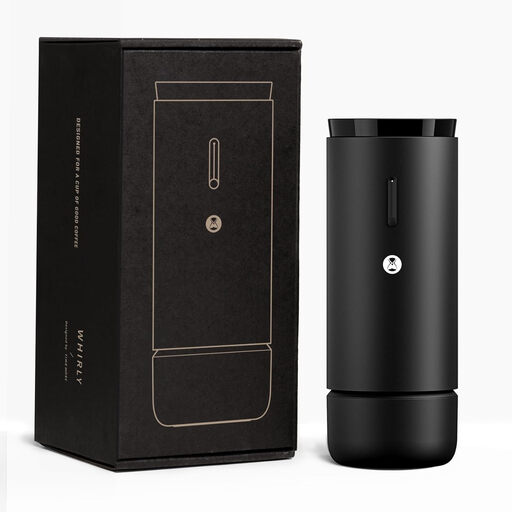
Why This Fits Their Persona: Suitable for coffee drinkers who want cordless operation at home, in the office or while camping, while still needing control from espresso to French press.
The stated 50g capacity, rechargeable design and auto-stop functions make its intended portable use clear. Its instructions also specify rest limits to help manage repeated batches.
30 grind settings, USB-C charging, 1,000mAh battery, 50g maximum capacity and a compact metal body.
We have compiled a complete, real-time list of products that fully satisfy these strict selection criteria and UK safety regulations.
It can be worthwhile if you want more control over particle size. Choose a model with a clearly marked coarse range and avoid grinding finer than necessary, as excess fine particles can increase sediment in a cafetière.
Brush away loose grounds after regular use and follow the product instructions for deeper cleaning. Removable hoppers, cups and burr components can make this easier. Do not immerse an electric motor base or rinse parts unless the manufacturer specifically states that they are water-safe.
The electricity used by a small grinder is generally limited because grinding takes a short time, but running costs depend on the motor, usage frequency and charging efficiency. A rechargeable model’s main advantage is flexibility away from a socket; a mains-powered model is more suitable for frequent household batches.