
24/7 Customer Support

Free returns

Same-day & Next-day Delivery

Quality Guaranteed

Unlock Your Welcome Offers: FREE Delivery | Up to 80% OFF | Free 30-day JoyPlus trial
Download the APP
A fresh coffee grinder can make a noticeable difference to your daily brew, but choosing one involves more than comparing burr size or counting grind settings. Many UK shoppers buy a grinder that looks capable on paper, only to discover that it is awkward to clean, unsuitable for their brewing method or expensive to use regularly.
This guide explains the practical specifications that matter and compares suitable options for different home, travel and light-commercial routines.
A high number of settings can be useful, but the spacing and adjustment mechanism matter too. A grinder with many poorly defined steps may be less useful than an adjustable coffee grinder with clear, repeatable changes between fine espresso and coarse French press settings.
For espresso, small adjustments can affect flow rate and extraction. For pour-over or cafetière coffee, a broader and consistent grind is usually more important than having dozens of tiny increments.
Blade grinders chop beans unevenly. This can produce a mixture of fine particles and larger pieces, which may lead to an inconsistent brew. A burr coffee grinder crushes beans between two surfaces, allowing more control over particle size.
A conical burr grinder is a popular choice for home use because it can support multiple grind ranges while generally keeping the machine relatively compact. However, burr material, alignment, motor design and adjustment quality still need checking.
A small portable coffee grinder may suit one or two cups, but it can become inconvenient if you prepare coffee for several people. Conversely, a large electric coffee grinder may occupy valuable kitchen worktop space when you only grind 15–20g at a time.
Also check whether the burrs and grounds container can be removed, whether the manufacturer recommends dry-brush cleaning and whether there is a stated limit on continuous use. These details can have more impact on everyday satisfaction than appearance.
For regular filter or espresso brewing, look for a burr coffee grinder rather than a blade design. Stainless steel burrs are used on several compact models, while larger home grinders may use coated or titanium-alloy burrs.
Alignment is particularly relevant in portable models. The STARESSO D6E PLUS, for example, lists a stainless steel burr with a triple coaxial alignment system and dual bearing support. These are objective design features intended to reduce burr movement during grinding.
Your brewing equipment should determine the adjustment range you need:
The Sage Smart Grinder Pro provides 60 grind settings, with selectable dosing for cups or shots. Its LCD displays the selected setting, grind time and number of cups or shots, while Dosing IQ allows time changes in 0.2-second increments.
An electric coffee grinder is convenient for repeated daily use, but it needs a suitable UK power supply and enough space around the motor for ventilation. A rechargeable coffee grinder removes the need for a socket, making it practical for camping, commuting or office use.
Capacity also matters. The HiBREW G3 has a 210g bean container and a 100g grounds container, while the STARESSO D6 PLUS manual grinder has a stated 20g capacity, which is more suited to single-batch preparation.
For travel, compare more than dimensions. Consider total weight, charging time, cleaning access and whether the grinder can handle your preferred roast. Some compact wireless models may require more care with oily or very hard beans.

Why This Fits Their Persona: A practical starting point for UK drinkers who make one or two cups and do not want another powered appliance on the worktop.
It uses a stainless steel burr and internal click-based adjustment rather than a basic blade mechanism. Its 20g capacity also makes the intended single-batch use clear.
Manual operation needs no electricity; metal construction, dual ball bearings and a silicone handle sleeve are listed features.

Why This Fits Their Persona: Suits households switching between espresso, filter and French press who value programmable dosing and direct-to-container grinding.
The LCD makes grind setting, time and dose selection visible, reducing reliance on guesswork. It offers 60 settings rather than a limited coarse-to-fine switch.
Conical burr design; programmable dosing in 0.2-second increments; supports portafilters, airtight containers and filter baskets.
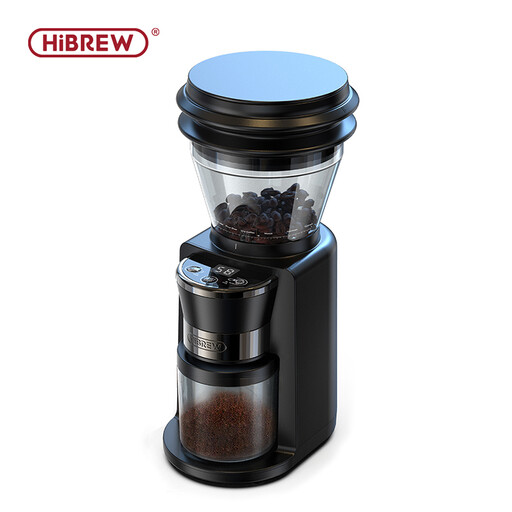
Why This Fits Their Persona: A logical match for larger households or users who prepare several coffees and prefer automated quantity controls.
Its 210g bean hopper and 100g powder tank are clearly specified, helping buyers assess capacity before purchase. The stated safety guidance limits continuous operation to 10 grinding cycles.
34 grind settings; 48mm conical burr; single- and double-cup quantity buttons; 220–240V, 50Hz specification for UK-compatible mains supply.

Why This Fits Their Persona: Useful for camping, commuting or office brewing where a mains-powered electric coffee grinder is inconvenient.
It provides one-touch operation without hand cranking and uses a rechargeable 1000mAh battery. Removable parts can be dry-brush cleaned, while the burr should not be rinsed with water.
Type-C charging; full-metal body; adjustable settings for espresso, moka pot, pour-over and French press; approximately 150mm tall and 52mm in diameter.
We have compiled a complete, real-time list of products that fully satisfy these strict selection criteria and UK safety regulations.
A manual coffee grinder uses no electricity, so its direct running cost is limited to maintenance and replacement parts. An electric coffee grinder consumes a relatively small amount of power per use, but its value comes from speed and convenience. For several daily brews, the reduced effort may justify the additional purchase and electricity cost.
Lifespan depends on burr material, motor use, cleaning and the type of beans ground. Regular dry-brush cleaning, avoiding foreign objects and respecting the stated duty cycle can help reduce wear. Check whether replacement burrs or service information are available before buying.
Choose a model with a clearly stated coarse-to-medium range and adjustable control. A conical burr grinder with multiple settings can support both methods, while a manual coffee grinder may be suitable when preparing smaller quantities. Always confirm the product’s specified brewing compatibility rather than relying on the product title alone.