
24/7 Customer Support

Free returns

Same-day & Next-day Delivery

Quality Guaranteed

Unlock Your Welcome Offers: FREE Delivery | Up to 80% OFF | Free 30-day JoyPlus trial
Download the APP
As a Joybuy Product Recommendation Officer, my role is to help you navigate the crowded market of home appliances. When it comes to buying a new coffee machine, it’s easy to get lost in a sea of technical jargon and marketing promises. Many find themselves with a machine that’s either too complicated, too expensive to run or simply doesn’t produce the coffee they were hoping for. This guide will help you sidestep the common pitfalls and focus on what truly matters for brewing a great cup at home.
Before looking at models, it’s crucial to be aware of a few common traps that can lead to buyer's remorse.
To find the right fit, focus on these three practical considerations that will directly impact your daily coffee experience.
Your ideal coffee machine depends on the balance you want between convenience, cost and control.
If you enjoy lattes, cappuccinos or flat whites, the milk frothing capability is key.
In many UK kitchens, counter space is at a premium. Always check the dimensions of a machine before purchasing. A compact coffee machine can deliver excellent results without dominating your worktop. Equally important is the water tank capacity. A larger tank (1 litre or more) is better for households with multiple coffee drinkers, as it will save you from constant refilling.
Based on these practical criteria, here are a few options tailored to different user needs.
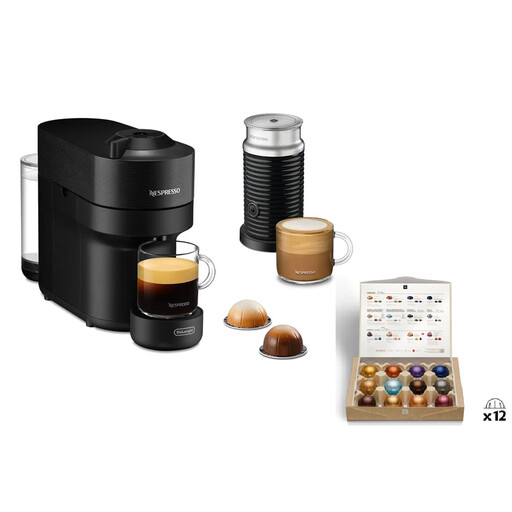
Why This Fits Their Persona: Perfect for those who need a great coffee quickly before heading out. The one-touch operation, fast 30-second heat-up and included Aeroccino for effortless lattes make the morning routine seamless. Its compact footprint is ideal for smaller kitchens.
The separate Aeroccino frother is far easier to clean than integrated milk systems, avoiding the maintenance pitfall. While it uses pods, the Vertuo capsules are aluminium and can be recycled via Nespresso's programme, addressing some environmental and cost concerns.
Barcode reading technology automatically adjusts brewing for each pod, ensuring consistent results. The bundle includes a milk frother for hot and cold milk foam, adding great versatility.

Why This Fits Their Persona: This machine caters to everyone. It offers one-touch espresso, coffee and Americano from fresh beans for those who want simplicity, plus a manual steam wand for family members who want to craft their own lattes. The 1.8-litre water tank handles multiple daily users with ease.
As a bean-to-cup machine, it avoids the high long-term cost of pods. The traditional steam wand is simple to wipe clean after each use, sidestepping the complex cleaning routines of automatic carafe systems.
The built-in grinder with 13 settings allows for customisation of coffee strength and flavour. It delivers the freshness of bean-to-cup with the convenience of one-touch operation.
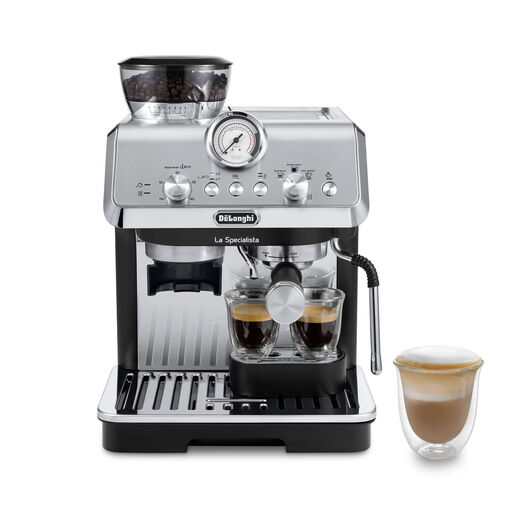
Why This Fits Their Persona: This machine is for those who want to be hands-on. With an integrated grinder, 3 temperature settings and a professional-style steam wand, it provides all the tools needed to learn and perfect the art of espresso making, from grinding and tamping to steaming milk.
It focuses on controllable factors like grind size and temperature, not just a high bar pressure number. Using whole beans is economical and the manual nature means cleaning is a straightforward part of the brewing ritual, not a hidden chore.
It includes a full barista kit (tamper, dosing funnel and milk jug), giving you everything you need to start. The My Latte Art steam wand is designed to help create high-quality microfoam.
We have compiled a complete, real-time list of products that fully satisfy these strict selection criteria and UK safety regulations.
For most machines, descaling is recommended every 2-3 months. However, if you live in a hard water area, which is common across much of the UK, you may need to do it more frequently, perhaps monthly. Many modern machines have an indicator light that will alert you when it's time to descale. Regular descaling is vital for maintaining water temperature and preventing blockages.
While you can use most coffee beans, it is advisable to avoid extremely oily, dark-roasted beans. Over time, the oils can build up and clog the internal grinder mechanism, which can be difficult to clean and may require servicing. A medium roast is generally a safe and flavourful choice that works well in most automatic grinders.
Not necessarily. As mentioned, the ideal pressure for a balanced espresso shot is around 9 bars. Both 15-bar and 19-bar pumps provide more than enough pressure to achieve this. The quality of your coffee will be far more influenced by other factors, such as the freshness of the coffee, the consistency of the grind, the water temperature and your tamping technique (on a manual machine). Focus on these elements rather than the pressure specification alone.