
24/7 Customer Support

Free returns

Same-day & Next-day Delivery

Quality Guaranteed

Unlock Your Welcome Offers: FREE Delivery | Up to 80% OFF | Free 30-day JoyPlus trial
Download the APP
Bringing the café experience into your kitchen is a tempting prospect, but the journey to the perfect home-brewed coffee is often fraught with confusion. With so many models on the market, it is easy to end up with a machine that disappoints. Many find their new home coffee machine gathering dust after just a few months, a victim of clever marketing and overlooked flaws.
As the Joybuy Product Recommendation Officer, my role is to help you navigate this landscape. Before you invest, let’s look at the three most common pitfalls that lead to buyer's remorse.
pod coffee machine can seem like a bargain initially. However, the ongoing expense of proprietary capsules can quickly add up, costing significantly more per cup than using fresh beans. Furthermore, the environmental impact of single-use pods is a growing concern for many households.barista coffee machine into little more than a countertop ornament.To make a sound choice, it is essential to look past the marketing jargon and focus on the core technical features that determine performance. Here are the three non-negotiable parameters to check.
You will see machines advertising 15-bar or even 20-bar pressure. While this sounds impressive, the industry standard for a balanced and flavourful espresso extraction is approximately 9 bars of pressure applied at the group head. Excessively high pressure can force water through the coffee grounds too quickly, leading to a bitter, over-extracted shot. A machine that can deliver consistent pressure around the 9-bar mark is more important than one that simply boasts a higher number.
The component that heats the water is critical for both speed and taste. There are two main types:
Sage coffee machine often feature this technology.For either system, look for machines with PID (Proportional-Integral-Derivative) temperature control. This digital feature ensures the water temperature remains stable throughout the brewing process, preventing sour (too cold) or burnt (too hot) flavours.
Your preference for milky coffees like lattes and cappuccinos will determine which coffee machine with milk frother is right for you.
espresso machine, this gives you complete control to texture milk into velvety microfoam, essential for latte art. It requires practice but offers superior results for the aspiring home barista.To help you find a machine that aligns with your lifestyle, we have matched a few standout models to different user profiles.
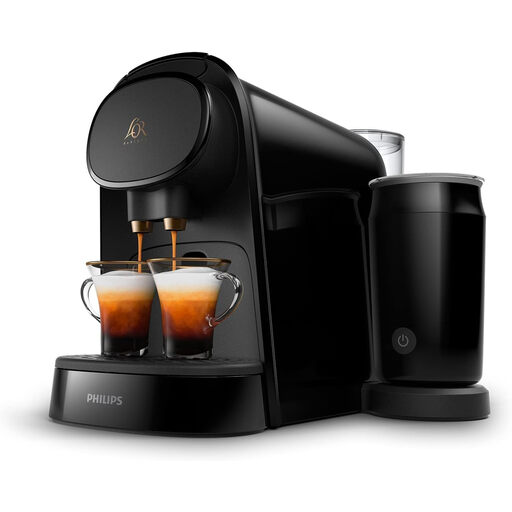
Why This Fits Their Persona: Ideal for those with busy mornings who need a quality coffee with zero fuss. This machine eliminates the steps of grinding and tamping, delivering a consistent espresso or lungo before you head out the door.
It sidesteps the "hidden cost" trap by being a Nespresso compatible machine, giving you a wide choice of pods beyond a single brand. This flexibility helps manage long-term running costs.
Its exclusive dual-capsule system can brew two coffees at once or a single double espresso, a practical feature for couples or those needing an extra boost. It also includes a separate milk frother for lattes.

Why This Fits Their Persona: Perfect for those who want to learn the craft of espresso without a huge initial investment. It provides the essential manual controls to experiment with grind, tamp pressure and milk texturing.
This machine avoids the "underpowered all-in-one" trap by focusing on the fundamentals. It is a dedicated manual espresso machine, not a compromised hybrid, ensuring its components are built for their specific purpose.
The combination of a 15-bar pump and a stainless steel manual steam wand provides the authentic, hands-on experience needed to develop barista skills. Its compact design is also ideal for smaller UK kitchens.

Why This Fits Their Persona: For the user who values freshness and control above all. This machine offers a complete bean to cup coffee machine experience, allowing for precise customisation of grind size, dose and extraction.
This is a high-performance all-in-one that avoids compromise by using quality components, including hardened steel burrs and a fast ThermoJet heating system. The intuitive LCD screen also simplifies cleaning and maintenance prompts.
The integrated grinder with 30 grind settings and a 3-second heat-up time provide unparalleled speed and freshness. The powerful manual steam wand is capable of producing true café-quality microfoam for latte art.
Of course, no setup is complete without the right tools. For those with a manual machine, a dedicated portafilter brush like the MHW-3BOMBER Coffee Portafilter Cleaning Brush can make the cleaning process much quicker. And for families, a kids coffee machine like the Casdon Barista Coffee Machine Play Set can be a wonderful way to include little ones in the morning ritual safely.
We have compiled a complete, real-time list of products that fully satisfy these strict selection criteria and UK safety regulations.
Due to the varying levels of water hardness across the UK, it is generally recommended to descale your machine every 2-3 months. Hard water areas like London and the South East may require more frequent descaling. Many modern machines have an indicator light that will alert you when it's time to run a descaling cycle.
Initially, a bean to cup coffee machine is a larger investment. However, the cost per cup is significantly lower, as whole beans are much cheaper than pods. If you drink coffee daily, the machine can pay for itself over time. The trade-off is the higher requirement for cleaning and maintenance compared to the simple drop-in-and-go nature of a pod coffee machine.
While a higher number seems better, both 15 and 20 bars refer to the maximum pressure the pump can produce, not the pressure used during extraction. A quality machine regulates this down to the optimal 9 bars at the coffee puck. Therefore, there is no practical flavour advantage between a 15-bar and a 20-bar machine for making espresso. Focus instead on features like temperature stability and grinder quality.