
24/7 Customer Support

Free returns

Same-day & Next-day Delivery

Quality Guaranteed

Unlock Your Welcome Offers: FREE Delivery | Up to 80% OFF | Free 30-day JoyPlus trial
Download the APP
Buying one of the many coffee machines available in the UK can seem straightforward until you compare capsule systems, grinders, pressure ratings, milk frothers and water-tank sizes. A machine that suits a busy office may be inconvenient for a flat-dweller, while a manual espresso machine may offer useful control but require more time each morning.
This guide explains the specifications that matter, highlights common buying traps and matches several options to different household needs.
Many espresso machines advertise 15, 19 or 20-bar pumps. This figure describes the pump’s maximum capability, not necessarily the pressure used throughout extraction. Coffee flavour also depends on grind size, dose, tamping, water temperature and the brewing system.
Treat pump pressure as one specification rather than a standalone quality guarantee. A machine with temperature control, pre-infusion or adjustable settings may provide more useful control than a higher headline number.
“Capsule coffee machine” does not mean every capsule will fit. Systems may accept only a particular capsule range, such as Nespresso Original, Nespresso Vertuo or Tassimo T DISCs. Some multi-capsule machines also support ESE pods, ground coffee and more than one capsule format, but the included adapters should be checked before purchase.
Capsules can simplify preparation, but their ongoing cost and availability should be considered. If you prefer buying different beans from UK supermarkets or independent roasters, a manual or bean-to-cup machine may offer more flexibility.
A compact coffee machine still needs clearance for its water tank, capsule holder, bean hopper or steam wand. Check the full dimensions, cable position and the space above the machine before ordering. Cup clearance matters too: some compact models are designed for espresso cups rather than tall travel mugs.
For small kitchens, a front-access water tank or a narrow body can be more practical than simply choosing the machine with the smallest advertised footprint.
A larger tank reduces refilling, but it also takes up more room and becomes heavier to remove. Capacities in the supplied options range from 600ml on compact multi-capsule models to 1.8 litres on some bean-to-cup coffee machines.
Look for removable tanks, accessible drip trays and clear cleaning instructions. Milk-frothing systems need particular attention: wipe the wand immediately after use and follow the manufacturer’s descaling guidance. Hard water in some UK areas can increase limescale, so regular descaling is important for performance and hygiene.
Check that the product is specified for the UK’s 220–240V supply and use a suitable earthed socket. Do not operate a machine without water, and keep hot outlets, steam wands and cords away from children. Never remove a portafilter or capsule holder while brewing, as hot water and pressure may be released.
The following selections are matched to distinct usage profiles rather than ranked as universally suitable.
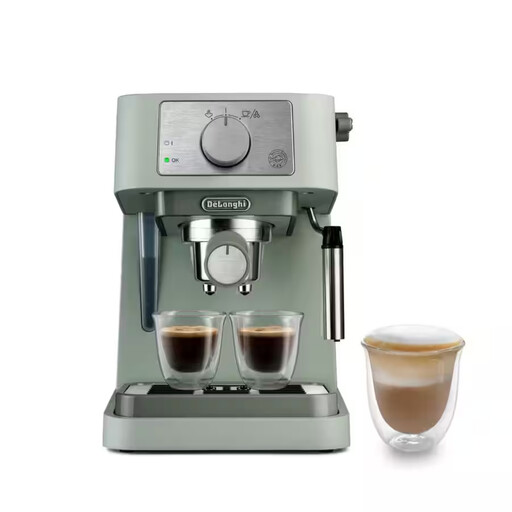
Why This Fits Their Persona: A compact option for first-time home baristas in flats or smaller UK kitchens, with the choice of ground espresso or ESE pods.
It does not rely on one capsule ecosystem and includes single- and double-shot baskets, helping buyers avoid compatibility surprises.
15-bar pump, manual stainless-steel steam wand, two-tier drip tray and a transparent water-level indicator.
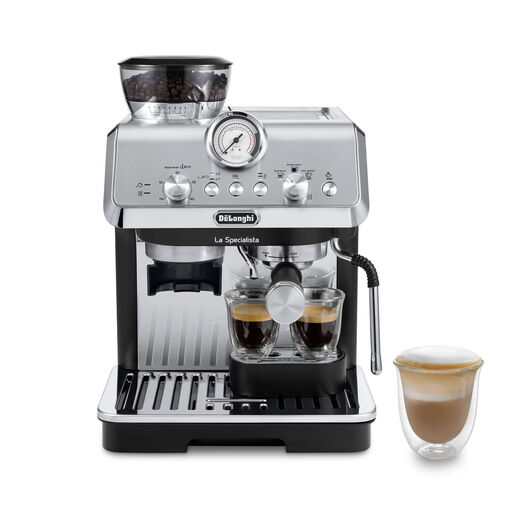
Why This Fits Their Persona: Suitable for coffee lovers who want freshly ground beans and hands-on control over espresso, long black and milk-based drinks.
Its integrated grinder and adjustable settings make the coffee process visible, rather than hiding all preparation behind a one-touch claim.
Integrated burr grinder with eight settings, three infusion temperatures, a 1.7-litre tank and professional-style steam wand.

Why This Fits Their Persona: Designed for homes where several people want different drinks without measuring, grinding and tamping for every cup.
It uses whole beans rather than locking the household into a capsule range, while still offering one-touch drink controls.
Four one-touch recipes, 13 grinder settings, adjustable aroma and temperature, and a 1.8-litre removable water tank.

Why This Fits Their Persona: A practical choice for users who switch between capsule formats, espresso powder and hot or cold drinks.
Its stated compatibility includes several pod formats and espresso powder, reducing the risk of buying a machine that accepts only one system.
Hot and cold modes, a 20-bar pump, 600ml tank and compact 260 × 260 × 110mm body. Check cup height before purchase.
We have compiled a complete, real-time list of products that fully satisfy these strict selection criteria and UK safety regulations.
Before buying, calculate more than the purchase price. Capsule users should compare the price per serving and check whether compatible pods are readily available. Bean-to-cup owners need to budget for whole beans, cleaning tablets and descaler. Manual machines may cost less per drink when using ground coffee, but they require more preparation and cleaning time.
For iced coffee, choose a machine that can produce a concentrated espresso or has a cold-brew setting. Brewing a large, watery drink directly over ice can dilute the flavour. Large ice cubes, a short espresso extraction and cold milk or water usually give better control.
Running cost depends on the drink format, electricity use, cleaning products and coffee. Capsules are convenient but may cost more per serving than beans or ground coffee. Auto shut-off and energy-saving modes can reduce unnecessary standby use.
Lifespan varies with construction, water quality, frequency of use and maintenance. Empty the drip tray, clean removable parts and descale according to the manual. Machines with grinders and milk systems have more components to maintain than basic drip coffee makers.
Usually, yes, provided the manufacturer permits it. However, water hardness varies across the UK and can contribute to limescale. Check the manual, use the recommended filter if supplied and follow the stated descaling schedule.