
24/7 Customer Support

Free returns

Same-day & Next-day Delivery

Quality Guaranteed

Unlock Your Welcome Offers: FREE Delivery | Up to 80% OFF | Free 30-day JoyPlus trial
Download the APP
Choosing among coffee machines can be surprisingly difficult. Product pages often highlight pressure ratings, drink menus and “professional” features, but these figures do not always explain how an appliance will fit your kitchen, routine or budget.
A compact pod machine may be convenient but restrict your capsule choices. An espresso machine may offer more control but require grinding, tamping and regular cleaning. Even a simple filter coffee maker can disappoint if its capacity does not match the number of people using it.
This guide explains the practical details worth checking before buying, followed by product recommendations matched to different UK lifestyles.
Many espresso machines advertise 15-bar, 19-bar or 20-bar pump pressure. This is a specification of the pump, not a complete measure of extraction quality. Coffee grind size, dose, tamping, water temperature and freshness also affect the result.
Treat pressure as one comparison point rather than a guarantee. A machine with a suitable filter basket, stable heating and straightforward controls may be more useful than one promoted mainly through a large pressure number.
Pod coffee machines and capsule coffee makers are not universally compatible. Some use one capsule format, while multi-capsule models may accept several adapters. Check the exact capsule types before buying, especially if your household already has a preferred coffee subscription or brand.
Also consider ongoing costs. Capsules can be convenient, but buying coffee grounds or whole beans may offer more flexibility over time. Look for machines that clearly state whether they accept E.S.E. pods, ground coffee or specific capsule systems.
A coffee machine with a milk frother, grinder or removable brewing parts needs more cleaning than a basic filter coffee maker. Milk residue should be wiped and flushed promptly, while capsule and espresso machines may require descaling according to the instructions.
Measure the available space, including room to remove a water tank or open the capsule compartment. Compact coffee machines can still be unsuitable if a wall cupboard prevents the lid or portafilter from opening fully.
Choose the method that matches how much control you want:
A 600ml tank is convenient for occasional single servings, while a 1.1-litre to 1.8-litre tank reduces refilling for households or frequent users. Remember that the stated capacity includes water used for brewing and, in some machines, rinsing or steaming.
For filter coffee, check the jug or reservoir capacity in relation to the number of drinkers. A 750ml machine may suit one or two people, whereas a 1-litre French press is more suitable for serving several small cups.
If you regularly make lattes or cappuccinos, look for a manual steam wand or integrated milk system. Manual wands offer more control but require practice and cleaning. One-touch systems are simpler but may provide less control over milk texture.
For hot and cold coffee makers, check whether the cold function produces a chilled drink directly or simply brews hot coffee over ice. Also confirm the recommended cup height. Some compact models cannot accommodate tall travel mugs.
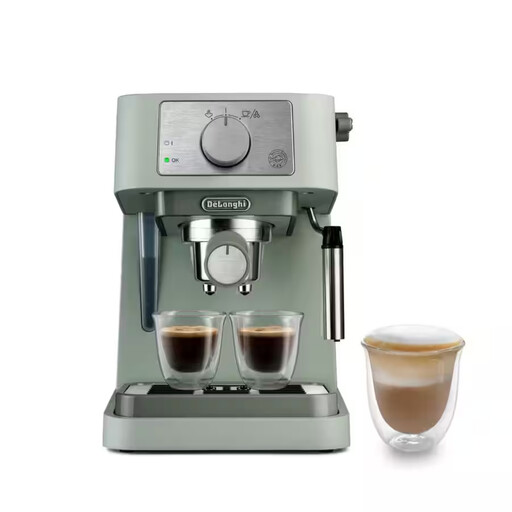
Why This Fits Their Persona: Its compact footprint and manual controls suit first-time home users, students and flat dwellers who want espresso and milk drinks without a large bean-to-cup appliance.
It states compatibility with both ground espresso and E.S.E. pods, reducing reliance on one coffee format. The transparent water indicator also makes refilling easier.
15-bar pump specification, manual stainless-steel steam wand, two-tier drip tray and 220–240V operation.

Why This Fits Their Persona: Designed for coffee drinkers who want fresh-bean preparation, adjustable settings and milk drinks in one worktop appliance.
Instead of relying only on a pressure figure, it provides a built-in grinder with 20 grind adjustments, pre-infusion and stated PID temperature control.
20-bar pump specification, 1.8-litre removable tank, hot and cold modes and a steam wand.

Why This Fits Their Persona: A useful option for shared homes or offices where different people prefer different pod systems, ground coffee or iced drinks.
Its stated six-in-one compatibility includes several pod formats, E.S.E. pods and espresso powder. Check each adapter and capsule specification before ordering.
20-bar pump specification, 600ml reservoir, hot and cold modes and automatic shut-off after 15 minutes.

Why This Fits Their Persona: This non-electric portable espresso maker suits camping, travel, car journeys and offices without a suitable mains socket.
It does not require electricity, so there is no risk of buying a mains-powered appliance for a location without a reliable socket. It is also detachable and washable.
Manual operation, capacity of up to 24g of ground coffee and stated 15–20-bar extraction range.
We have compiled a complete, real-time list of products that fully satisfy these strict selection criteria and UK safety regulations.
Pod coffee machines generally require the fewest preparation steps: fill the tank, insert a compatible capsule and start brewing. Filter coffee makers are also straightforward for preparing several cups. Manual espresso machines offer greater control but require grinding, dosing, tamping and cleaning.
Empty drip trays and rinse removable parts regularly. Clean a steam wand immediately after each milk drink. Descale at the interval stated in the manual, as water hardness varies across the UK. A machine that is easier to dismantle is more likely to be maintained consistently.
Running costs depend on the coffee format, drink frequency, water use and electricity consumption. Pod machines add the continuing cost of capsules, while espresso and filter machines use ground coffee or beans. Compare the purchase price with the cost of your preferred coffee over several months and choose a reservoir size that avoids unnecessary daily refilling.