
24/7 Customer Support

Free returns

Same-day & Next-day Delivery

Quality Guaranteed

Unlock Your Welcome Offers: FREE Delivery | Up to 80% OFF | Free 30-day JoyPlus trial
Download the APP
Choosing among coffee machines can feel complicated when product pages emphasise pressure ratings, drink menus and “barista-style” features. The most suitable machine depends less on impressive-sounding marketing and more on how you drink coffee, how much work you want to do and how much kitchen space you have.
For UK households, the main options include bean-to-cup coffee machines, capsule or pod coffee machines, manual espresso machines and fully automatic coffee machines. Each has practical advantages, but each can also create avoidable costs if you overlook compatibility, cleaning or capacity.
A 15-bar or 20-bar pump rating may look decisive, but it does not tell you everything about the drink in your cup. Extraction also depends on grind size, dose, water temperature, brewing volume and the coffee itself. A high number should therefore be treated as one specification, not a guarantee of flavour.
For capsule machines, pod compatibility and brewing controls can be more important than the headline pressure figure. For espresso machines with grinder systems, adjustment range and ease of use may have greater day-to-day impact.
Capsule and pod coffee machines are convenient, but you must check the exact system before buying. Some machines accept only a particular capsule format, while others support several pod types or ground coffee. A lower purchase price can become less attractive if your preferred pods are expensive or difficult to source.
Bean-to-cup machines use whole beans, which can offer more choice and avoid capsule waste, but they require regular emptying, rinsing and descaling. Consider the total routine rather than just the machine price.
A compact machine may have a small water tank, limited cup clearance or a narrow drip tray. Conversely, larger coffee machines for home may need substantial space above and around the unit for refilling and maintenance.
Milk systems also need attention. Automatic milk carafes are convenient, while manual steam wands offer more control but require cleaning after use. Always check whether the brew group, drip tray and milk components are removable or dishwasher-safe.
A 600 ml water tank, such as the one in the compact HiBREW H1C, may suit one or two users but will need more frequent refilling. Larger 1.8-litre tanks found on several automatic coffee machines are more practical for families or small offices.
Bean hoppers between 250 g and 300 g reduce refilling during busy periods. For pod machines, capacity is less about storage and more about the used-pod container and drip tray.
Measure the available area, including room for the water tank and bean hopper to be removed. The HiBREW H1C measures approximately 260 × 260 × 110 mm, but its product information recommends cups around 6–8 oz and warns that mugs taller than 3.8 inches may not fit.
For UK use, verify the product specification shows 220–240 V compatibility and follow the supplied instructions. Coffee machines produce hot water, steam and, in some cases, high-pressure brewing. Place the appliance on a stable, heat-resistant surface and keep it away from children.
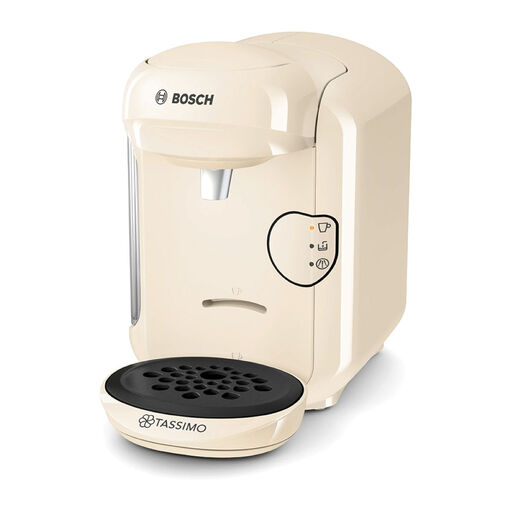
Why This Fits Their Persona: A compact option for households wanting one-touch coffee, tea and hot chocolate without buying a separate grinder or learning manual espresso preparation.
The machine clearly uses Tassimo T DISCs, helping buyers check compatibility before purchase rather than assuming all pods fit.
One-touch operation, barcode-guided brewing, removable 0.7-litre tank and automatic cleaning and descaling programmes.

Why This Fits Their Persona: Suited to coffee drinkers who want broad drink variety, freshly ground brewing and dedicated hot and cold preparation in one countertop appliance.
Its description distinguishes cold-brew preparation from iced drinks, making the cooling method clearer than a generic “cold coffee” label.
Over 50 listed hot and cold drink recipes, 1.8-litre water tank, adjustable grinder and separate hot and cool milk systems.

Why This Fits Their Persona: A practical match for home baristas who want fresh grinding, espresso control, milk drinks and hot or cold modes without separate grinder equipment.
It provides concrete control details, including 20 grind settings, PID temperature control and pre-infusion, rather than relying only on a pressure headline.
Built-in burr grinder, 1.8-litre tank, steam wand and one-touch controls with adjustable grind and shot settings.
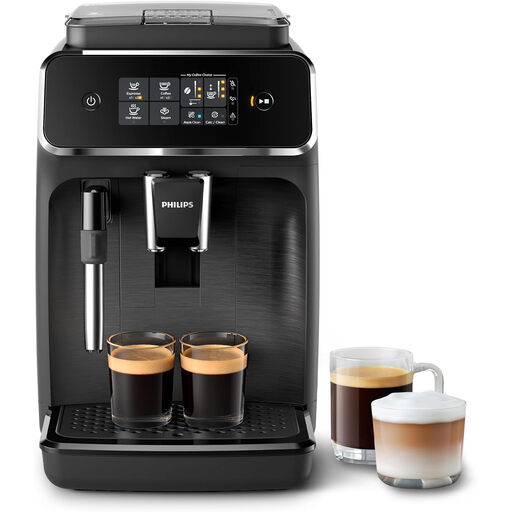
Why This Fits Their Persona: Designed for repeated daily use where two-touch drink selection, a larger tank and accessible cleaning parts matter more than manual preparation.
The removable brew group and dishwasher-safe components make the cleaning workload visible before purchase.
1.8-litre tank, 275 g bean capacity, 12 grinder settings, classic milk frother and automatic descaling alerts.
We have compiled a complete, real-time list of products that fully satisfy these strict selection criteria and UK safety regulations.
They can suit households that drink several cups daily and prefer whole beans, adjustable strength and fewer manual steps. However, they cost more than many capsule machines and need regular rinsing, grounds-container emptying and descaling. Check the tank, hopper and cleaning access before buying.
Running cost depends on power rating, heating time, drink frequency and standby behaviour. Features such as automatic shut-off can reduce idle operation, but they do not replace sensible use. Follow the manufacturer’s instructions and switch off or unplug the machine when appropriate.
Lifespan varies with construction, usage, water hardness and maintenance. Empty the drip tray and grounds container as instructed, clean milk components after use and descale when prompted. Hard-water areas may require closer attention, particularly if the machine does not use a replaceable water filter.