What to check before buying
Decide whether a tin is essential, then match the amount and preparation involved to your expected turnout. Pack weights alone do not establish identical serving counts across products.
400g ready-to-serve tins
Choose when: You require a can and would rather open custard in smaller batches.
Trade-off: Serving a larger group may require several cans; check each product's portion guide.
1kg ready-to-serve carton
Choose when: Group portions matter more than metal-can packaging.
Trade-off: It is not a tin, and an opened large pack needs a plan for any custard left over.
Custard powder
Choose when: You can prepare custard and want to choose the milk, added sugar or consistency.
Trade-off: It cannot be opened and served immediately; Bird's says to refrigerate made-up custard and treat it as fresh food.
| Concern |
What to check |
Who this matters to |
| Group portions |
Compare the pack's stated servings with your planned portions. Ambrosia states eight 125g servings for its 1kg Devon Custard carton; Sainsbury's states four servings for its 500g ready-to-eat carton. |
When I am serving custard alongside cake for several guests, I want enough portions without preparing it during the event. About 29% of consumers put low-prep group serving first. |
| Tinned format |
Confirm that the pack is a can rather than a carton; allow for more than one 400g can if the required amount exceeds a single pack. |
If the custard must come in a tin, a larger carton does not meet my packaging requirement. For about 23% of consumers, keeping to tins is the primary need. |
| Usable amount |
Compare pack sizes and stated servings, then read the opened-pack storage instructions before deciding how much to buy. |
I want enough for the turnout without opening more custard than we can use or store afterwards. Avoiding unnecessary leftovers comes first for about 18% of consumers. |
| Nutrition information |
Compare the per 100g nutrition panels on the exact variants. Sainsbury's lists 2.0g fat per 100g for Ambrosia Low Fat Custard Can 400g. |
If I am choosing between ready-to-serve variants, I want to read their own nutrition labels rather than assume they are alike. About 18% of consumers prioritise that comparison. |
| Recipe control |
Check the powder's preparation method, ingredients needed and yield per batch, as well as the facilities available for making it. |
When I can make custard myself, I want to choose the milk and adjust the recipe for the occasion. That is the leading need for about 12% of consumers. |
Custard options on Joybuy
These options include ready-to-serve custard in larger and 400g packs, plus powder for hosts who can prepare it. Choose by the packaging and preparation your coffee morning calls for; a carton or powder does not meet a tins-only requirement.
 No image available
Ambrosia Light Devon Custard 1kg
Consider this larger pack when you expect to serve several guests and do not require a tin. Confirm the pack's own serving guide rather than applying the portion count stated for a different Ambrosia 1kg variant.
Check its packaging, nutrition panel, allergens and instructions for storing any custard left after opening.
View on Joybuy
 No image available
Ambrosia Low Fat Custard 400g
This 400g can keeps to a tinned format; plan for multiple cans if your required portions exceed one pack. Sainsbury's lists 2.0g fat per 100g for this named variant, so compare its current nutrition label with any alternative you are considering.
Check the pack's serving guide, allergens and opened-can storage instructions before the event.
View on Joybuy
 No image available
Ambrosia Devon Custard 400g
Choose this 400g can if you want ready-to-serve tinned custard and can open more than one can if the turnout requires it. Do not use the eight-serving guide for Ambrosia's separate 1kg carton to calculate portions from this can.
Read this pack's own serving, allergen and storage instructions when planning the amount to prepare.
View on Joybuy
 No image available
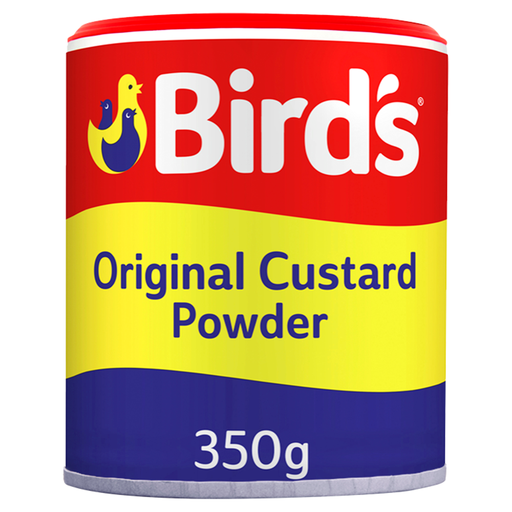
Bird's Custard Powder 350g
This is an alternative when you have time and facilities to make custard rather than open a tin. Bird's states that the 350g pack contains 40 portions; its standard preparation makes four servings per batch.
Check the packet method and ingredients you will add. Bird's says to refrigerate made-up custard and treat it as fresh food.
View on Joybuy
Questions about serving custard
Can I buy one family-size tin for a coffee morning?
If the pack must be a tin, plan around the 400g Ambrosia and Tesco cans described here and work out how many you need. Ambrosia's larger 1kg ready-to-serve Devon Custard pack is a carton, not a tin.
How many servings are in a 1kg carton?
Ambrosia describes its 1kg Devon Custard carton as providing eight 125g servings. Use that guide for that product, then check whether those portions suit the cakes or puddings you will serve; do not assume every 1kg custard pack has the same stated yield.
Can I heat ready-to-serve custard in its can or carton?
Transfer the custard before heating it. Tesco instructs customers to empty its 400g can into a non-metallic container for microwave heating or a saucepan for hob heating; Sainsbury's instructs customers to transfer its 500g carton contents into a microwaveable dish before microwaving. Follow the directions on the exact pack.
How should I serve custard hot over a longer coffee morning?
Plan hot holding rather than leaving the whole batch out. The Food Standards Agency's caterer guidance says hot-held food must be kept at 63°C or above; its provision for displaying food outside hot holding for up to two hours can be used only once. Heating smaller batches as needed is another way to plan the service.
What should I check before serving custard to guests with allergies?
Check the current ingredients and allergen statement on every exact pack, and keep the packaging available for guests. Include ingredients added when preparing powder: a powder's label alone does not describe the finished custard. Do not assume that another flavour, format or variant has the same allergen information.


