Choose coffee bags for kettle-and-mug service, one-cup filters if staff can manage a pour-through step, or ordinary ground coffee where a compatible brewer is already available. Offer decaf as a distinct choice without calling it caffeine-free, and check the actual pack before describing any bag as pyramid-shaped.
Who is choosing the coffee?
Managers planning kettle-and-mug service
For a counter or communal lounge without a coffee machine or cafetière, individually portioned coffee bags offer a way to prepare one cup without measuring loose grounds. Taylors Out of Home describes its coffee bags as needing a kettle, mug and spoon.
Shops offering a separate decaf choice
A clearly labelled decaf product lets customers choose it separately from regular coffee. Keep the original product wording: University Hospitals of Leicester NHS Trust notes that decaffeinated coffee can still contain very low levels of caffeine.
Shops considering used-filter disposal
Rombouts makes a product-specific home-composting claim for its one-cup filters. Staff still need a workable pour-through routine and should check which materials their local waste collection accepts.
What should the shop check?
Start with the equipment and serving routine, then check the exact format, preparation instructions and labels on the products you intend to stock.
| Priority | What to check | Your needs |
|---|
| Serving equipment |
Can staff use a kettle and mug, securely support a one-cup filter, or use a brewer compatible with the ground coffee? |
I need a single-cup method that works with the equipment at the counter, without adding a brewing step staff cannot manage. |
| Bag or filter format |
A coffee bag steeps in the mug; a one-cup filter sits on the cup while water passes through. If pyramid shape matters, check the actual bag and pack specification. |
The shape may affect how I describe and display the product. I do not want to label a cup-supported filter as a pyramid bag. |
| Preparation time |
Read each pack’s water and timing instructions. Taylors of Harrogate specifies a four-minute brew for its Decaffé coffee bags; Rombouts’ Decaf One Cup Filter must be left to drain. |
For counter service, I need a routine that allows for steeping or draining rather than treating either format like instant coffee. |
| Decaf choice |
Check that the particular pack says decaf and retain that wording on the shelf. Do not substitute “caffeine-free”: University Hospitals of Leicester NHS Trust notes that decaf can contain very low levels of caffeine. |
Some customers may prefer decaf, so I want them to be able to distinguish it from regular coffee without an unsupported caffeine claim. |
| Used materials |
Check claims for the exact filter and distinguish it from wrappers and outer packaging. Confirm what the shop’s local waste collection accepts. |
I want staff instructions that match both the product pack and the way waste is collected from this shop. |
Common buying mistakes
-
Calling every single-cup product a pyramid bag
A coffee bag and a cup-supported filter are prepared differently, and neither format name confirms a pyramid shape.
Inspect the actual product and its manufacturer specification before using “pyramid bag” on a shelf label.
-
Describing decaf as caffeine-free
University Hospitals of Leicester NHS Trust notes that decaffeinated coffee may still contain very low levels of caffeine. Rombouts states a level below 0.1% for its Decaf One Cup Filters specifically.
Use the wording on the exact product label and keep regular and decaf choices clearly identified.
-
Buying loose ground coffee for a kettle-only counter
Ordinary ground coffee needs a compatible brewing method, measuring and clean-up; it cannot be prepared by following coffee-bag instructions.
Check the equipment and staff routine before stocking it for counter service. Use coffee bags for steeping in a mug or one-cup filters where staff can manage pouring and draining.
-
Applying one filter’s disposal claim to everything in the pack
Rombouts’ claim about home composting applies to its specified used filter, not automatically to freshness film, cartons or other brands’ coffee bags.
Follow the exact pack instructions and check the shop’s local commercial-waste arrangements before making a disposal claim.
Relevant brand ranges
These ranges illustrate different preparation formats; a brand name alone does not establish a bag’s shape or the suitability of every product in its range.
Taylors of Harrogate
Taylors Out of Home presents coffee bags as a kettle-and-mug option. Its Decaffé coffee bags provide a distinct decaf example.
- Tesco’s listing describes the Decaffé bags as individually wrapped; Taylors specifies a four-minute brew for that product.
- Check the physical bag before describing it as pyramid-shaped, and follow the instructions for the particular pack stocked.
Rombouts
Rombouts offers Original and Decaf one-cup filters, a pour-through format rather than a bag that steeps in the mug.
- Rombouts lists both as 10-count products and gives preparation and used-filter disposal guidance for its Decaf filter.
- The filter must sit securely on a cup and drain; check local disposal arrangements before adopting the brand’s home-composting claim for shop guidance.
Lavazza
Lavazza UK describes ground-coffee products for moka, espresso and filter preparation.
- The stated brewing methods give a starting point for matching a product to existing equipment.
- Check the particular coffee and brewer together; ordinary ground coffee is not a kettle-and-mug bag.
Illy
Illy identifies its 250 g Classico filter-ground coffee as suitable for filter coffee machines and coffee pots.
- Its stated filter use helps a shop with compatible equipment distinguish it from single-cup bags.
- The filter-ground product does not replace a portioned coffee bag or cup-supported filter.
Tesco Finest
Tesco Finest is a conventional ground-coffee range to consider where the shop has a suitable brewer.
- Choose a particular ground-coffee product by checking its stated preparation method.
- Do not treat a conventional ground-coffee pack as an individually portioned coffee-bag product.
Sainsbury's
Sainsbury’s Taste the Difference ground coffees provide a conventional-brewing route, distinct from the Taylors coffee bags listed by the retailer.
- The ground-coffee range includes regular, decaf and Half Caff choices.
- Check both the caffeine wording and brewing format on the exact pack; Half Caff ground coffee is not a single-serve bag.
Joybuy single-cup options
These options cover coffee bags that steep in a cup and filters used over a cup. Check the pack if pyramid shape or a clearly labelled decaf product is required.
 No image available
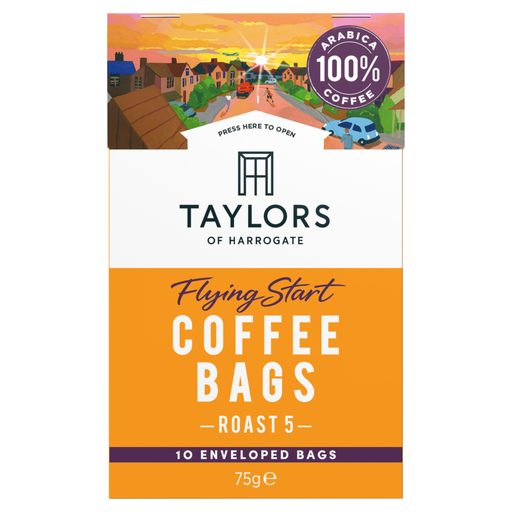
Taylors of Harrogate Flying Start Coffee Bags 75g
Individually wrapped, cup-brewed bags suit a kettle-and-mug service without measuring loose grounds. The product description identifies 100% Arabica coffee and a dark roast. Check this pack’s brewing instructions and label before setting a serving routine or describing its shape or caffeine status.
View on Joybuy
 No image available
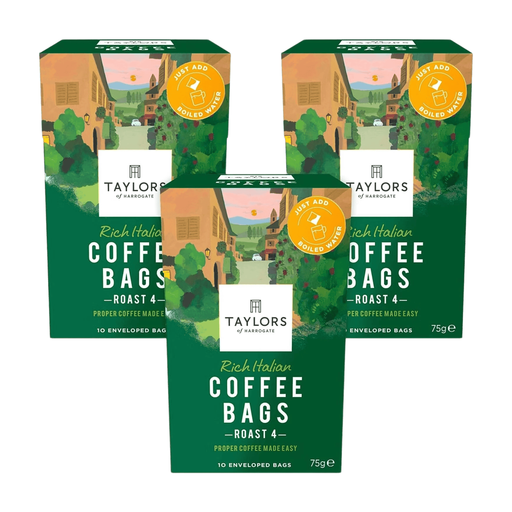
Taylors of Harrogate Rich Italian Coffee Bags 75g x 3
This three-pack offers portioned coffee bags for one-cup preparation without dosing loose grounds. The product description identifies a medium roast, 100% Arabica coffee and caffeine, so this is not the decaf choice. Check the pack for brewing time and bag shape.
View on Joybuy
 No image available
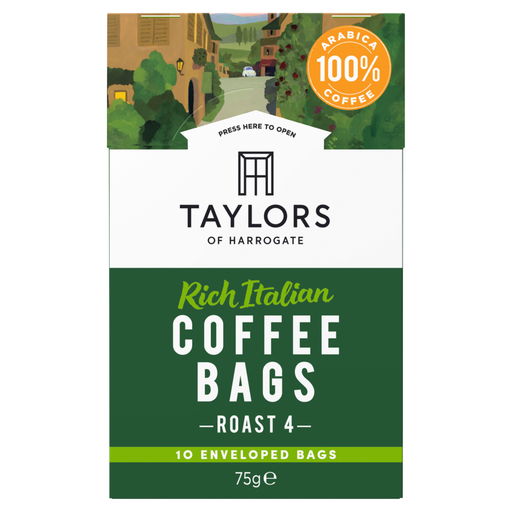
Taylors of Harrogate Rich Italian Coffee Bags 75g
Individually wrapped bags provide a cup-brewed option where staff have a kettle and mug. The product description identifies a medium roast and 100% Arabica coffee. Confirm this pack’s brewing instructions, bag shape and caffeine wording before using those details in staff or shelf guidance.
View on Joybuy
 No image available
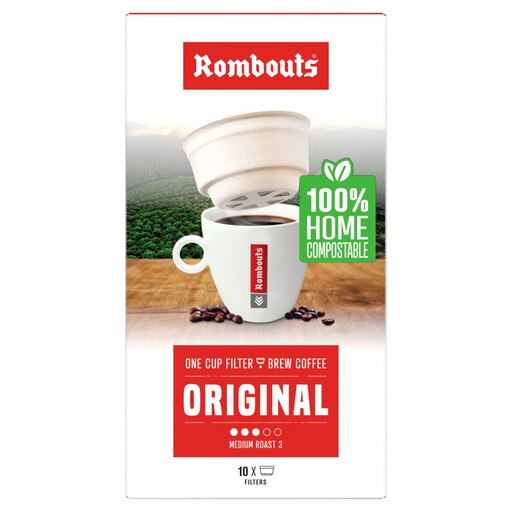
Rombouts Original One Cup Filter Coffee 70g
This portioned coffee uses a filter supported over a cup, rather than a bag steeped in it. Staff need to manage pouring and draining. The home-composting claim concerns the used filter; check local waste arrangements before describing how the shop disposes of it.
View on Joybuy
 No image available
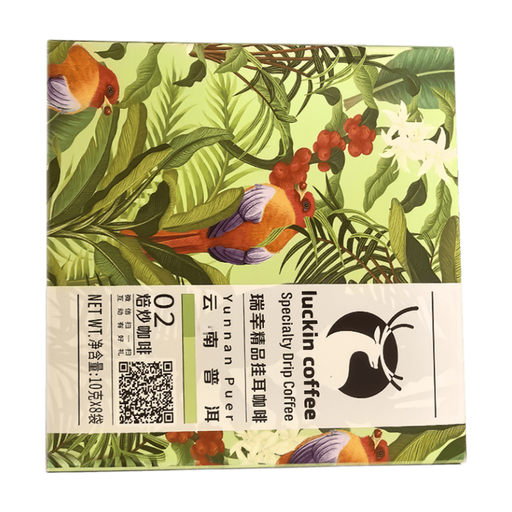
Ri Xin Yunnan Pu'er 2.0 Series Drip Coffee 10g x 8 bags
Each 10 g portion hangs over a cup for pour-through preparation, rather than steeping in the mug. The product instructions specify slowly pouring approximately 150 ml of hot water and waiting for it to drip through. Check the pack before making a pyramid-shape or decaf claim.
View on Joybuy
Questions about stocking and serving
Are coffee bags and one-cup filters the same thing?
No. A coffee bag steeps in a mug, while a one-cup filter rests on the cup and lets water drain through. Taylors of Harrogate specifies a four-minute brew for its Decaffé bags; Rombouts gives cup-placement and draining instructions for its Decaf One Cup Filters.
Does a retirement shop have to choose decaf instead of regular coffee?
No. A separate decaf choice can help customers distinguish it from regular coffee, but it is not a universal medical requirement. Check that the particular product is labelled decaf rather than assuming every single-cup bag or filter is.
Can a decaf coffee be labelled caffeine-free?
Do not use “caffeine-free” solely because a product says decaf. University Hospitals of Leicester NHS Trust notes that decaffeinated coffee can retain very low levels of caffeine; Rombouts states less than 0.1% for its Decaf One Cup Filters specifically. Use the exact pack wording.
Can used one-cup filters go in the shop’s food waste?
Check the exact filter and the shop’s collection arrangements first. Rombouts says its Decaf One Cup Filter can be home composted or disposed of with food or green waste, but that product-specific statement does not establish what a local commercial collection accepts.


