Parents stocking drinks for school weeks
Distinguish sugary, zero-sugar and caffeine-free variants, and consider when a fizzy drink will be consumed rather than treating it as everyday hydration.


For school-week drinks, do not make sugar-sweetened cola part of a child’s daily routine: GOV.UK oral-health guidance says sugar-sweetened fizzy drinks have no place in children’s daily diets. If buying cola for occasional use, compare the sugar information on the exact variant and choose an explicitly caffeine-free version when avoiding caffeine matters. Zero-sugar fizzy drinks are not a substitute for water between meals, and prolonged sipping is a consideration even without sugar.
Distinguish sugary, zero-sugar and caffeine-free variants, and consider when a fizzy drink will be consumed rather than treating it as everyday hydration.
Look for an explicitly caffeine-free variant. Pepsi Max No Caffeine and Coca-Cola Zero Sugar Caffeine Free are examples identified on their UK brand pages.
Compare can size and pack count like for like. Tesco grocery listings include own-label cola multipacks alongside branded varieties; check the exact variant’s label before choosing.
For school-week shopping, start with when the drink will be used, then check sugar, caffeine and the exact pack format.
| Priority | What to check | Your needs |
|---|---|---|
| Sugar | Read sugars per 100ml on the exact variant. Distinguish sugar-sweetened cola from zero-sugar cola; GOV.UK advises against sugar-sweetened fizzy drinks in a child’s daily diet. | I’m choosing drinks for repeated school-week use, so I want to know whether a cola contains sugar before buying it. |
| Caffeine | Check the full variant name and ingredients. Pepsi UK lists caffeine in standard Pepsi Max, while its Pepsi Max No Caffeine page identifies a separate caffeine-free variant. | If caffeine avoidance matters in my household, a zero-sugar label alone is not enough. |
| Drinking pattern | Consider whether the drink will be sipped over a long period. The Scottish Dental Clinical Effectiveness Programme advises against prolonged sipping of soft drinks containing sugar or acid. | For between-meal drinking, I’d choose water rather than keep a fizzy cola on hand throughout the day. |
| Pack format | Compare the number of cans, volume per can and total volume. Check that the flavour and caffeine statement belong to the multipack being selected. | A multipack works for my household only if its can size and exact variant suit how we’ll use it. |
| Flavour | Read the variant name rather than assuming a flavoured cola has the same ingredients as a plain one. Pepsi UK identifies Cherry and Lime as distinct Pepsi Max varieties. | I’ll choose a flavoured version only if the person drinking it wants that flavour. |
Pepsi UK lists caffeine in standard Pepsi Max; Pepsi Max No Caffeine is a separate variant.
When avoiding caffeine matters, check the full name and ingredient list of the exact can or multipack.
GOV.UK oral-health guidance says sugar-sweetened fizzy drinks have no place in a child’s daily diet.
Use water for routine drinking. If choosing cola for an occasion, check whether the particular variant contains sugar.
The Scottish Dental Clinical Effectiveness Programme advises against prolonged sipping of soft drinks containing acid, as well as those containing sugar.
Avoid sipping cola over long periods; for regular between-meal drinking, choose water.
These ranges illustrate variant differences to check; a brand name alone does not identify a drink’s sugar or caffeine content.
Coca-Cola’s UK range includes Original Taste and a separately named Zero Sugar Caffeine Free variant.
Pepsi UK identifies standard Pepsi Max, Pepsi Max No Caffeine and flavoured Pepsi Max variants including Cherry and Lime.
Tesco’s grocery listings include own-label Xero Cola and Diet Cola multipacks alongside branded cola.
These 24-can cola multipacks include explicitly caffeine-free variants and other named cola varieties. Check each exact pack against the sugar and caffeine requirements that matter to your household.
 No image available
The named no-caffeine variant is relevant when avoiding caffeine matters. The pack contains 24 × 330ml cans; check its sugar and sweetener information on the exact label.
 No image available
This explicitly caffeine-free Pepsi Max variant is a choice to consider when avoiding caffeine. Pepsi UK lists 0g sugars per 100ml for Pepsi Max No Caffeine; this multipack contains 24 × 330ml cans.
 No image available
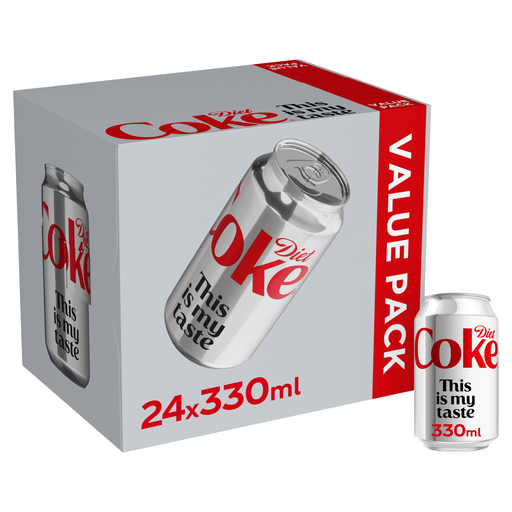
This 24 × 330ml Diet Coke pack is not labelled as the no-caffeine variant. If avoiding caffeine is a requirement, choose a pack that explicitly identifies itself as caffeine-free.
 No image available
Pepsi UK lists 0g sugars per 100ml for standard Pepsi Max, but its ingredients include caffeine. This is a 24 × 330ml pack; choose the separately named no-caffeine variant if caffeine avoidance matters.
 No image available
This named Zero Sugar variant comes in 24 × 330ml cans. It is not labelled as the caffeine-free variant, so check the exact pack if avoiding caffeine matters.
No. Choosing a zero-sugar variant avoids the sugar in a sugar-sweetened cola, but it does not make fizzy cola a substitute for water between meals. GOV.UK advises against sugar-sweetened fizzy drinks in children’s daily diets, while the Scottish Dental Clinical Effectiveness Programme advises against prolonged sipping of soft drinks containing acid.
No. Pepsi UK lists caffeine in standard Pepsi Max and identifies Pepsi Max No Caffeine as a separate variant. Check the full name and ingredients of the exact pack if caffeine avoidance matters.
Avoid prolonged sipping of fizzy cola. The Scottish Dental Clinical Effectiveness Programme advises against sipping soft drinks containing sugar or acid over long periods; for routine between-meal drinking, choose water.