Organisers buying for mixed preferences
Separate requests for regular, zero-sugar and caffeine-free cola rather than assuming that one shared bottle covers all three.


A 2-litre bottle makes sense for office snacks when colleagues will share it and can store it as directed after opening. Choose a zero-sugar cola if sugar per serving is the deciding factor, or a regular cola if that is the version colleagues specifically want. Check the exact variant for caffeine, sweeteners and phenylalanine information; a zero-sugar name alone does not establish that it is caffeine-free.
The useful starting point for a shared office bottle is whether one variant meets the preferences of the people who will drink it.
Separate requests for regular, zero-sugar and caffeine-free cola rather than assuming that one shared bottle covers all three.
Consider how many colleagues will share a 2-litre bottle and whether the office can store it according to its label after opening.
Check the sugar figure for the exact variant, along with its caffeine, sweetener and phenylalanine statements where those details matter to colleagues.
Start with the requested cola variant, then check the serving label and whether the bottle size fits the office’s storage and sharing plans.
| Priority | What to check | Your needs |
|---|---|---|
| Sugar per glass | Compare sugars per 100ml and per intended serving on the exact bottle. Tesco Groceries lists Coca-Cola Original Taste at 27g sugars per 250ml, Pepsi Max at 0g per 250ml and Tesco Diet Cola at under 0.1g per 250ml. | I want the shared bottle to match colleagues’ request for regular or zero-sugar cola, rather than choosing by bottle size alone. |
| Caffeine and ingredients | Check whether the named variant says caffeine-free; standard Pepsi Max lists caffeine in its ingredients, according to Tesco Groceries. Read the sweetener and phenylalanine statements on the exact label. | If colleagues avoid caffeine, I need a variant whose bottle label confirms it, not just the word ‘zero’ in its name. |
| Servings and storage | Allow for the size of each pour: the checked 2-litre Coca-Cola, Pepsi Max and Sainsbury’s cola listings describe eight 250ml servings. Sainsbury’s instructs buyers to refrigerate its checked cola bottles and use them within three days of opening. | Will enough people share the bottle, and can we refrigerate it once opened? |
| Cola variant | Distinguish classic, diet, zero-sugar and caffeine-free names before ordering. Check the ingredient and nutrition panels: Tesco Groceries lists 4.4g sugars per 100ml for Tesco Classic Cola, while its Diet Cola has under 0.1g per 250ml. | Some colleagues may ask for a particular regular cola; others may prefer a separately labelled diet or caffeine-free variant. |
Sugar figures differ between the checked regular and zero-sugar bottles: Tesco Groceries lists 27g per 250ml for Coca-Cola Original Taste and 0g per 250ml for Pepsi Max.
Read the exact bottle’s figures per 100ml and per planned glass before choosing a variant for the office.
Tesco Groceries lists caffeine in standard Pepsi Max. Pepsi Max Caffeine Free and Coca-Cola Zero Sugar Caffeine Free are separately named variants, according to Pepsi UK and Coca-Cola GB.
When caffeine matters, confirm the full variant name and its bottle label. Check sweetener and phenylalanine statements separately.
A 2-litre bottle provides eight 250ml glasses at that serving size. The checked Sainsbury’s cola labels instruct buyers to refrigerate after opening and use the bottle within three days.
Check the chosen bottle’s storage instructions and consider a smaller format if the team is unlikely to finish it within the labelled period.
These examples show why the exact cola variant matters; a brand name alone does not identify its sugar or caffeine content.
Coca-Cola Original Taste 2L is a regular-cola reference for offices specifically requesting that variant.
Pepsi Max 2L is a labelled zero-sugar option; Pepsi Max Caffeine Free is a distinct variant.
Tesco’s checked 2-litre Classic and Diet colas illustrate how two own-label variants can have different sugar figures.
Sainsbury’s checked 2-litre Cola and Diet Cola bottles offer two separately labelled own-label variants.
These are six-bottle packs of 2-litre zero-sugar cola for an office considering several shared bottles. Check whether that quantity fits your storage space and plans for opening them.
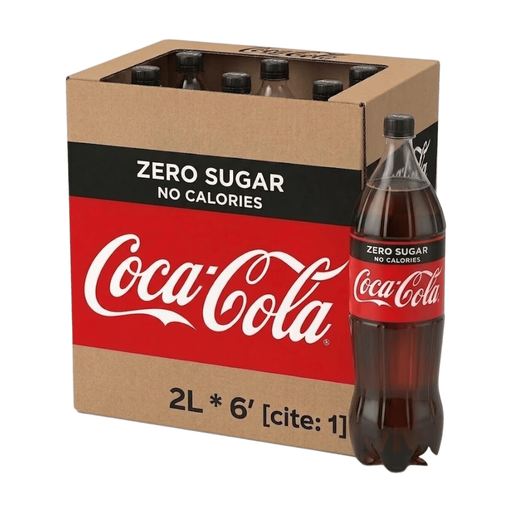 No image available
For an office planning to share several zero-sugar cola bottles. The pack contains six 2-litre bottles, and the product information states 0g sugars per 100ml. It contains caffeine and sweeteners and identifies a source of phenylalanine; check the packaging for storage directions after opening.
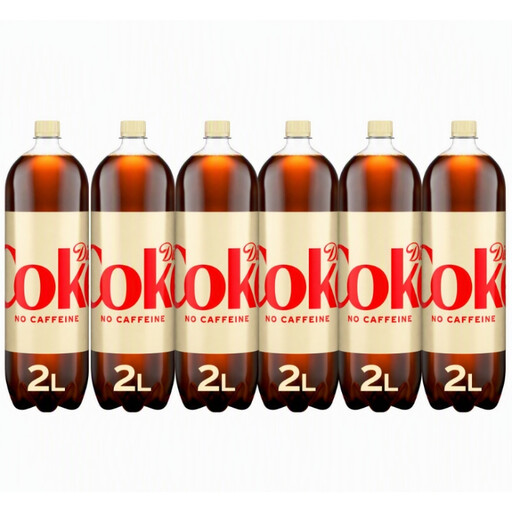 No image available
For an office considering a six-pack of 2-litre zero-sugar cola bottles. The product information states 0g sugars per 100ml and per 250ml. Although the variant is named Caffeine Free, a caffeine warning conflicts with that description: check the exact bottle label before choosing it for anyone avoiding caffeine. The information also lists aspartame and acesulfame K and identifies a source of phenylalanine.
A 2-litre bottle provides eight 250ml glasses if poured at that serving size. The checked Coca-Cola Original Taste, Pepsi Max and Sainsbury’s cola listings use eight 250ml servings; allow for different pour sizes when planning for colleagues.
Follow the directions on the bottle you buy. The checked Sainsbury’s Cola and Diet Cola labels say to refrigerate after opening and use within three days; do not assume every variant has identical instructions.
No. Tesco Groceries lists caffeine in standard Pepsi Max 2L, while Pepsi UK identifies Pepsi Max Caffeine Free as a separate variant. Check the exact bottle label, including its sweetener and phenylalanine information, when choosing for colleagues with specific requirements.