Households stocking drinks for after school
Individual cans make it straightforward to count out a household supply. Check the number and size of cans, then decide whether the intended use calls for standard, zero-sugar or caffeine-free cola.


For a household supply, choose a zero-sugar cola multipack if sugar content is the deciding factor, but check the exact variant: zero sugar does not necessarily mean caffeine-free. Choose a pack explicitly labelled caffeine-free if avoiding caffeine matters, or a standard cola if its stated sugar content suits the intended occasion. If a can might go into a school packed lunch, check that school's policy before buying for that purpose.
The useful starting point is where the cans will be consumed and which formulation the household wants.
Individual cans make it straightforward to count out a household supply. Check the number and size of cans, then decide whether the intended use calls for standard, zero-sugar or caffeine-free cola.
A zero-sugar variant answers a different label preference from standard cola. Check the full product name and the sugars figure per 100 ml: variants from the same brand can differ.
Look for an explicit caffeine-free designation rather than relying on a zero-sugar name. Check the ingredients and any phenylalanine statement if those details matter to your household.
Choose the formulation first, then compare can quantities and confirm whether the cans are intended for home or for a school packed lunch.
| Priority | What to check | Your needs |
|---|---|---|
| Sugar content | Read the sugars figure per 100 ml on the exact variant. Coca-Cola GB lists 10.6 g for Original Taste; Pepsi UK lists 0 g for Pepsi Max. These figures describe different products, not every cola from either brand. | If I want zero-sugar cans for the household, I need to select that formulation rather than assuming the brand name tells me the sugar content. |
| Caffeine and sweeteners | Look for an explicit caffeine-free name and read the ingredients. Pepsi UK lists caffeine flavouring in Pepsi Max, while its separate Pepsi Max No Caffeine variant is caffeine-free; zero-sugar variants can contain sweeteners. | For a caffeine-free choice, the words 'zero sugar' alone are not enough for me to identify the right pack. |
| Pack quantity | Compare both can count and can size. Tesco Groceries has listed 24 × 330 ml branded multipacks alongside an 8 × 330 ml Tesco Xero Cola pack; check the exact pack you select. | I want enough individual cans for home use without mistaking a smaller multipack for the same quantity. |
| School use | Check the individual school's packed-lunch policy before sending a can. The Department for Education's school food standards address food and drink provided to pupils in state-funded schools; they do not establish what a particular school permits from home. | A drink bought for our back-to-school household supply may be for home, not necessarily for a packed lunch. |
A zero-sugar can may still contain caffeine: Pepsi UK lists caffeine flavouring in Pepsi Max, while its caffeine-free version has a distinct name.
Choose a pack explicitly labelled 'caffeine free' or 'no caffeine' when that distinction matters, and read its ingredients for sweeteners and phenylalanine information.
Pack counts and total volume differ, even when individual cans are the same size. An eight-can pack will not provide the same number of cans as a 24-can pack.
Check both the number of cans and the volume per can against the household supply you intend to keep.
A multipack bought for after-school use does not establish whether a school permits cola brought from home.
Check the relevant school's packed-lunch policy before planning to send a can.
Compare named formulations rather than treating all colas from one brand as interchangeable. A retailer listing is useful for identifying a pack format, not for assuming that it will remain in stock.
Coca-Cola GB identifies separate Original Taste, Zero Sugar and Zero Sugar Caffeine Free formulations.
Pepsi UK identifies Pepsi Max, Pepsi Max No Caffeine and Pepsi Classic as distinct formulations.
Tesco Groceries has listed branded 24 × 330 ml cola multipacks and its own-label Tesco Xero Cola 8 × 330 ml pack.
These 24 × 330 ml cans cover standard, zero-sugar and caffeine-free cola choices for household supplies. Check the exact variant's ingredients and the school's policy if a can is intended for a packed lunch.
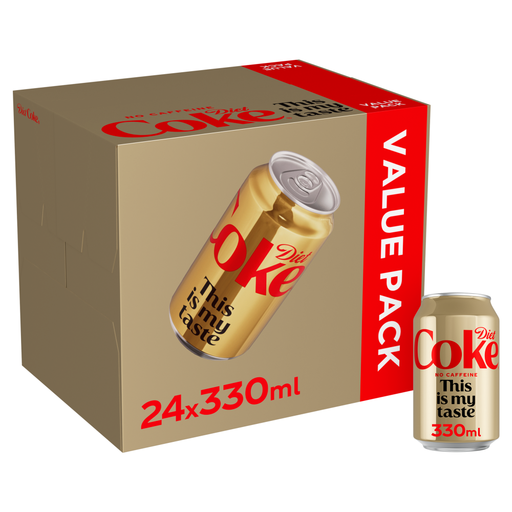 No image available
A 24-can household option when zero sugar and no caffeine are both priorities.
The product information identifies 330 ml cans and lists sweeteners and a source of phenylalanine. Check the ingredients if those details matter to you.
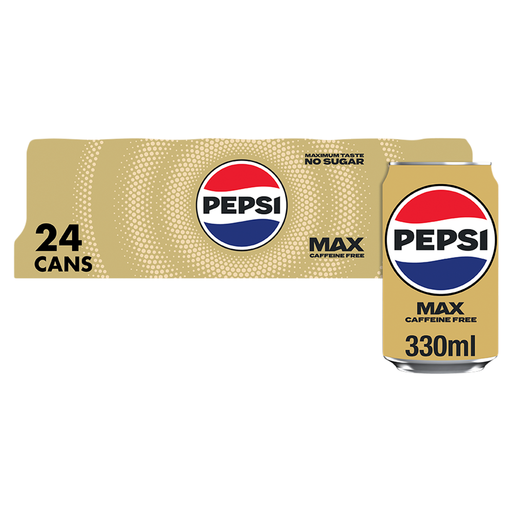 No image available
This 24-can pack is a zero-sugar, caffeine-free choice for keeping individual cans at home.
Its product information lists sweeteners and a source of phenylalanine; read the ingredients if relevant to your choice.
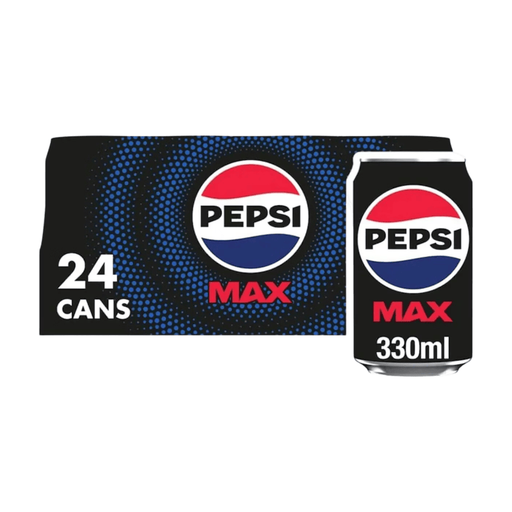 No image available
A 24-can zero-sugar option for households that are not seeking a caffeine-free cola.
The ingredients list flavourings including caffeine, sweeteners and a source of phenylalanine. This is a different variant from Pepsi Max Caffeine Free.
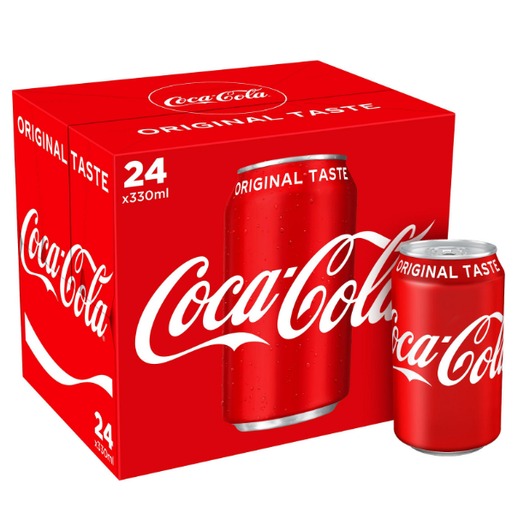 No image available
This 24-can pack is the standard Original Taste formulation for households choosing that variant.
Coca-Cola GB lists 10.6 g sugars per 100 ml for Original Taste, and the product information identifies caffeine. Check that formulation against the intended use rather than treating it as a zero-sugar option.
 No image available
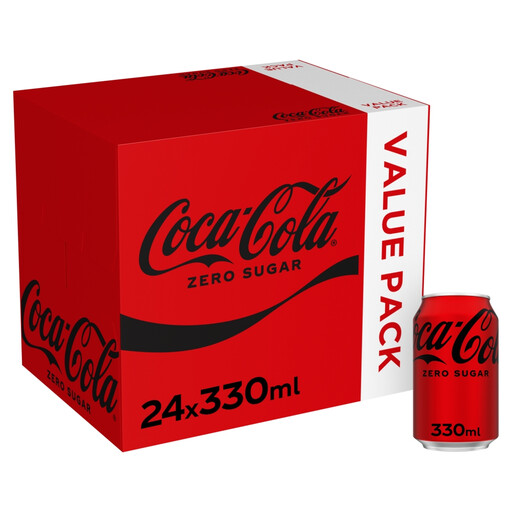
A 24-can zero-sugar choice for household stocking when caffeine is acceptable.
Its ingredients list caffeine and sweeteners, and the product information identifies a source of phenylalanine. Choose the separately named caffeine-free variant if avoiding caffeine is essential.
Check the individual school's packed-lunch policy before sending one. The Department for Education's school food standards concern food and drink provided to pupils in state-funded schools; they do not, on their own, tell you what a particular school permits from home.
Not necessarily. Pepsi UK lists caffeine flavouring in Pepsi Max and identifies Pepsi Max No Caffeine as a separate variant; Coca-Cola GB likewise distinguishes Coca-Cola Zero Sugar from Zero Sugar Caffeine Free. Check the exact pack name when avoiding caffeine.
Some zero-sugar colas contain aspartame. GOV.UK food-labelling guidance specifies a 'contains a source of phenylalanine' statement for products containing aspartame, so read the ingredients and pack wording for the variant you choose.
No: the figure depends on the exact formulation. Coca-Cola GB lists 10.6 g sugars per 100 ml for Coca-Cola Original Taste, while Pepsi UK lists 0 g per 100 ml for Pepsi Max. Compare the labels of the particular multipacks you are considering.