People packing cola regularly
Compare regular and zero-sugar cans by the nutrition for a whole can, rather than relying on the multipack name.


For regular office lunches, a zero-sugar cola multipack suits someone who wants to avoid the sugars in regular cola; choose an explicitly caffeine-free version if caffeine matters too. Regular cola remains an option for those who prefer it, but check the sugars in a whole can. For a shared fridge or uncertain demand, match the pack count and can size to what people are likely to use.
Compare regular and zero-sugar cans by the nutrition for a whole can, rather than relying on the multipack name.
Look for an explicitly caffeine-free variant. A zero-sugar label alone does not establish that a cola contains no caffeine.
Check colleagues’ preferences for regular, zero-sugar and caffeine-free cola before choosing the number of cans to store.
Start with the exact drink variant, then check its whole-can label and whether the pack size suits your lunch routine.
| Priority | What to check | Your needs |
|---|---|---|
| Sugars per can | Read the sugars figure for a whole can and check whether the panel is stated per 100ml instead. Joybuy lists 35g sugars per 330ml can for Coca-Cola Original Taste, while Pepsi UK lists 0g per 330ml for Pepsi Max. | If cola is a frequent lunch drink, I want to distinguish a regular sweetened can from a zero-sugar one. |
| Caffeine | Check the exact variant name and ingredients. Pepsi UK lists caffeine in standard Pepsi Max; Pepsi Max No Caffeine is a separate product. | For a lunch without caffeine, I need the cans themselves to be labelled caffeine-free. |
| Ingredients | Read the sweetener and phenylalanine wording on the exact pack. Pepsi UK states that Pepsi Max and Pepsi Max No Caffeine contain a source of phenylalanine. | If a particular ingredient matters to me, the label on the chosen flavour and variant is what I need to check. |
| Pack and can size | Check both the can count and volume, the best-before date and available storage space. Tesco lists 24 × 330ml cola options alongside smaller packs. | A smaller supply makes sense while office preferences are uncertain; for an established routine, I can judge how many cans will be used. |
Joybuy lists 35g sugars in a 330ml can of Coca-Cola Original Taste. The NHS recommends that adults have no more than 30g of free sugars a day, so the whole-can figure matters when comparing lunch drinks.
Read the nutrition panel for the full can and compare the exact regular and zero-sugar variants you are considering.
Standard Pepsi Max contains caffeine, according to Pepsi UK, whereas Pepsi Max No Caffeine is explicitly labelled as a different variant.
Check both the product name and ingredient panel if you want to avoid caffeine.
Twenty-four cans need more storage space than an eight-can pack, and a shared supply may include variants that colleagues do not want.
Check preferences, storage space and the printed best-before date before deciding on a pack count.
A pack with a different can count or volume will not provide the same number of 330ml lunch servings.
Check the particular listing’s can size, count, ingredients and best-before date before comparing it with another case.
Its UK range includes Original Taste, Zero Sugar and a separate caffeine-free Zero Sugar variant.
Pepsi UK distinguishes regular Pepsi, Pepsi Max and Pepsi Max No Caffeine.
RC Cola International identifies cola within its drinks portfolio.
Tesco’s cola-can category lists regular, zero-sugar and caffeine-free variants in 24 × 330ml formats.
Its Diet Coke No Caffeine listing identifies a 24 × 330ml caffeine-free, no-sugar variant.
These cans cover regular, zero-sugar and caffeine-free choices for a personal or shared office lunch supply, with both eight-can and 24-can packs.
 No image available
A 24-can option when the lunch supply needs an explicitly caffeine-free Pepsi Max variant. Pepsi UK lists 0g sugars per 330ml for Pepsi Max No Caffeine and states that it contains a source of phenylalanine.
 No image available
A zero-sugar 24-can option for lunches where caffeine is acceptable. Pepsi UK lists 0g sugars per 330ml and identifies caffeine and a source of phenylalanine in this variant.
 No image available
A 24-can zero-sugar option for a regular lunch supply. Joybuy lists 0g sugars per 330ml for this pack; its ingredients include caffeine and sweeteners, so it is not the caffeine-free variant.
 No image available
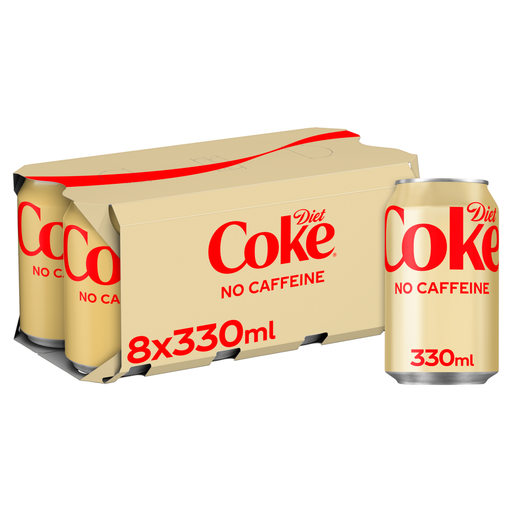
The eight-can format allows a smaller initial office supply, and the title identifies it as caffeine-free. Check the exact pack label for its nutrition, sweeteners and phenylalanine wording.
 No image available
A regular sweetened-cola case for people who specifically prefer Original Taste. Joybuy lists 35g sugars per 330ml can, and Coca-Cola GB lists caffeine flavouring in Original Taste.
Choose a zero-sugar variant if avoiding the sugars in regular cola is important to you. Joybuy lists 35g sugars in a 330ml can of Coca-Cola Original Taste and 0g in its 330ml Coca-Cola Zero Sugar can; check the whole-can figures for any other variant you consider.
No. Pepsi UK lists caffeine in standard Pepsi Max, and Joybuy lists it in Coca-Cola Zero Sugar. Choose a product explicitly labelled No Caffeine or Caffeine Free if that distinction matters for your lunch.
Check colleagues’ preferred variants, the can count and volume, available fridge space and the printed best-before date. Read the exact packs for sugars, caffeine, sweeteners and phenylalanine wording rather than assuming similarly named drinks have the same ingredients.
No. Pepsi UK states that Pepsi Max and Pepsi Max No Caffeine contain a source of phenylalanine, and Sainsbury’s gives the same wording for its listed Diet Coke No Caffeine pack. Read the label of the exact variant you plan to buy.