Buying for today’s lunch
If you have no time to steep coffee and no hot water, look for a ready-to-drink cold brew or another chilled iced coffee. Check the exact drink’s ingredients rather than assuming every iced coffee is black coffee.


For a cold coffee at the same lunch break, choose a ready-to-drink product rather than a bag that needs steeping. A purpose-made cold-brew bag makes sense if you can prepare it ahead and follow its storage instructions; a pyramid coffee bag is a practical lunch option when you have hot water, but its shape alone does not establish that it works for cold brew.
The useful distinction is whether your drink must be ready now, can be prepared beforehand or can be brewed with hot water at lunch.
If you have no time to steep coffee and no hot water, look for a ready-to-drink cold brew or another chilled iced coffee. Check the exact drink’s ingredients rather than assuming every iced coffee is black coffee.
If you can make coffee before you leave and carry it in a suitable container, consider a bag explicitly intended for cold brewing. Follow that product’s steeping and storage directions; do not substitute a conventional coffee bag on the basis of its shape.
A portioned coffee bag, including a pyramid-format bag, offers a machine-free way to make coffee at your lunch destination. Check the pack’s brewing directions if you specifically want a cold-brewed drink.
Start with when you will drink the coffee and what preparation is possible, then check the directions and the exact pack.
Choose it when: You need a cold drink for the same lunch break without brewing.
Trade-off: You buy the drink as prepared, so check its ingredients, serving size and caffeine information on the exact pack.
Choose them when: You can brew ahead and carry the finished coffee to lunch.
Trade-off: Steeping takes advance planning, and a multi-cup bag may make more than you want for one lunch.
Choose them when: Hot water is available where you will have lunch.
Trade-off: A pyramid shape is a bag format, not a cold-brewing instruction.
| Priority | What to check | Your needs |
|---|---|---|
| Ready at lunch | Check whether the drink is ready to drink or needs water and mixing. If buying a bag, check whether it must steep before serving. | I have a short lunch break and want to drink the coffee without brewing it there. |
| Preparation time | Read the exact cold-brew directions and storage instructions. RAVE Coffee’s method for its cold-brew ground coffee specifies approximately 12–24 hours in the fridge; that timing should not be assumed for every bag. | If I can prepare coffee the evening before, I can consider a purpose-made cold-brew product instead of buying a finished drink. |
| Water and equipment | Check whether a coffee bag requires hot water or a product can be mixed with cold water. Allow for the cup, bottle or other container its directions require. | There is hot water at my lunch destination, or I can carry what I need to mix a cold drink. |
| Pack details | Check the exact serving size, ingredients, allergen information and caffeine information where available. Do not infer a drink’s contents from the words “iced coffee” or “cold brew”. | I want to know what is in the particular drink I will carry or buy, especially if I am choosing between black and flavoured coffee. |
The shape does not tell you whether cold water is an intended brewing method. Marks & Spencer instructs buyers to brew its Jump Start Coffee Bags with hot water for four minutes.
Read the directions on the exact pack. For cold brewing, look for explicit cold-water, steeping and storage instructions.
Cold-brew preparation can take much longer than a lunch break: RAVE Coffee’s method for its cold-brew ground coffee calls for approximately 12–24 hours in the fridge.
If you are buying for today’s lunch without preparing ahead, choose a ready-to-drink cold coffee. For a bag, plan around its own instructions.
Coffee Friend describes Sandows cold brew as sugar-free and dairy-free, while Sainsbury’s iced-coffee listings include an oat latte containing cold brew. Those descriptions apply to different products.
Check the ingredients, nutrition and allergen information on the exact drink, particularly when choosing a milk-based or flavoured option.
Cold serving temperature does not tell you a drink’s caffeine content. The NHS identifies coffee as a source of caffeine.
If caffeine quantity matters to your purchase, check the serving information on the pack or ask the manufacturer about the exact product.
These examples illustrate different preparation routes; a brand’s coffee bags and its ready-to-drink products should not be treated as interchangeable.
Chamberlain Coffee describes its Organic Cold Brew Elephant Large Coffee Bags as purpose-made for cold brew.
Sandows makes cold brew, and retailer Coffee Friend describes a Sandows product as ready to drink.
Raw Bean describes its Bean Bags as pyramid-shaped coffee bags for machine-free brewing.
Taylors coffee-bag variants appear in Tesco and Waitrose listings.
M&S offers individually wrapped Italian Style Coffee Bags and gives hot-water instructions for its Jump Start Coffee Bags.
These Joybuy options are portioned coffees for mixing with cold water at lunch. They are not pyramid bags or confirmed cold-extracted cold brew, and both need water and something to mix them in.
 Image unavailable
The portioned liquid can be mixed with cold water when you want a drink without steeping, provided you have water and a cup. Its title specifies ten 25 ml pouches and a dark roast. It is a concentrate, not a coffee bag; check the preparation method if cold extraction matters to you.
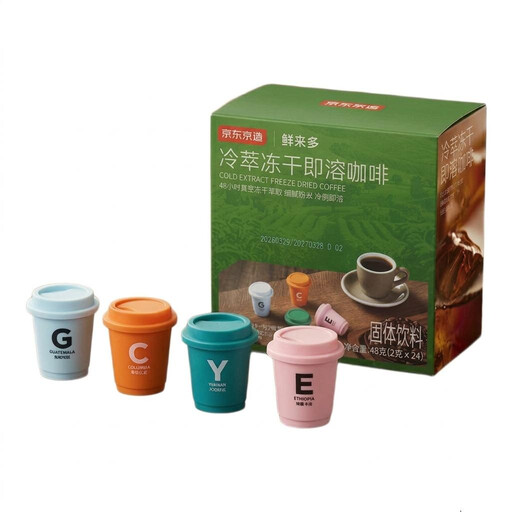 Image unavailable
One capsule can be stirred into cold water for a drink made at lunch without a long steep; you still need water and a cup. The title specifies 24 capsules of 2 g each and Arabica coffee. This is instant powder rather than a coffee bag or confirmed cold-extracted brew; check the selected flavour if the variant matters to you.
No: a pyramid shape alone does not establish a cold-brewing method. Check the exact pack for cold-water and steeping instructions. M&S, for example, directs buyers to use hot water for its Jump Start Coffee Bags.
Follow the bag’s own steeping and storage directions rather than assuming one time applies to every product. As an illustration of advance preparation, RAVE Coffee specifies approximately 12–24 hours in the fridge for its cold-brew ground-coffee method; Chamberlain Coffee describes its large bags as made for cold brew.
Choose a ready-to-drink cold brew or another chilled iced coffee for the same lunch break. Coffee Friend describes Sandows cold brew as ready to drink, while Sainsbury’s lists iced coffees that include a product containing cold brew; check the exact drink’s ingredients.
Cold coffee should not be assumed to be caffeine-free: the NHS identifies coffee as a source of caffeine. If the amount matters to you, check the exact product’s serving information or ask its manufacturer.
Read the exact pack’s ingredient and allergen information, particularly when comparing black coffee with milk-based or flavoured iced drinks. Check its serving size and caffeine information as well if those affect your choice.