
24/7 Customer Support

Free returns

Same-day & Next-day Delivery

Quality Guaranteed

Unlock Your Welcome Offers: FREE Delivery | Up to 80% OFF | Free 30-day JoyPlus trial
Download the APP
A collapsible camping wagon can simplify trips to a campsite, beach, festival or market stall, but choosing by capacity alone can lead to an awkward and costly purchase. A large-looking folding camping wagon may have limited usable space, wheels that struggle on grass, or a frame that becomes difficult to store in a typical UK home or car boot.
Before buying, look beyond phrases such as “heavy duty” and “all terrain”. Check the actual load rating, folded dimensions, wheel construction and braking system. These details determine whether a portable folding trolley is genuinely useful for your routine.
A 200-litre or 300-litre body may hold a lot of equipment, but volume and load capacity are different measurements. Camping chairs, bedding and clothing can fill a wagon without reaching its weight limit, while bottled water, tools or stock for a market stall may reach the limit quickly.
Also check whether the stated volume includes an open tailgate or stackable extension. A large capacity utility wagon may have a smaller enclosed base than its headline figure suggests.
An off-road camping cart should be assessed by wheel size, tread and material rather than the label alone. Small wheels can sink into sand or catch on gravel. Swivel wheels may improve manoeuvrability on hard ground, while larger fixed wheels can feel more stable when moving a heavy load in a straight line.
For beaches, muddy campsites and uneven grass, look for wide, rugged wheels and a handle that gives enough clearance around the rear axle.
A wagon that carries substantial equipment is not automatically practical if it cannot fit into your car, shed or hallway. Check the folded dimensions, wheel removal system and whether the frame folds without tools.
A foldable garden cart or outdoor utility trolley should also be dried before storage. Damp fabric folded into a confined space can develop unpleasant odours, while wet metal components may be more vulnerable to corrosion over time.
Choose a load rating that suits the heaviest items you expect to carry, not just your average picnic load. A 200kg load capacity wagon may suit tools, supplies or event stock, but the stated limit must not be exceeded. Distribute weight evenly across the base to reduce tipping risk, especially on grass or sloping ground.
Never use a camping wagon as a seat or step. Check that the frame is fully opened and locked before loading, and apply both brakes when stationary on an incline.
High sides can help prevent loose items falling out, while an open tailgate can make it easier to transport long or bulky objects. Side pockets and cup holders are useful for smaller accessories, but they should not replace a secure main compartment.
Consider whether you need a beach wagon for towels and cool bags, a heavy-duty camping trolley for cooking equipment, or a market trolley for boxes and stock. A 127-litre body may be easier to handle and store than a 200-litre model, even where the larger wagon offers more carrying space.
Look for a sturdy metal or steel frame, reinforced fabric and wheels suited to the surfaces you regularly use. PU or rubber wheels with bearings may provide smoother movement, while rugged PVC or rubber wheels can be appropriate for outdoor ground.
A dual-brake system helps keep the trolley stationary when parked, but it does not make a loaded wagon safe on every slope. Avoid steep or unstable terrain and follow the product’s safety instructions. For regular garden use, compare frame finish, fabric cleanability and wheel maintenance as well as appearance.
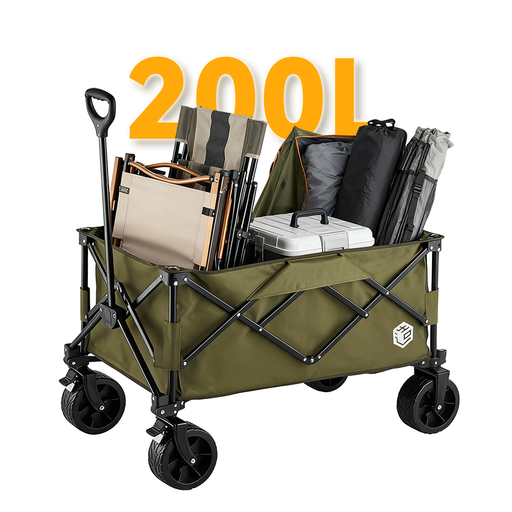
Why This Fits Their Persona: A practical option for occasional campers, picnickers and shoppers who want a high-sided wagon with substantial space without choosing a specialist event trolley.
Its listed 200L capacity, high-sided design, large off-road wheels and dual brakes make the key specifications visible rather than relying only on a “heavy duty” description.
200L capacity; collapsible frame; large off-road wheels; dual brakes; suitable for camping, gardening and grocery transport.
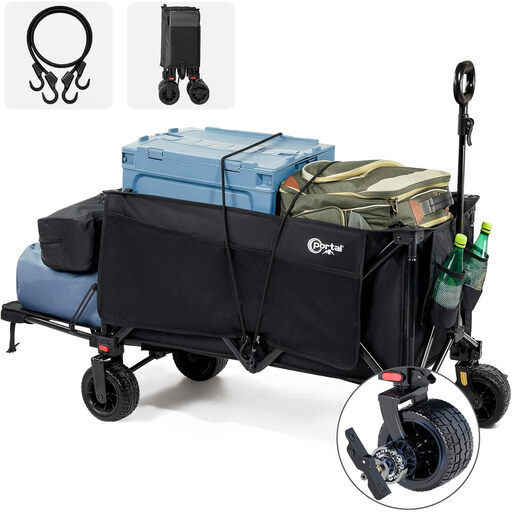
Why This Fits Their Persona: Suits festival-goers, event vendors and families carrying varied equipment who value organisation, removable wheels and a larger stated capacity.
The product information separates its 300L capacity with open tailgate from its 132kg load limit, helping buyers avoid treating volume as carrying weight.
PU wheels with bearings; dual brakes; side pockets and cup holders; quick-release wheels; folded dimensions of 35 x 26 x 80cm.
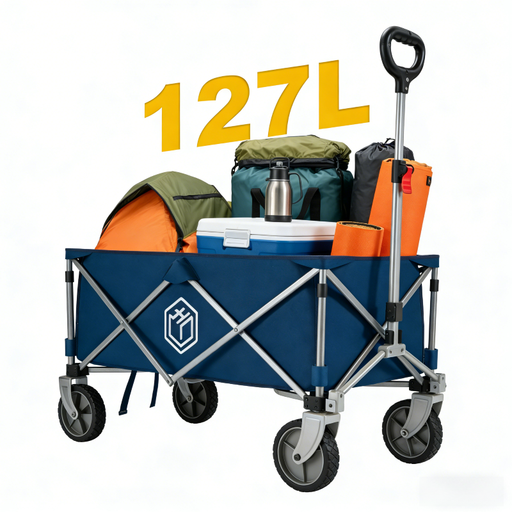
Why This Fits Their Persona: A compact heavy-duty option for gardeners, traders and campers who prioritise a high stated load rating while still needing a foldable wagon for storage.
The 127L interior and 200kg maximum load are stated separately, making it clearer that this model focuses on dense, heavier items rather than maximum volume.
127L capacity; listed 200kg load capacity; collapsible design; steel frame; suitable for camping, shopping, vending and moving supplies.
We have compiled a complete, real-time list of products that fully satisfy these strict selection criteria and UK safety regulations.
Some are suitable for firm sand and beach paths, especially models with wide off-road wheels. Very soft sand can still make any loaded wagon difficult to pull. Reduce the load, keep the wagon balanced and check the wheel tread before buying.
Service life depends on load frequency, terrain, moisture and storage. Avoid exceeding the stated capacity, clean grit from the wheels and store the wagon dry. Regularly inspect stitching, frame joints, wheel fittings and brakes for wear.
No. A portable folding trolley is manually operated, so it has no fuel or battery cost. The practical running costs are limited to cleaning and possible replacement wheels or hardware, depending on the model and frequency of use.