
24/7 Customer Support

Free returns

Same-day & Next-day Delivery

Quality Guaranteed

Unlock Your Welcome Offers: FREE Delivery | Up to 80% OFF | Free 30-day JoyPlus trial
Download the APP
A collapsible camping wagon can save repeated trips between the car and campsite, beach, allotment or market stall. However, large capacity figures and “all-terrain” wording do not always tell the full story. A trolley that looks suitable online may be awkward to steer, difficult to store or unstable when heavily loaded.
Before choosing a foldable camping cart, check how its capacity, wheels, frame, brakes and folded size match your intended use. The right specification depends on whether you need a beach wagon for soft sand, a garden trolley for soil and tools, or a grocery transport cart for relatively flat pavements.
A 200L camping wagon may hold a large amount of bulky equipment, but volume and weight are separate measurements. Sleeping bags and picnic blankets occupy space without weighing much, while paving slabs, drinks or gardening materials can approach the frame’s load limit quickly.
Check both:
Never rely on a “stackable capacity” figure as a replacement for the maximum weight rating.
Large wheels with a rugged tread can help a trolley move over grass, gravel and uneven ground. They do not make a fully loaded wagon effortless on deep sand, steep slopes or thick mud.
For an off-road camping trolley, look at:
A 360-degree swivel wheel design can help when shopping or manoeuvring around a garden. Larger fixed or off-road wheels may be more suitable for trails, fields and beach approaches.
“Portable folding wagon” usually means the frame collapses, but the folded dimensions still matter. A high-sided 200L model may take more boot space than a smaller 127L camping cart.
Before ordering, measure:
Also check the folding mechanism. The wagon should be fully opened and locked before loading, with fingers kept clear of hinges and moving sections.
For day trips, a 127L camping cart may provide a useful balance between storage and manoeuvrability. A 200L camping wagon is more appropriate when carrying tents, chairs, cool boxes and family supplies together. For market stalls, moving supplies or heavier garden work, compare the published load rating carefully rather than selecting by litres alone.
A high-sided design helps contain loose items, but it can also raise the centre of gravity. Keep heavier goods low and distribute them across the base to reduce tipping risk.
Common materials include steel or carbon steel frames, polyester or Oxford fabric bodies, polypropylene components and rubber, PVC or polyurethane wheels.
Look for:
A camping wagon is not automatically waterproof. After use in UK rain, wipe the frame and fabric, allow them to dry fully and store the trolley in a dry place. Avoid immersing the cart in water unless the product specifically permits it.
Dual brakes can help keep a loaded wagon stationary on a gentle incline, but they are not a substitute for safe positioning. Apply the brakes whenever the trolley is stationary, particularly at a campsite, festival field or sloping garden.
For safer use:
The following options match different shopping priorities. Product specifications should still be checked on the individual listing before purchase, particularly load limits and folded dimensions.
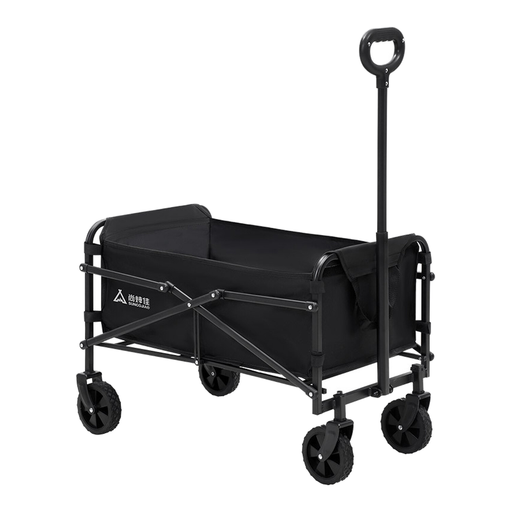
Why This Fits Their Persona: A practical choice for occasional camping, picnics, grocery trips and beach outings where a 170L cargo area is useful without moving up to the largest wagon format.
The listing specifies a 100kg load capacity and 170L capacity, making the volume-to-weight distinction clearer. It also uses a 600D Oxford fabric cargo bag rather than relying only on a marketing description.
Foldable frame, multi-directional swivel wheels and a stated 100kg load rating. Minor wheel assembly is required.
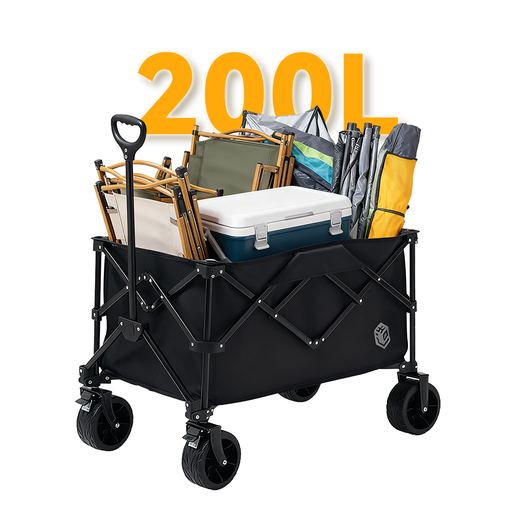
Why This Fits Their Persona: Suitable for families and outdoor users who want a large-capacity wagon for camping, gardening, shopping and beach equipment, with a focus on materials and braking features.
The listing identifies a steel frame, 600D Oxford cloth, PVC off-road wheels and a double-brake design. These are specific construction details to compare against vague “heavy-duty” wording.
200L capacity, foldable storage, off-road wheels and dual brakes. The listing advises keeping the wagon for outdoor use and not exceeding its stated load capacity.
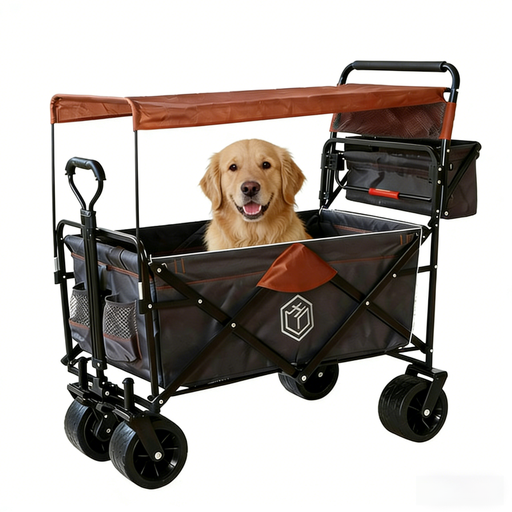
Why This Fits Their Persona: Its stated configuration is aimed at heavier outdoor transport, vending, moving and repeated campsite use where a reinforced frame and weather-cover option are useful.
The product listing specifies a 150L body, reinforced carbon steel frame, dual brakes and a stated 260kg load capacity. Confirm the current product page before loading, as conditions and ratings must be followed.
Detachable canopy, reinforced carbon steel frame and dual brake explosion-proof wheels as listed. It is designed for outdoor transport rather than road use.
We have compiled a complete, real-time list of products that fully satisfy these strict selection criteria and UK safety regulations.
A camping and picnic trolley can remain more reliable when it is maintained between trips:
For wet British weather, a breathable storage location is preferable to folding the wagon while it is still damp in a sealed car boot or shed corner.
Some are suitable for beach access, but performance depends on wheel width, tread and sand firmness. Large off-road wheels may move more easily across compact sand than narrow shopping-cart wheels. Avoid overloading the wagon on loose sand, and clean salt and grit from the wheels afterwards.
Ratings vary considerably. The products listed above specify capacities from 100kg to 260kg, but these figures are product-specific and should not be generalised. Use the lower of the manufacturer’s stated limit and any terrain-specific guidance, distribute the load evenly and avoid steep or unstable ground.
Many collapsible models are supplied ready to unfold, although some carts require wheels or handles to be attached. Check the listing before purchase. In every case, confirm that the frame is fully open and locked before loading, and keep hands away from the folding joints during setup and storage.