
24/7 Customer Support

Free returns

Same-day & Next-day Delivery

Quality Guaranteed

Unlock Your Welcome Offers: FREE Delivery | Up to 80% OFF | Free 30-day JoyPlus trial
Download the APP
A collapsible camping wagon can make a family camping trip, festival visit or garden project much easier. It can carry tents, cool boxes, folding chairs, groceries and tools in one journey rather than several. However, not every foldable camping cart is suitable for the weight or terrain you have in mind.
The most common buying mistakes are rarely obvious from a product photograph. A wagon may look spacious but have a modest load limit, or advertise all-terrain wheels that are difficult to manoeuvre on sand. Before choosing, check these potential pitfalls.
A large litre figure describes the internal space, not necessarily the weight the frame, base or wheels can support. A 200L wagon may hold bulky camping equipment, but dense items such as bottled drinks, firewood or market stock can quickly approach the stated limit.
Check both:
Never treat a quoted 200kg load capacity wagon as suitable for every surface or incline. The manufacturer’s safety instructions remain the controlling guidance.
Large wheels with a pronounced tread can assist movement across grass, gravel and firm sand. They do not remove the need to push carefully over ruts, mud, steep slopes or loose beach sand. Small swivel wheels may be convenient in a car park or shop, but wider fixed wheels can offer more predictable movement on rough ground.
For a camping and beach trolley, assess wheel size, tread, width and turning design together. Also check whether the brakes lock the wagon securely when stationary.
A wagon that fits camping equipment may not fit easily in a small hatchback once folded. Look for the folded measurements, handle position and whether the wheels remain attached during storage. A complicated setup can also become frustrating when unloading at a rainy campsite.
The frame should be fully opened and locked before loading. Keep fingers clear of folding joints, and allow fabric and frame components to dry before storage.
A heavy-duty utility wagon should combine a stable frame with a reinforced base and fabric that is appropriate for the intended load. Steel frames can provide substantial structural support, while Oxford fabric or polyester bodies are commonly used for flexible cargo compartments.
Do not use the maximum figure as a daily target. Heavy objects should be placed low and centrally, with lighter items around them. Uneven loading can affect stability even when the total weight is below the stated limit.
Some products list a 260kg load capacity, while others specify 200kg or 100kg. These figures should be compared only when the rest of the design and usage conditions are understood.
For an off-road camping trolley, look for:
An all-terrain wagon with brakes is useful on gentle slopes and at busy outdoor locations, but it is not a substitute for supervision or careful positioning. Apply the brakes whenever the wagon is stationary, particularly on an incline.
High sides help prevent tents, picnic supplies or grocery bags from falling out. A 127L wagon may be easier to handle and store than a 200L model, while a larger large-capacity garden cart may reduce the number of trips for bulky tools or plant supplies.
Consider your usual vehicle and storage area before buying. A portable folding wagon is only practical if one person can unfold it, move it and store it without difficulty.
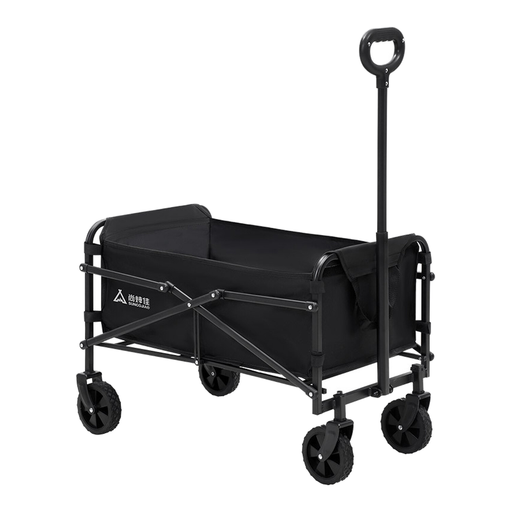
Why This Fits Their Persona: Its approximately 4.8kg product weight and foldable format suit occasional campers, picnic users and shoppers who prioritise easier transport and storage.
The listed 100kg load limit is clearly differentiated from larger heavy-duty models, helping buyers avoid paying for capacity they do not require.
It provides a 170L cargo capacity, multi-directional swivel wheels and a foldable frame.
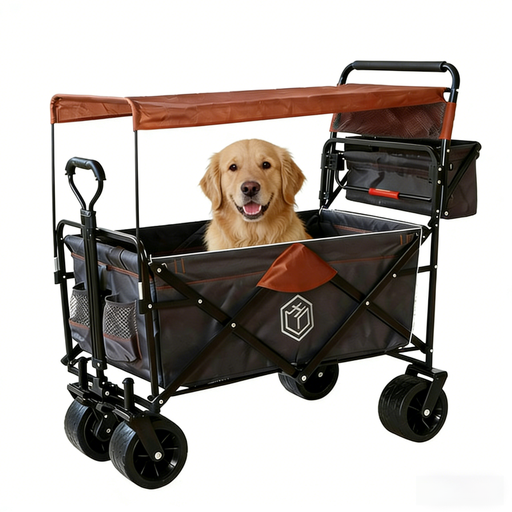
Why This Fits Their Persona: This option is aimed at buyers wanting a reinforced off-road design for camping, picnics, vending and moving bulky supplies.
Its listed 150L volume is presented alongside a 260kg maximum load, so capacity and weight are not treated as the same measurement.
It has a reinforced carbon steel frame, dual brake wheels, a detachable canopy and safety belt.
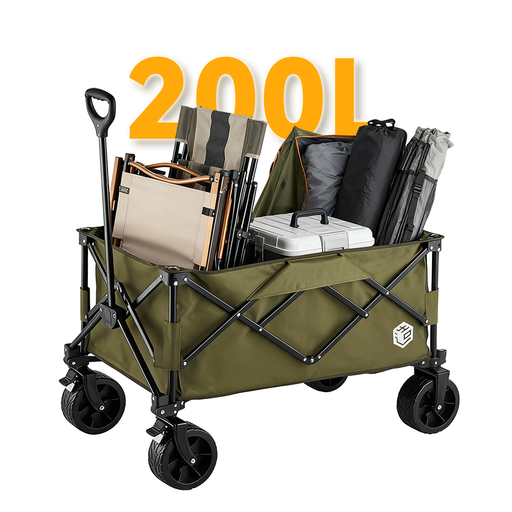
Why This Fits Their Persona: The high-sided 200L design suits families, market traders, gardeners and festival-goers carrying multiple bulky items.
Its product information specifies both the 200L interior and dual brakes, while also warning users to distribute weight and lock the frame before loading.
It offers 200L capacity, large off-road wheels, dual brakes and a collapsible metal-frame design.
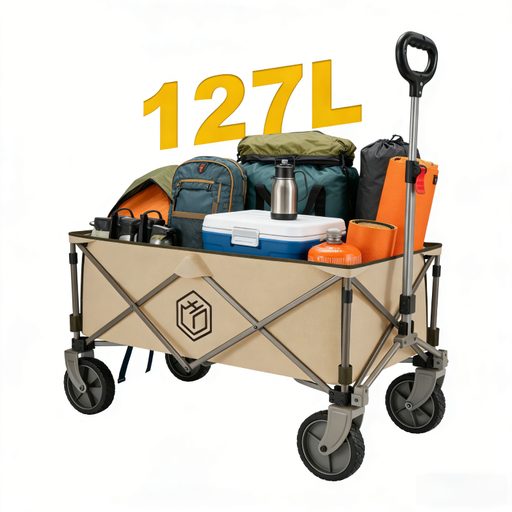
Why This Fits Their Persona: A 127L shopping and grocery cart can suit regular supermarket runs, allotments, picnics and lighter outdoor hauling where compact storage matters.
The 127L volume and 200kg load limit are stated separately, and the guidance advises against steep or uneven surfaces.
It has a foldable design, 127L interior, 200kg stated load capacity and dual-brake 360-degree swivel wheels.
We have compiled a complete, real-time list of products that fully satisfy these strict selection criteria and UK safety regulations.
A collapsible camping wagon should be opened on level ground and checked for a secure frame lock before loading. Keep the heaviest items low, avoid exceeding the stated limit and use the brakes when parked. Do not use an outdoor utility cart as a seat, step or child carrier unless the product specifically states that it is designed for that purpose.
After a muddy camping trip or beach visit, wipe the frame, fabric and wheels with a damp cloth. Salt and grit can accelerate wear, so clean them before storage. Dry the wagon fully, inspect wheel bolts and brakes periodically, and store it somewhere dry. These simple steps can help reduce odours, rust and avoidable mechanical problems.
It can be suitable for firm sand, paths and grass when fitted with large, suitably treaded wheels. Loose, deep sand may still be difficult. Distribute the load evenly and avoid pulling a fully loaded wagon across steep or unstable areas.
Many models require no major assembly and can be unfolded for use. Some lighter carts may require wheel attachment. Always check that wheels, handles, brakes and locking mechanisms are secure before carrying equipment.
A manual wagon has no fuel or charging cost. Ongoing expenses are generally limited to cleaning and possible replacement parts such as wheels or fasteners. Keeping it dry, avoiding overloads and checking the brakes can help prevent premature wear.