
24/7 Customer Support

Free returns

Same-day & Next-day Delivery

Quality Guaranteed

Unlock Your Welcome Offers: FREE Delivery | Up to 80% OFF | Free 30-day JoyPlus trial
Download the APP
Buying coloured felt tip pens can seem straightforward until the first pen dries out, the ink bleeds through your notebook or the tips prove unsuitable for detailed work. Students, parents, journalers, crafters and artists all need slightly different specifications, so a large colour count alone should not decide your purchase.
This guide from the Joybuy Product Recommendation Officer explains the practical features to check, common buying traps and suitable options for different uses.
A large assorted colour pen set may look attractive, but it can include several shades that are too similar for everyday note-taking. If you mainly need pens for school notes or planners, a compact set with useful core colours may be more practical than a very large collection.
For illustration, colouring or craft projects, however, a broader colour range can reduce the need to mix or layer shades. Check whether the set includes useful variations such as fluorescent, pastel or metallic colours rather than focusing only on the total number of pens.
A fine-tip pen designed for outlines will be slow and uneven when used to fill a large area. Conversely, a broad fibre-tip pen may obscure small lettering and detailed patterns.
Fineliner pens and fine-tip pens are generally more suitable for precise writing, templates, rulers, hatching and intricate drawing. Fibre-tip pens and felt-tip marker pens with wider nibs are more suitable for colouring, bold headings and larger areas.
Water-based ink is commonly used in coloured pens and can offer smooth application, but performance varies between paper types. Thin notebook pages may show through even when a product is described as resistant to bleed-through. Test a pen on a spare page before using it in a finished journal or artwork.
Caps also matter. Leaving pens uncapped can shorten their usable life, even where a product has protection against drying out. Replace each cap firmly after use and follow any storage guidance, such as keeping pens horizontal.
For detailed work, look for a stated line width rather than vague wording such as “precision tip”. The STABILO Point 88 range, for example, specifies a 0.4 mm line width and has a metal-cased tip, making it suitable for rulers, stencils, fine writing and sketching pen applications.
A pen with an approximately 1 mm M-tip is more appropriate for clear, stronger lines and filling moderate areas. Wider tips, such as the 3 mm XL tip on the STABILO Trio Deco, can make colouring larger sections quicker.
A metal-framed or metal-cased tip may help retain its shape during regular use, but it does not make a pen suitable for every surface. Use paper, card or other recommended absorbent materials unless the product description states otherwise.
Water-based ink pens are a popular choice for schoolwork, journaling and general drawing. They are usually easy to use and may be washable or suitable for watercolour-style effects, depending on the product.
The STABILO Pen 68 range states that its water-based ink can be used with a brush and water on watercolour paper to create aquarelle effects. This should be treated as a creative technique rather than a guarantee of identical results on ordinary notebook paper.
For artwork where water resistance and fade resistance are important, the Faber-Castell Pitt Artist set uses pigmented, waterproof ink according to its product description. Always consider the paper, drying time and intended permanence before using ink on a final piece.
An assorted colour pen set can be useful for colour coding, classroom activities and creative work. Check:
For children, check age guidance, small-part warnings and supervision requirements. Pens should not be chewed or treated as toys, and ink should be kept away from the eyes and mouth.
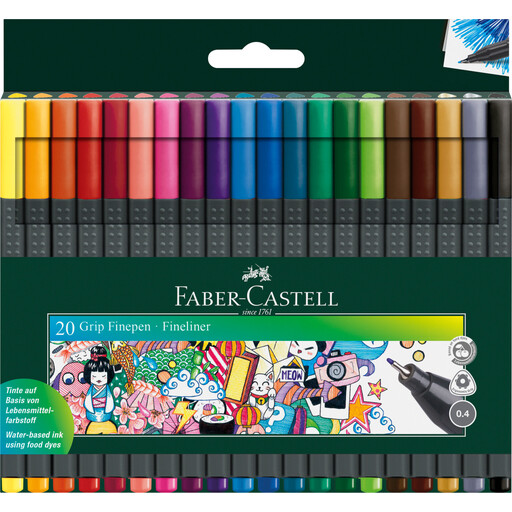
Why This Fits Their Persona: A 20-pen wallet gives students, journalers and first-time buyers a practical range for notes, colour coding and detailed drawing without moving immediately to a larger art collection.
The stated 0.4 mm line width avoids the uncertainty of an unspecified fine tip, while the wallet format keeps the set organised.
0.4 mm line width, triangular grip zone and long metal-framed tip for rulers and templates.
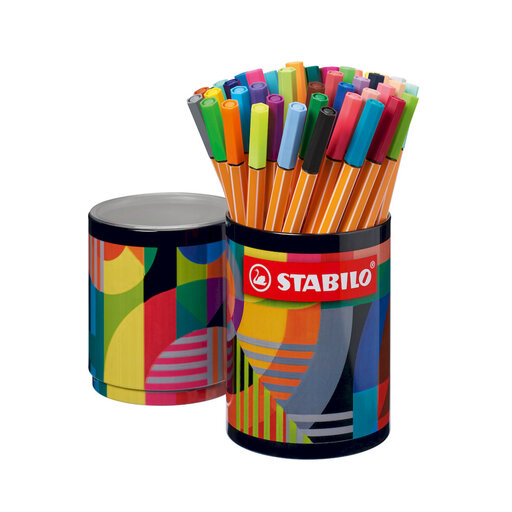
Why This Fits Their Persona: Suitable for illustrators, detailed journal layouts and anyone who values a broad selection of fine coloured pens in a protective tin.
The defined 0.4 mm tip and metal casing provide clearer information than broad claims about precision or durability.
45 assorted colours, water-based ink and suitability for rulers and stencils.
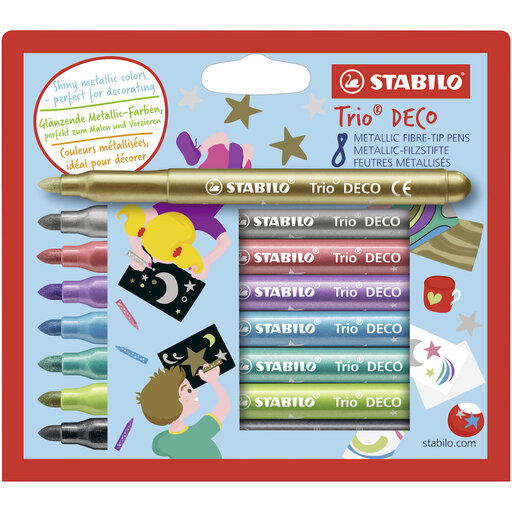
Why This Fits Their Persona: Crafters, teachers, parents and creative hobbyists can use the metallic colours for decorating paper, card, wood and other absorbent surfaces.
Its purpose is clearly defined as metallic colouring rather than general-purpose fine writing, with a stated 3 mm XL tip.
Metallic ink, eight assorted colours and an ergonomic triangular grip zone.
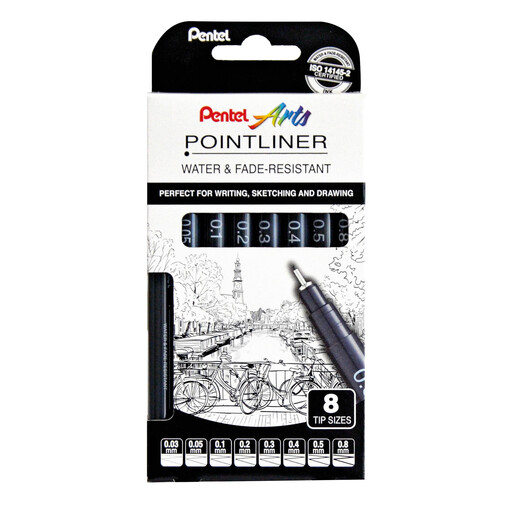
Why This Fits Their Persona: Illustrators and sketchers who need consistent black line work can use the range of tip sizes for outlines, shading and detail.
The product description specifies 11 available tip sizes and a robust tip, making line-width selection more transparent.
Water- and fade-resistant pigment ink is specified, with options for intricate details through to bold lines.
We have compiled a complete, real-time list of products that fully satisfy these strict selection criteria and UK safety regulations.
Yes, but choose the tip and ink carefully. Fine-tip or fineliner pens are suited to small headings, habit trackers and detailed layouts. Test water-based ink pens on the reverse of a page first, particularly when using lightweight planner paper.
Lifespan depends on use, pressure, storage and how often the cap is replaced. Pens used for large areas will run out sooner than those used for occasional writing. Keep caps secure, store the pens as directed and avoid pressing heavily on the tip.
Some products specify washable ink, while others do not. The Faber-Castell double-ended fibre-tip set states that its water-based ink is washable from most fabrics, but ink can still stain depending on the material and drying time. Treat washable claims as practical guidance rather than a guarantee for every fabric.