
24/7 Customer Support

Free returns

Same-day & Next-day Delivery

Quality Guaranteed

Unlock Your Welcome Offers: FREE Delivery | Up to 80% OFF | Free 30-day JoyPlus trial
Download the APP
Buying coloured pencils can look straightforward until you compare core types, colour counts, paper compatibility and intended age range. A low-priced set may suit quick colouring, while a larger set can be more practical for layering, blending or detailed illustration. The key is to match the pencil to the project rather than paying for features you will not use.
A 72-colour set offers more shades, but it may not be the most useful choice for a child, beginner or occasional crafter. A smaller set can be easier to organise and may include the essential colours needed for schoolwork, sketching and simple colouring.
Check whether the set includes a storage tin or case, whether replacement pencils are available and whether the colours are clearly identified. A large collection is less convenient if pencils become difficult to find or carry.
Not all coloured pencils behave in the same way:
Choosing the wrong core can lead to disappointing results, particularly if you expect a dry coloured pencil to produce watercolour effects.
Marketing descriptions often highlight colour intensity but say less about everyday handling. A fragile core may snap during sharpening, while a very soft core can wear down quickly during large-area colouring. Look for details such as break-resistant bonding, lead diameter and barrel shape.
For younger users, a chunky or ergonomic barrel may be easier to control. Adults working for long periods may prefer a traditional slim barrel with a comfortable finish and dependable sharpening performance.
Decide how you will use the pencils. For colouring books and general drawing, standard artist coloured pencils with smooth laydown are a practical starting point. For wet techniques, choose watercolour pencils and confirm that your paper is suitable for moisture.
Pastel pencils are useful for dry blending, soft shading and work on darker papers, but their dusty marks require careful storage and a well-ventilated working area. If you are creating precise preliminary sketches, include graphite drawing pencils among your drawing and sketching supplies.
A 12-colour set is compact and suitable for basic projects. Sets of 24 or 36 offer more scope for gradients and subtle colour changes. A 72-colour collection is more appropriate for illustrators, adult colouring enthusiasts or users who regularly blend and layer.
Colour count alone does not indicate lightfastness, opacity or blendability. Where artwork is intended for display, check the manufacturer’s stated specifications rather than assuming that every shade will perform in the same way over time.
Useful details include:
For children, supervise use where the product instructions recommend it and keep pencils and sharpeners away from children under three because of potential choking hazards.
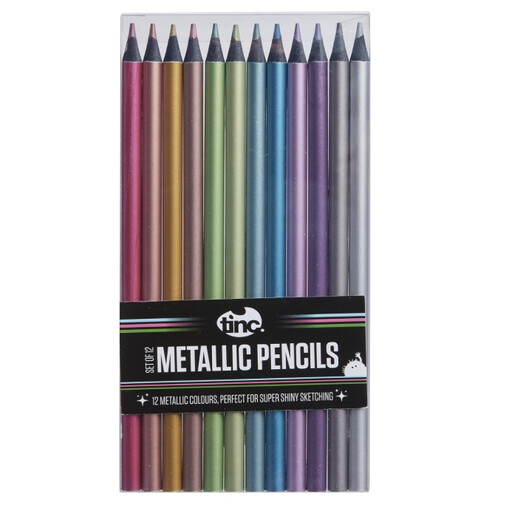
Why This Fits Their Persona: A compact option for children, school pencil cases, creative notes and casual colouring at home, with 12 bright metallic shades rather than an oversized collection.
The stated 12-colour format keeps the purchase focused and manageable, while the metallic finish is a clearly defined feature rather than an implied all-purpose art medium.
Bright metallic colours; compact dimensions of H18 × W9 × D0.8 cm and a stated weight of 79 g.
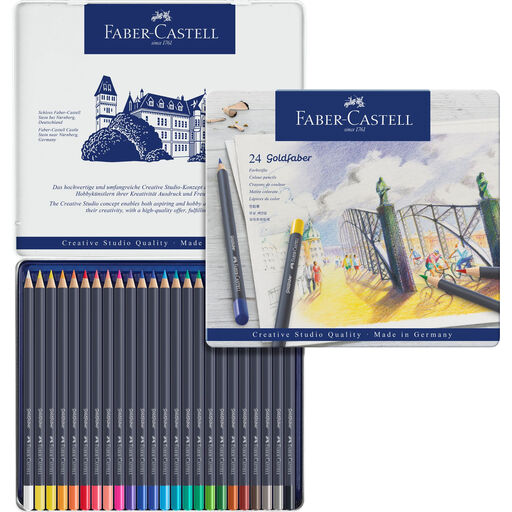
Why This Fits Their Persona: Suitable for students, illustrators and hobbyists who want a 24-pencil set for regular drawing, layering, hatching and detailed colouring.
The product specification identifies a 3.3 mm lead and states that it is smudge-resistant and water-resistant, giving buyers more practical information than colour count alone.
Tin of 24; designed for layering, blending and hatching across a wide range of drawing techniques.
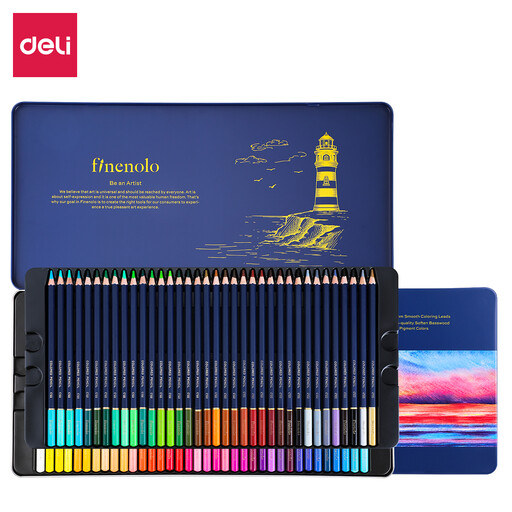
Why This Fits Their Persona: A useful match for adult colouring, detailed illustration, studio use and anyone who frequently needs many shades for blending and layering.
The 72-colour count is paired with stated pigment-based cores, a metal tin and break-resistant leads, making the format more suitable for frequent use and storage.
72 assorted colours; metal tin for portability and organisation.
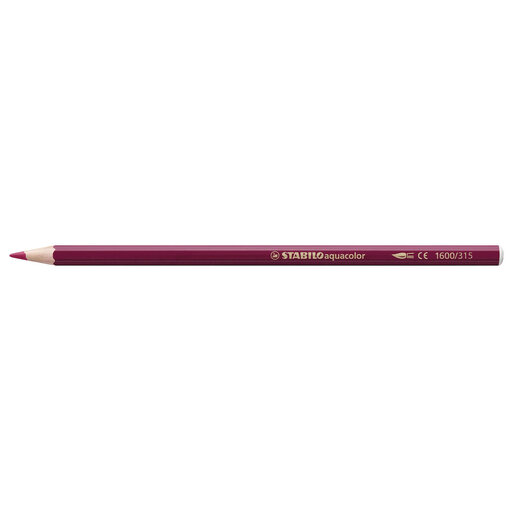
Why This Fits Their Persona: Appropriate for sketchbook users, art students and hobbyists who want dry colouring alongside water-activated lines, shading and wash-style effects.
Its water-soluble design is stated clearly, so buyers can select it for wet techniques instead of expecting standard coloured pencils to behave like paint.
24 colours; 2.8 mm water-soluble lead for dry or wet use.
Coloured pencils work particularly well with a few basic additions:
For mixed-media projects, an acrylic starter set or compact watercolour travel kit can extend the range of techniques without requiring a separate purchase for every accessory.
We have compiled a complete, real-time list of products that fully satisfy these strict selection criteria and UK safety regulations.
Yes. The suitable set depends on the intended activity. Coloured pencils for children should be easy to grip, clearly labelled and used according to the supplied age guidance. Adults may prefer larger colour ranges, softer leads, improved blendability or specifications such as lightfastness for display work.
Lifespan depends on how often they are used, pressure applied, sharpening frequency and core softness. Storing pencils in a dry place, avoiding excessive pressure and using a compatible sharpener can help reduce breakage and waste. Larger sets may last longer overall because usage is distributed across more colours, although frequently used shades will wear faster.
They can be used dry on ordinary drawing paper, but wet techniques are more reliable on paper designed to handle moisture. Test a small area first, use limited water and allow layers to dry where necessary. A water brush, palette and suitable paper can help you control the final effect.