
24/7 Customer Support

Free returns

Same-day & Next-day Delivery

Quality Guaranteed

Unlock Your Welcome Offers: FREE Delivery | Up to 80% OFF | Free 30-day JoyPlus trial
Download the APP
Whether you're diving into a new colouring book, organising your life with a bullet journal, or keeping the kids entertained, the right set of colouring pens can make all the difference. But the market is flooded with options, and it's easy to end up with a set that disappoints. As a Joybuy Product Recommendation Officer, my role is to help you see past the marketing claims and focus on what truly matters for your creative projects. Let's look at the common pitfalls and how to find a set that genuinely works for you.
Many of us have been let down by a new pen set. Before you spend your money, be aware of these frequent issues that marketing slogans often hide.
To avoid these traps, focus on a few key technical details. Understanding these will empower you to select a set that performs as you expect.
The tip of the pen dictates what you can do with it. There is no single "correct" type; it depends entirely on your intended use.
The ink inside the pen is the most critical component. The two main types have distinct properties.
For most hobbyists, students and journal keepers, a high-quality, water-based ink is the more practical and forgiving choice.
Based on these practical considerations, here are a few recommendations from our catalogue, matched to different types of users.
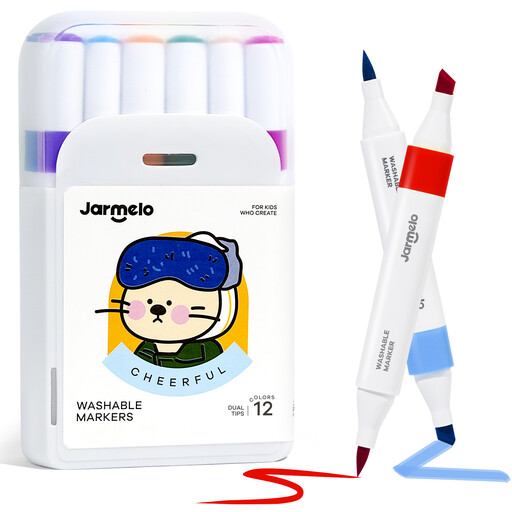
Why This Fits Their Persona: This set is designed with children's safety and parents' peace of mind at its core. The thick, ergonomic barrel is easy for small hands to hold, and the included carry case helps with organisation.
It directly addresses the "washable" pitfall by specifying that its non-toxic, water-based ink is 90% washable from both skin and most fabrics, offering more reliable clean-up. The ventilated safety caps also reduce choking hazards.
The dual-tip design (brush and chisel) provides creative versatility, allowing kids to switch between broad colouring and finer details without changing pens.
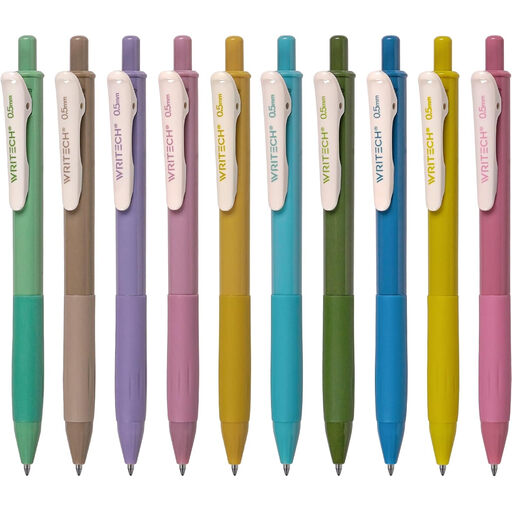
Why This Fits Their Persona: Perfect for colour-coding notes, habit tracking and creative journaling. The unique vintage colour palette offers a sophisticated alternative to standard brights, and the retractable design is convenient for quick entries.
This set tackles the "non-bleed" issue with its quick-drying gel ink. By drying fast, it minimises the time the ink has to soak into the paper, significantly reducing smudging and bleed-through on most standard journal papers.
The 0.5mm fine point tip delivers precise, skip-free lines ideal for neat handwriting and detailed doodles. The ergonomic, non-slip grip also ensures comfort during long writing sessions.
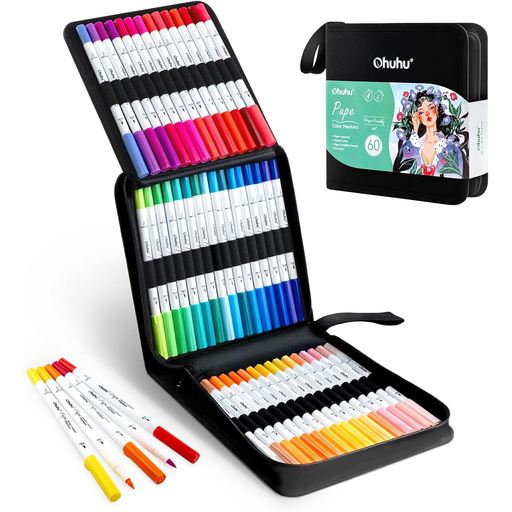
Why This Fits Their Persona: This comprehensive set is for those looking to take their art to the next level. The huge range of 59 colours plus a colourless blender offers limitless creative potential for illustration, adult colouring and calligraphy.
It features an upgraded "paper-friendly" water-based ink specifically formulated to reduce paper fluffing and damage. This is a more honest approach than a simple "non-bleed" claim, acknowledging the pen-and-paper interaction.
The versatile dual tips (0.4mm fineliner and a 1-5mm flexible brush) make this an all-in-one solution for both detailed line work and broad, expressive colouring. The ink is also blendable for creating smooth gradients.
We have compiled a complete, real-time list of products that fully satisfy these strict selection criteria and UK safety regulations.
1. How can I stop my colouring pens from bleeding through paper? The most effective method is to use paper with a higher weight, measured in grams per square metre (gsm). For most felt tip pens, paper above 100gsm works well. For more intense alcohol markers, look for 160gsm or higher marker-specific paper. Always test a new pen on a spare sheet or an inconspicuous page corner first.
2. What is the difference between brush pens and felt tip pens? A standard felt tip (or fibre tip) pen has a firm, fixed nib that produces a consistent line width. This is great for predictable results in writing and simple colouring. A brush pen for calligraphy has a flexible, tapered nib that behaves like a small paintbrush. By changing the angle and pressure, you can vary your line width from very fine to very broad, which is ideal for artistic lettering and illustration.
3. How should I store my dual tip markers to make them last longer? To ensure the ink remains evenly distributed to both tips, it is always advisable to store dual tip markers horizontally. If stored vertically, gravity can cause all the ink to pool at the bottom nib, leaving the top one to dry out prematurely. Keeping them in their original case on a flat surface is a simple way to prolong their life.