For warming custard, prioritise adjustable microwave heating, a microwave-safe vessel and a routine that allows you to stir and check it; extra oven functions are useful only if you will use them for other parts of the meal. If family-sized or rectangular dishes matter, compare the space offered by a larger turntable or flatbed with your actual cookware. A compact model may be enough when you mainly warm custard and ordinary plates, provided it fits your kitchen and the food-handling instructions are followed.
Who each option suits
Custard-and-sauce reheaters
If warming custard or other sauces is your main task, focus on microwave controls, a suitable vessel and the stirring and standing instructions for the food. Grill, convection and air-fry functions do not take the place of those steps.
Family-meal multitaskers
If you also want to accommodate serving dishes or cook other meal components, compare cavity layout and dish fit before choosing extra cooking modes. A turntable diameter, flatbed layout or two-level cooking arrangement can change which cookware is practical.
Worktop-space-conscious cooks
If counter space is limited, check the appliance’s external dimensions and required clearances alongside its cooking functions. A slim or compact design is worth considering only if your usual dishes will still fit.
What matters when choosing
Start with how you will warm the custard, then check dish fit and any cooking modes you expect to use beyond reheating. Installation requirements can rule out an otherwise suitable model.
| Concern | What to check | Who this matters to |
|---|
| Controlled custard warming |
Check the microwave power settings and whether the timer allows short heating intervals; use a microwave-safe vessel. |
I want to stir and check custard between heating intervals rather than leave it on one long cycle; around 36% of consumers put controlled warming first. |
| Family dish fit |
Measure your largest microwave-safe dish against the turntable diameter or usable flatbed area, not just the stated litre capacity. |
When I serve a family meal, I need my bowl or serving dish to fit without assuming that cavity capacity tells the whole story. Around 29% of consumers prioritise family dish fit. |
| Cooking beyond reheating |
Confirm the particular grill, convection or air-fry modes you would use, along with any required racks or trays. |
I would use the appliance for other meal components as well as custard, so its additional cooking modes matter to me; around 21% of consumers make multifunction cooking their primary concern. |
| Kitchen fit and setup |
Check external dimensions and the manual’s ventilation requirements; for a countertop model, check its plug and socket arrangements. |
My kitchen has limited space, and the appliance needs a suitable position and power connection. Kitchen fit and setup come first for around 14% of consumers. |
Buying pitfalls
-
Expecting combination modes to warm custard evenly on their own
Grill, convection and air-fry functions do not remove the need to stir custard and follow any standing instructions. GOV.UK advises following the food manufacturer’s microwave reheating directions, including stirring and standing.
Use microwave mode for ordinary warming, follow the pack or recipe directions, and stir and check the custard before serving.
-
Choosing by litre capacity alone
Capacity does not tell you whether a particular serving dish will fit. Sharp lists a 270mm turntable for the YC-PC254AU-S, Panasonic lists a 34cm turntable for the NN-CD58RSBPQ, and its NN-CF87LBBPQ uses a flatbed.
Measure the width and height of your microwave-safe dishes, then compare them with the usable cooking space and the appliance’s installation requirements.
-
Using unsuitable containers or an extension lead
Container choice and the power connection remain important even when a microwave has additional cooking modes. Electrical Safety First advises using microwave-safe items and avoiding an extension lead for this high-power appliance.
Check container markings, follow the manual’s instructions for each cooking mode and use a suitable wall socket for a countertop model.
-
Applying cooking claims to every dish
Panasonic’s stated time and energy comparisons concern its own tests against specified built-in ovens; they do not establish what will happen with every recipe or appliance.
Choose additional modes for meals you intend to cook, and check the exact model’s functions, accessories and dimensions rather than relying on a headline comparison.
Relevant brands to consider
Panasonic
Panasonic’s cited combination models offer two different family-dish layouts: a slim 27L turntable model and a 31L flatbed model.
- Panasonic lists a 34cm turntable and 1000W inverter microwave output for the NN-CD58RSBPQ; the NN-CF87LBBPQ has a flatbed and two-level cooking.
- Compare the exact model with your cookware and available space. Panasonic’s own time and energy comparisons should not be assumed to apply to every dish.
Samsung
Samsung’s cited 28L and 32L models combine microwave cooking with other meal-preparation functions.
- Samsung describes a turntable-disable option for larger square dishes on the MC28A5135CK/EU and microwave, grill, convection and air-fry functions on the MC32DG7646CKE3.
- The MC32DG7646CKE3’s remote features require a compatible app, Wi-Fi and a Samsung account; check whether you would use them.
Sharp
Sharp’s YC-PC254AU-S is a 25L combination model to consider when ordinary plates and a more compact cavity meet your needs.
- Sharp specifies 900W microwave output, a 1200W grill, convection cooking and a 270mm turntable for this model.
- Check wide family serving dishes against the 270mm turntable rather than relying on the 25L capacity alone.
Joybuy products for fitted kitchens
These built-in microwave-and-grill models suit a fitted-kitchen route rather than a freestanding worktop setup. Check cabinet fit and your serving dishes; only the CDA model listed here also specifies convection in its product name.
 No image available
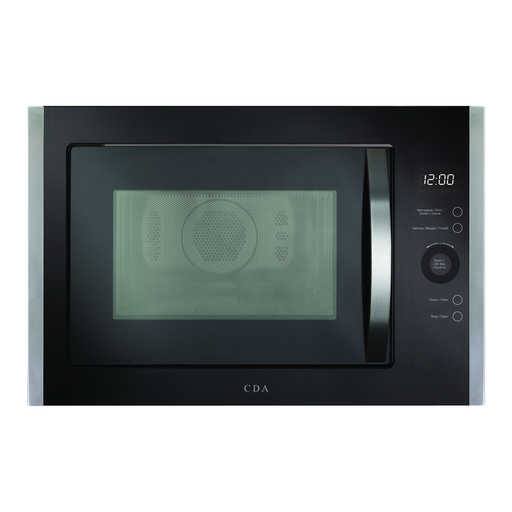
CDA VM452SS built-in microwave with grill and convection, 25L, 900W, stainless steel
Consider this built-in model if you want microwave reheating alongside grill and convection cooking. Its listed capacity is 25L and its microwave output is 900W.
Check that your cabinet meets the installation and ventilation requirements, and compare your serving dish with the usable turntable and rack space.
View on Joybuy
 No image available
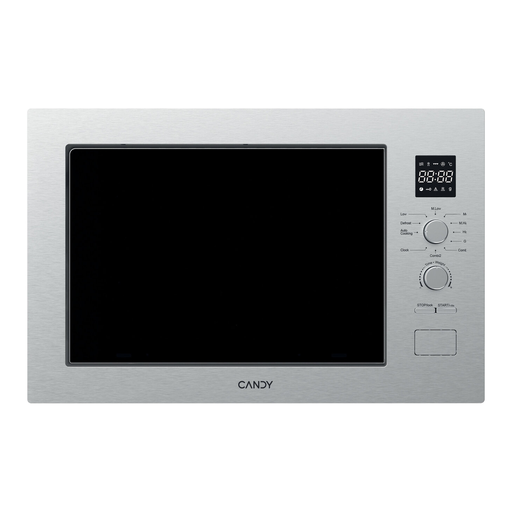
Candy CA38FL7NWXUK built-in microwave with grill, stainless steel
Consider this built-in microwave when reheating and grilling meet your cooking needs. Do not assume it has convection cooking: check the functions you require before choosing it.
Confirm the cabinet dimensions and installation requirements, and check that your usual dishes fit.
View on Joybuy
 No image available
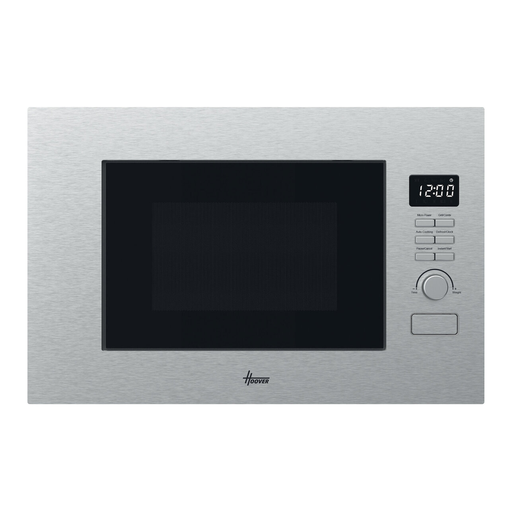
Hoover HO38FL7NWBXUK H-Microwave 300 built-in microwave with grill, 20L, stainless steel
Consider this 20L built-in microwave if warming custard and using a grill suit your plans and your serving dishes fit its cavity.
Check cabinet cut-out and ventilation requirements in the manual. If grill output matters to you, confirm the exact model specification before buying.
View on Joybuy
Common questions
Do I need a combination microwave just to warm custard?
No—a solo microwave can warm custard. Choose a combination model if you will also use functions such as grilling or convection cooking; for the custard itself, follow the pack or recipe instructions and stir as directed.
How should I warm custard in a combination microwave?
Use microwave mode and follow the custard pack or recipe directions, including any instructions to stir or leave it to stand. Use a microwave-safe vessel, warm it in manageable intervals and check it before serving.
What microwave size works for a family meal?
Choose by the dishes you need to fit, not by litre capacity alone. Measure your largest microwave-safe bowl or serving dish and compare it with the model’s turntable or usable flatbed space; a larger cavity does not, by itself, settle whether a particular dish fits.
What should I check before setting up a countertop combination microwave?
Check the manual’s clearance and ventilation instructions and make sure the appliance has a suitable power connection. Electrical Safety First advises that a countertop microwave used in the UK should have a UK three-pin plug with a fuse; use microwave-safe containers and follow the instructions for the cooking mode selected.


