Occasional cottage users warming small portions
If you mainly warm compote, porridge, sauces or leftovers, clear controls, a bowl that fits and easy cleaning matter more than oven-style cooking modes.


For warming fruit compote, prioritise easy-to-use microwave power and timer controls, a cavity that fits your microwave-safe bowl, and straightforward cleaning; convection capacity matters less for that task. Consider a flatbed if rectangular dishes make a turntable awkward, or additional oven functions if the cottage will use them for other meals. The built-in models below also require suitable cabinetry, rather than a place on the worktop.
If you mainly warm compote, porridge, sauces or leftovers, clear controls, a bowl that fits and easy cleaning matter more than oven-style cooking modes.
A flatbed may help if you use rectangular microwave-safe dishes that sit awkwardly on a turntable. You still need to measure the appliance, the available space and any required clearances.
If guests will also grill, bake or reheat larger meals, extra cooking modes may be useful. Match the appliance to the kitchen space and manage cleaning, maintenance and applicable accommodation requirements.
Start with the compote bowl and the space available for the appliance. Then decide whether other meals justify grill or convection functions; a built-in model needs compatible cabinetry, while a countertop model needs a suitable worktop position.
| Concern | What to check | Who this matters to |
|---|---|---|
| Controlled compote warming | Look for adjustable microwave power, a clear timer and room for your microwave-safe bowl. Stir the compote and check its temperature before serving. | If I usually warm one small portion, I want simple controls rather than extra oven programmes. Roughly 50% of consumers would put controlled small-portion warming first. |
| Space and dish fit | Measure the intended position, door-opening space and required clearances. Check dish fit and whether a turntable or flatbed suits your cookware. | With little kitchen space or rectangular serving dishes, I need an appliance and cavity that fit how I cook. Around 30% of consumers would make space and dish flexibility their primary concern. |
| Cooking beyond compote | Check which grill, convection or combination modes you would actually use, along with cavity and dish fit. | If guests will prepare more than small reheated portions, I want the appliance to cover some oven-style tasks too. About 20% of consumers would prioritise broader cooking capability. |
Grill and convection modes add cooking options, but they are not needed for basic microwave warming and may make the controls more involved.
Choose for bowl fit, microwave controls and cleaning first. Consider the additional modes if the cottage will use them for other meals.
A cavity’s litre figure does not establish whether your bowl or rectangular dish will fit or rotate freely.
Check the dish against the usable cavity or turntable dimensions, and measure the appliance’s installation space separately.
Metal can spark in microwave mode, and containers not intended for microwave use may be unsuitable. Electrical Safety First advises that UK countertop microwave ovens have a fused three-pin plug.
Use a clearly marked microwave-safe container, keep metal out of microwave mode and connect a countertop appliance to a suitable wall socket rather than an extension lead.
Food splashes and damaged plugs or cables need attention, particularly in an appliance used by successive guests.
Clean and inspect the microwave between stays and keep its instructions available. For an English self-catering holiday home, follow the electrical-safety guidance identified by GOV.UK; check the requirements that apply to the property’s location and operation.
Panasonic’s NN-DF38PBBPQ illustrates a compact flatbed combination format.
Samsung’s MC28A5125AK/EU is a 28L countertop convection combination model.
Sharp’s YC-QC254AU-B illustrates a 25L flatbed model with additional cooking modes.
The Russell Hobbs RHM3002 illustrates a larger, turntable-based combination microwave.
These built-in microwaves offer microwave warming plus other cooking modes for cottages with suitable cabinets. Check installation and ventilation requirements before choosing either one; neither is a freestanding countertop option.
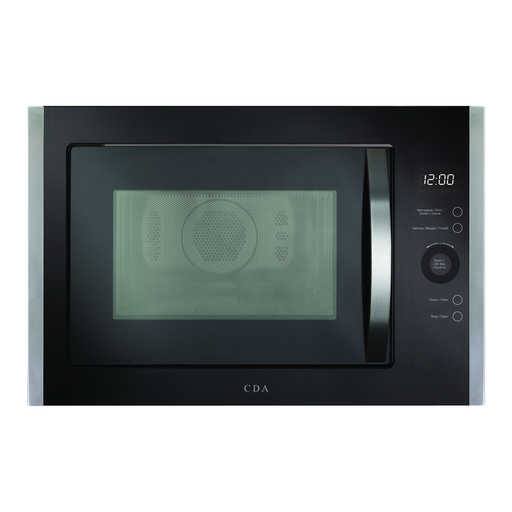 Image unavailable
Consider this model if the cottage has suitable built-in cabinetry and will use grill or convection cooking as well as microwave mode for compote.
The product name specifies a 25L cavity, 900W microwave output, grill and convection functions, and a stainless-steel finish.
Check that the kitchen has a compatible 60cm-high unit, meets the installation clearances and accommodates your usual microwave-safe bowl.
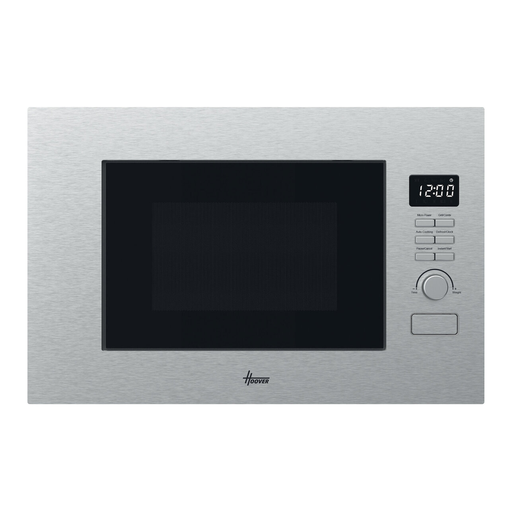 Image unavailable
Consider this model for a compatible built-in cabinet if you want microwave warming and an occasional grill option.
The product name specifies a 20L cavity, grill function and stainless-steel finish. Check whether its cooking modes cover any other meals you plan to make.
Confirm the cabinet and ventilation requirements, and check that your usual microwave-safe bowl fits. This built-in model should not be used freestanding.
No; microwave mode is the relevant function for warming compote. Choose convection or grill functions if you will also use the cottage microwave for baking, roasting, grilling or browning, and follow the instructions for the model and container you use.
No. Electrical Safety First advises against putting metal objects in a microwave because they can spark; remove the spoon and use a container marked microwave-safe.
Stir it thoroughly and check its temperature before feeding. For reheated baby food, the NHS advises heating it throughout, stirring to remove hot pockets, then allowing it to cool and checking the temperature.
Do not assume one annual testing rule applies to every holiday cottage. GOV.UK directs hosts of English self-catering holiday homes to Health and Safety Executive electrical-safety guidance; the Executive’s statement that law sets no annual PAT interval concerns low-risk work environments. Check the requirements for the property’s nation and operating arrangement while keeping the appliance maintained to prevent danger.
Clean the cavity and turntable, if fitted, as the manufacturer instructs, and inspect the plug and cable for damage. Do not use a damaged appliance; keep its instructions available for guests and maintenance.