What matters when choosing
Decide whether you need oven-style functions beyond butter softening, then check the controls, placement and dish fit of the exact model. A built-in appliance is a separate installation decision, not simply a way to avoid worktop clutter.
Freestanding combination microwave
Choose when: The appliance needs to sit on a shared worktop or move without alterations to the cabinetry.
Trade-off: It takes up counter space and needs a suitable socket and the ventilation clearance specified for that model.
Built-in combination microwave
Choose when: You are planning a permanent kitchen installation, have permission to make changes and want to keep the worktop clear.
Trade-off: Cabinet fit and electrical installation must be arranged for the exact appliance; it is not a plug-in substitute for a countertop model.
| Concern |
What to check |
Who this matters to |
| Controlled butter softening |
Check the microwave power settings and whether the timer and stop control let you pause for frequent checks. |
For recipes that require creaming, I need butter that is pliable rather than liquid, so I want to catch it before it melts. Around 36% of consumers put that control first. |
| Shared-kitchen use |
Check worktop space, the specified ventilation clearance and access to a suitable wall socket. |
When several people use the same worktop, I need an appliance we can position and use safely without obstructing one another. That is the primary concern for around 29% of consumers. |
| Room for baking dishes |
Compare your intended dishes with the cavity dimensions, turntable diameter and the model’s dish guidance, not litres alone. |
If I will bake or grill as well as soften butter, I need my usual dishes to fit and function as intended. Around 21% of consumers prioritise that flexibility. |
| Permanent installation |
Confirm permission, cabinet cut-out, electrical requirements and installation arrangements for the exact built-in model. |
Where the kitchen is being fitted permanently, I would rather preserve worktop space and plan the appliance into the cabinetry. For around 14% of consumers, that is the deciding need. |
Brands to consider for specific features
These model and range examples can help you identify specifications to compare; a feature on one model does not apply to every microwave from the same brand.
Panasonic
Its NN-CD58JSBPQ is a freestanding 27 L combination model to investigate when both worktop space and several cooking modes matter.
- Panasonic lists 1000 W inverter microwave power, six power levels, a 1300 W quartz grill and 100–220°C fan-assisted convection for the NN-CD58JSBPQ.
- Check its dimensions and controls against your space and butter-softening routine; Panasonic’s own oven comparisons do not establish savings for that task.
Samsung
Its MC28A5125AK/EU is a 28 L convection combination model relevant when dish shape affects your choice.
- Samsung says the MC28A5125AK/EU can operate with its turntable disabled, allowing use of the interior with larger square dishes.
- Confirm the exact model’s power settings and controls before relying on it to soften butter gently.
Sharp
Its R959SLMA provides published measurements to compare when a larger freestanding cavity is important.
- Sharp’s R959SLMA data sheet specifies 40 L capacity, 900 W microwave output, six power levels and a 36.2 cm turntable.
- Its stated external dimensions of 550 × 368 × 537 mm and weight of 27 kg make worktop fit and handling important checks in a shared kitchen.
Bosch
Its UK range is relevant when considering a microwave as part of a permanent kitchen installation.
- Bosch lists built-in and freestanding microwaves alongside microwave combination ovens.
- Check the exact model’s cooking functions, cabinet cut-out and installation requirements; the wider range does not mean every model is a combination microwave.
Combination microwaves on Joybuy
These models offer different approaches to shared-kitchen baking, from multi-function countertop choices to a Samsung model with a turntable-off option for dish shape. For butter softening, check each model’s low-power settings and how readily you can stop to inspect the butter; also confirm that it fits the intended space.
 No image available
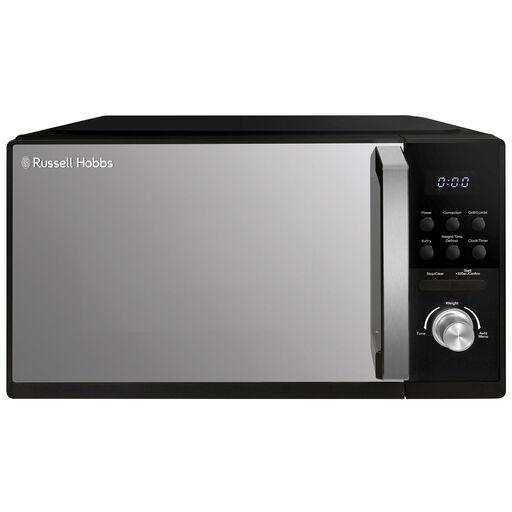
Russell Hobbs RHMAF2508B 25 L 4-in-1 digital combination microwave
Consider this 25 L model if you want one digital combination appliance for butter preparation and other shared-kitchen cooking. Before relying on it for frequent butter checks, confirm how its lower power settings, timer and stop control operate; check the plug and placement instructions too.
View on Joybuy
 No image available
Toshiba MW3-SAC23SF(MB) 23 L 4-in-1 air-fry combination microwave
This model is worth considering if you would also use its air-fry and grill functions. Its product name specifies 900 W microwave output and a 1000 W grill; neither figure establishes how gently it softens butter. Check the power settings, stop control, external dimensions and plug before choosing it for a shared worktop.
View on Joybuy
 No image available
DAEWOO SDA2618GE 26 L 5-in-1 air-fryer combination microwave
Consider this model if you want to compare a 26 L multi-function appliance for butter preparation and occasional baking. The product name also states 2400 W without identifying it as microwave output, so do not use that figure to judge butter-softening control. Confirm the lower power settings, stop control, plug and required placement clearances.
View on Joybuy
 No image available
Samsung MC28A5125AK/EU 28 L convection combination microwave
Consider this model if fitting larger square dishes matters as well as occasional oven-style cooking. Samsung says its turntable can be disabled, but that feature does not establish suitability for gentle butter softening. Check its microwave power settings, timer and stop control, plus its installation format and dimensions for your kitchen.
View on Joybuy
Common questions
Do I need a high-wattage microwave to soften butter?
No: maximum wattage alone is not the useful deciding measure for this task. Look for power settings and a timer you can interrupt, then check the butter frequently in a microwave-safe dish. King Arthur Baking explains that butter intended for creaming should be softened rather than melted.
Is a combination microwave worthwhile if I only want to soften butter?
A solo microwave may cover butter softening, reheating and defrosting if those are your only intended tasks. Consider a combination model when you will also use its grill or convection functions for cooking; those functions do not themselves make butter softening gentler. Which? describes combination microwaves as adding grill and convection cooking to regular microwave use.
Can we run a shared-kitchen microwave from an extension lead?
Electrical Safety First advises against powering a microwave through an extension lead. Plan for a suitable wall socket at the intended location and follow the exact model’s installation and ventilation instructions.
What if the microwave door or seal is damaged?
Take the appliance out of normal shared use and arrange repair or replacement. Electrical Safety First says defects in a microwave door or its surrounding seal warrant repair or replacement.
What should I check about the plug on a countertop model?
Check that the appliance has an appropriate UK three-pin fused plug and can use a suitable wall socket in the intended location. Electrical Safety First gives this plug guidance for countertop microwaves; the manufacturer’s installation instructions still govern the model’s placement and use.


