Regular bread defrosters
If sliced bread or rolls often go straight from freezer to mealtime, look for a clearly labelled defrost function, usable low-power controls or a programme specifically listed for bread.


Choose a combination microwave with defrost controls you can use for sliced bread, then check that your usual plates and cooking dishes fit. A bread-specific programme offers a guided starting point if you defrost bread often, but a model with suitable manual controls may also meet your needs. If larger dishes or an integrated kitchen matter more, compare cavity and installation requirements before choosing extra cooking modes.
If sliced bread or rolls often go straight from freezer to mealtime, look for a clearly labelled defrost function, usable low-power controls or a programme specifically listed for bread.
If the same appliance will reheat food and handle grill or oven-style tasks, check dish fit and the cooking modes you will actually use, not microwave wattage alone.
If one appliance needs to cover several cooking tasks, weigh its worktop footprint against the cabinet, ventilation and electrical requirements of a built-in model.
For a combination microwave used to defrost sliced bread at family meals, establish how you want to control defrosting, then check dish fit, useful cooking modes and the intended installation space.
| Concern | What to check | Who this matters to |
|---|---|---|
| Controlled bread defrosting | Look for a labelled defrost function, available low-power settings and time or weight controls; check the exact programme list if you want a bread setting. | When bread comes from the freezer just before a meal, I want a setting I can control without warming the edges too far. Around 36% of consumers put controlled bread defrosting first. |
| Dish and cavity fit | Compare your plates and cooking dishes with the internal dimensions and turntable diameter or flatbed area, as well as the stated capacity. | If I also prepare several servings, my usual dishes need to fit without relying on the litre figure alone. For around 29% of consumers, dish and cavity fit is the primary concern. |
| Cooking versatility | Check for the grill and convection modes you intend to use, and whether any required racks or trays are included. | I want to defrost bread and use the appliance for other parts of the meal, but extra modes matter only if I will use them. Cooking versatility comes first for around 21% of consumers. |
| Space and installation | Check external dimensions and ventilation instructions; for a built-in model, confirm cabinet and electrical requirements before ordering. | In my kitchen, the appliance must fit its intended position and have a suitable electrical supply. Around 14% of consumers prioritise space and installation above the other concerns. |
Programme lists differ by model. Panasonic lists options for small bread pieces and a big bread piece on the NN-CD58RS; the cited Sharp YC-PC254AU-S and Kenwood K30GMB25 instead document general defrost controls.
Read the exact model's programme list. If it does not list bread, check its manual for suitable time, weight and low-power defrost instructions.
Capacity does not tell you the full usable dish area. The cited Sharp 25L model has a 270mm turntable, while Panasonic specifies 340mm for the 27L NN-CD58RS and 360mm for the 34L NN-CD88QSBPQ.
Measure your widest usual plate and cooking dish, then check the cavity, turntable and external dimensions against your intended space.
A built-in model can require cabinet planning and a different electrical arrangement. Professional installation and a dedicated circuit are specified for the cited AEG 8000 CombiQuick built-in model.
Check the exact appliance's cabinet cut-out, ventilation and electrical instructions with the manufacturer or a qualified installer before ordering.
A model requiring a dedicated circuit can also involve electrical and installation work.
Electrical Safety First advises against powering a microwave through an extension lead and recommends checking for a standard UK three-pin plug and fuse on a countertop appliance.
Plan for a suitable wall socket, follow the model's ventilation instructions and check the retailer and exact model before purchase.
Relevant if you want to compare a countertop bread-programme model with a larger combination microwave offering additional cooking modes.
Relevant if you prefer adjustable time-and-weight defrost controls in a countertop model with grill and convection functions.
Relevant when you want to assess a larger countertop cavity alongside time-and-weight defrost controls.
Relevant to an integrated-kitchen plan rather than a straightforward countertop replacement.
These choices cover combination microwaves to consider when bread defrosting is part of family-meal preparation: two countertop options and a built-in option. Check each model's defrost instructions and the space available in your kitchen before deciding.
 No image available
Consider this countertop model if you want bread defrosting alongside other cooking modes; check the manual for the defrost controls and whether they suit sliced bread.
The product name specifies a 23L cavity, 900W microwave output, 1000W grill, app control and 10 cooking presets. Check your dish dimensions and the required worktop clearance.
 No image available
Consider this model if a 28L cavity and convection cooking suit your family dishes; check the manual for its bread-defrost settings before choosing it for that task.
The product name specifies 900W microwave output and a smart moisture sensor. Compare your cookware with the usable cavity area and check the appliance's external dimensions.
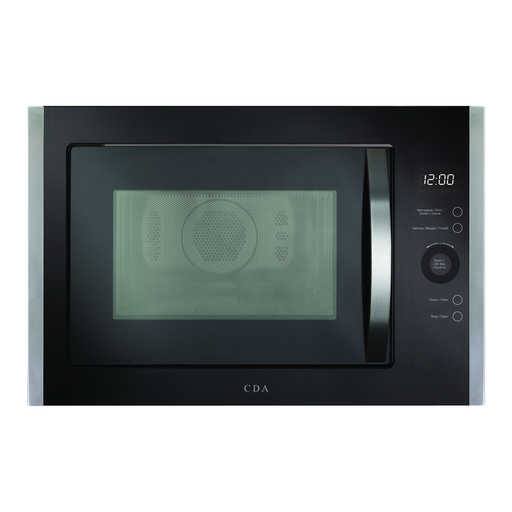 No image available
Consider this model for an integrated kitchen rather than a countertop position; check its bread-defrost controls and installation instructions before ordering.
The product name specifies a 25L cavity, 900W microwave output, grill and convection functions. Confirm the required cabinet opening, ventilation and electrical supply for the exact model.
Start with a genuine defrost function and check the available low-power controls. If bread is a frequent task, a named programme gives you a model-specific starting point: Panasonic lists options for small bread pieces and a big bread piece on the NN-CD58RS. Follow the instructions for the quantity you are defrosting.
A 25L model may suit your family dishes if their dimensions fit its usable cavity and turntable. For scale, Sharp specifies a 270mm turntable on the 25L YC-PC254AU-S, while Panasonic specifies 340mm on the 27L NN-CD58RS. Measure the dishes you intend to use rather than choosing by litres alone.
Electrical Safety First advises against powering a microwave through an extension lead. Plan for a suitable wall socket, check the countertop appliance's plug and fuse, and keep the ventilation areas clear as its instructions require.
Check the requirements for the exact built-in model rather than assuming it plugs in like a countertop appliance. Professional installation and a dedicated circuit are specified for the cited AEG 8000 CombiQuick model; cabinet fit, ventilation and electrical supply also need checking before purchase.
Use a container or accessory suitable for microwave use and follow the appliance instructions. Electrical Safety First warns against metal objects, foam trays and plastic storage bags not designed for microwave use; accessories suitable for grill or convection cooking are not automatically suitable for microwave defrosting.