
24/7 Customer Support

Free returns

Same-day & Next-day Delivery

Quality Guaranteed

Unlock Your Welcome Offers: FREE Delivery | Up to 80% OFF | Free 30-day JoyPlus trial
Download the APP
Whether you're a professional mechanic, a dedicated DIY enthusiast or simply tackling weekend repairs on your car, a reliable combination spanner set is the cornerstone of any toolbox. But with so many options on the market, it's easy to fall for marketing hype and end up with a set that disappoints. Many find their new tools are prone to rounding off bolts, rusting after a few months or simply not up to the task.
As the Joybuy Product Recommendation Officer, my role is to help you navigate these choices. We'll look past the flashy labels and focus on what truly matters, helping you avoid the common pitfalls that lead to wasted money and frustration.
Before you add any mechanics tool set to your basket, be aware of these frequent issues:
To ensure you get a durable and effective tool, focus on these three core parameters.
The foundation of a good spanner is the steel. Look for sets explicitly described as being made from heat-treated, drop-forged chrome vanadium steel.
The right type of spanner depends entirely on your primary use case.
For most automotive and home DIY tasks in the UK, a metric spanner set is essential. A comprehensive set should cover the most common sizes, typically from 8mm to 19mm, without skipping any. Check that the sizes are clearly stamped or etched onto both sides of the spanner for easy identification. Finally, consider the storage. A sturdy, blow-moulded case offers the most protection, while a well-made roll-up pouch provides a compact and portable solution.
Based on these practical criteria, here are a few options from our catalogue matched to different user needs.
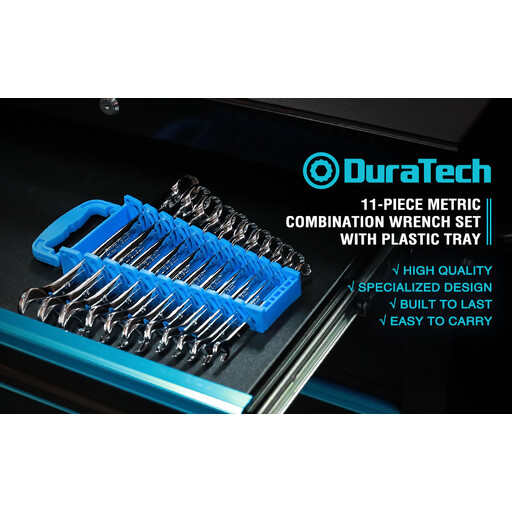
Why This Fits Their Persona: This set is an ideal starting point. It covers the most essential metric sizes (8-19mm) for tasks like assembling flat-pack furniture, bicycle maintenance or basic car repairs, without the complexity or cost of ratcheting features.
It's made from heat-treated chrome vanadium steel, avoiding the "soft steel" pitfall. The included organising rack is simple but effective, preventing the tools from getting lost in a drawer.
Features a 15-degree offset box end for better knuckle clearance and a 12-point design to reduce the risk of rounding fasteners. The polished finish makes it easy to wipe clean.
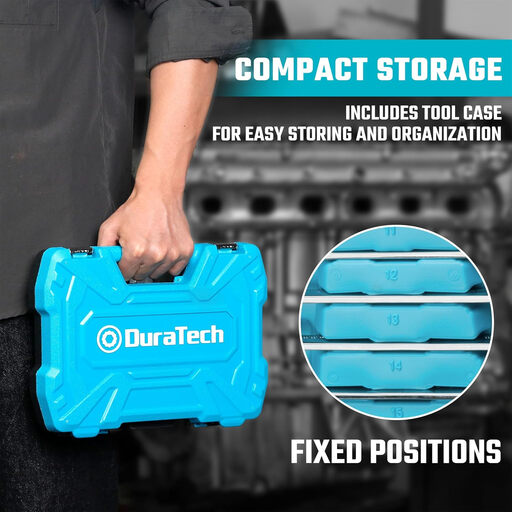
Why This Fits Their Persona: For those who spend hours in the garage or on the job, efficiency is key. This flex head spanners set combines a 72-tooth ratchet mechanism with a 180-degree pivoting head, dramatically speeding up work in confined areas like engine bays.
It balances a useful 72-tooth count with a robust build that exceeds ANSI standards, avoiding the weak ratchet trap. The sturdy, blow-moulded storage case protects the tools and keeps them organised.
The 5-degree swing arc and flexible head provide excellent access. The set includes a comprehensive 8-19mm size range, making it a versatile wrench set uk professionals can rely on.
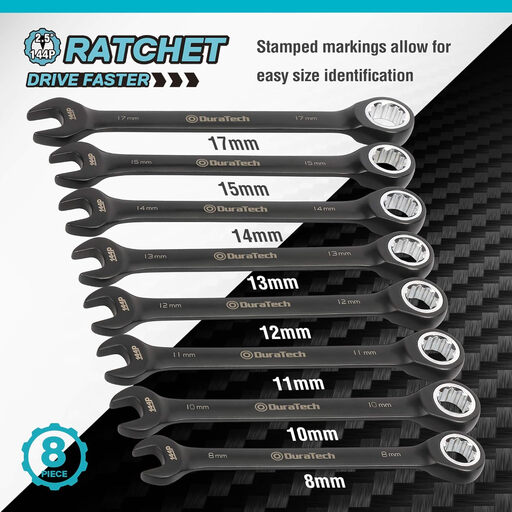
Why This Fits Their Persona: When every degree of movement counts, this set is a problem-solver. It's designed for mechanics and technicians who frequently work on modern, compact machinery where access is extremely limited.
While it has a very high tooth count, it uses a double-stacked pawl design to engage the gear, providing the necessary strength to avoid the "weak ratchet" trap despite its fine mechanism.
The 144-tooth ratchet requires only a 2.5-degree swing arc, allowing work in the most restrictive spaces. The black chrome finish offers superior corrosion resistance and a secure grip.
We have compiled a complete, real-time list of products that fully satisfy these strict selection criteria and UK safety regulations.
A 72-tooth ratchet requires a 5-degree arc of movement to engage the next tooth, which is a versatile standard for most jobs. A 144-tooth ratchet only needs a 2.5-degree arc, making it much more effective in extremely tight spaces where you can barely move the handle. The trade-off is that the finer teeth and pawls in a 144-tooth mechanism must be very well-engineered to handle high torque without failing.
Chrome vanadium (Cr-V) is an excellent base material due to its strength and hardness, but it's not an automatic guarantee of quality. The manufacturing process, specifically drop-forging and heat treatment, is what truly determines the tool's durability. A well-made tool from another alloy steel can outperform a poorly made Cr-V spanner. Always look for "heat-treated" and "drop-forged" in the product description.
For most modern cars in the UK, a core set of metric sizes will cover the majority of routine maintenance tasks. The most frequently used sizes are typically 8mm, 10mm, 12mm, 13mm, 14mm, 15mm, 17mm and 19mm. A set that includes all of these will be a very capable starting point for oil changes, brake jobs and other common repairs.