
24/7 Customer Support

Free returns

Same-day & Next-day Delivery

Quality Guaranteed

Unlock Your Welcome Offers: FREE Delivery | Up to 80% OFF | Free 30-day JoyPlus trial
Download the APP
A combination spanner set can cover everything from bicycle adjustments and household maintenance to vehicle repairs and workshop jobs. However, the cheapest-looking set is not always the most economical choice. Missing sizes, poor fastener contact and inconvenient storage can quickly make a tool set frustrating to use.
Before buying, watch for three common traps:
Most UK vehicles and modern equipment use metric fasteners, making a metric combination spanner set a sensible starting point for many households and mechanics. Common sizes include 8 mm to 19 mm, while broader sets may extend from 6 mm to 22 mm.
Older British, American or specialist equipment may use imperial measurements. The Silverline Combination Spanner Set 14pce covers 1/4" to 1-1/4", which is useful when your work involves imperial fasteners.
Do not assume that a metric and imperial set are interchangeable. A nearly fitting spanner can slip, damage the fastener and increase the risk of hand injury. Check the fastener markings or the equipment manual before ordering.
Chrome vanadium steel spanners are widely used for general mechanical work because they combine a strong alloy with a practical balance of weight and durability. Look for wording such as drop-forged, hardened and tempered or heat-treated. These terms describe manufacturing processes rather than decorative marketing features.
A chrome or mirror-polished finish can help resist corrosion and make grease easier to wipe away. A matte finish may show less dirt during workshop use. Neither finish alone confirms the tool’s working strength, so prioritise the stated material and construction.
For routine tightening and loosening, the ring end should sit squarely on the fastener. A 12-point ring spanner set engages more easily when access is awkward, while a six-point design may be preferable where maximum contact with a heavily loaded fastener is the priority.
A conventional open-ended combination spanner set offers a simple open jaw on one side and a ring end on the other. It is suitable for many maintenance tasks and does not contain a ratchet mechanism that could collect grit or require replacement.
A ratchet spanner set can speed up repetitive work because the tool does not need to be removed after each small turn. For tight spaces, check the swing arc. For example, the DURATECH ratcheting set listed below uses a 72-tooth mechanism with a stated 5° swing arc.
Flex-head ratchet spanners add an adjustable head angle, which can help when access is obstructed. A stubby spanner set has a shorter handle for confined areas, although the reduced leverage means it may be less suitable for stubborn fasteners.
Storage also matters. A spanner set with storage pouch keeps sizes together in a vehicle, tool cabinet or work bag. Check that the pouch labels each size and holds the tools securely rather than allowing them to slide out during transport.
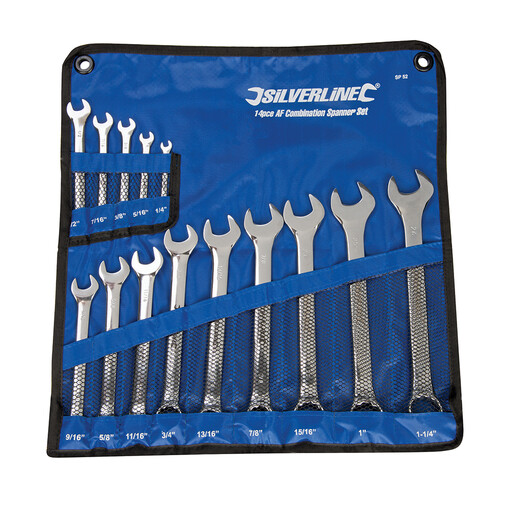
Why This Fits Their Persona: A straightforward option for UK DIY users who need imperial coverage for occasional repairs, furniture maintenance or older equipment.
The stated 1/4" to 1-1/4" range makes the measurement system clear, while the storage roll helps prevent misplaced tools.
Drop-forged chrome vanadium steel; 14-piece range; 15° offset ring ends; ballistic nylon storage roll.
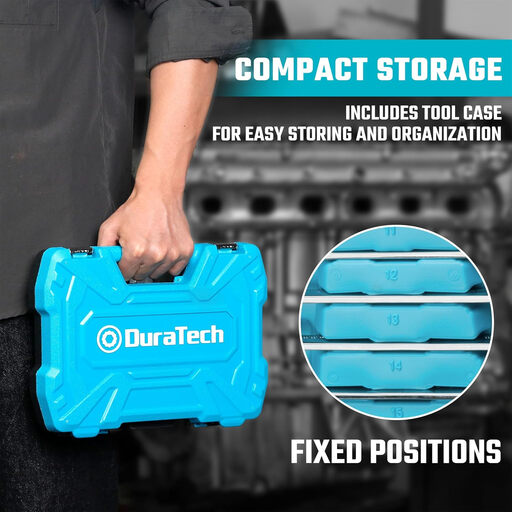
Why This Fits Their Persona: Suited to mechanics and tradespeople who regularly work around brackets, engine bays and other restricted access points.
The 180-degree flex head and stated 5° working swing arc address access limitations more directly than a fixed-head set.
8–19 mm metric coverage; 72-tooth ratchet; chrome vanadium steel; roll-up pouch with printed sizes.
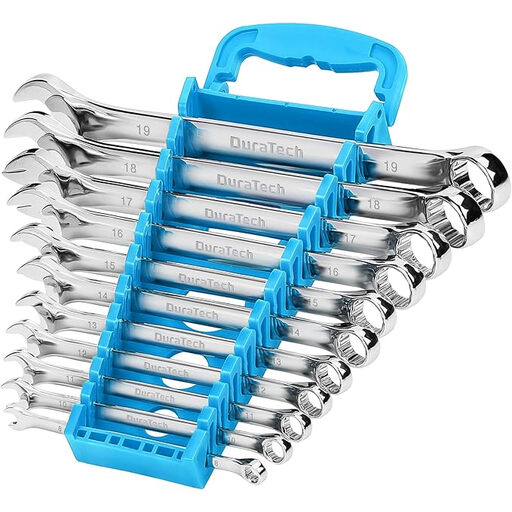
Why This Fits Their Persona: A practical fit for vehicle owners, maintenance workers and DIY users who want wider metric coverage without a ratchet mechanism.
The listed sizes and DIN 3113 compliance provide clearer specification information than relying on piece count alone.
6–22 mm metric range; 15° offset ring end; 12-point box end; labelled organiser pouch.
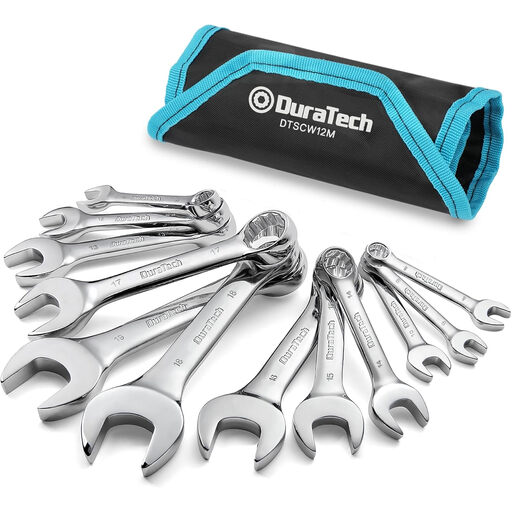
Why This Fits Their Persona: Suitable for compact car tool kits, motorcycle maintenance and fasteners positioned where a full-length handle cannot be turned.
The shorter beam is designed specifically for confined spaces, rather than presenting a standard-length tool as universally suitable.
8–19 mm metric coverage; 12-point ring end; 15° offset; roll-up carry pouch.
Choose the correct size and make sure the ring or open end is fully seated before applying force. Avoid using a spanner as a hammer, extension bar or substitute for a torque wrench. Where a specified torque setting applies, use a suitable calibrated torque tool.
Wear eye protection when working beneath vehicles or around debris. Keep tools clean and dry, inspect for cracks or deformation, and store them in their pouch or roll after use. Replace any spanner showing damage rather than continuing to use it.
Many modern vehicles use metric fasteners, so a set covering common sizes such as 8–19 mm can be useful. It is not universal: some vehicles or accessories may use imperial, Torx or specialist fasteners. Check the vehicle documentation and the individual fastener before purchasing.
They can save time on repetitive fasteners and are useful where the handle has limited movement. They are not automatically suitable for every job. A conventional spanner may offer simpler maintenance and a more direct feel, while ratchet mechanisms should be kept free from excessive dirt and used within the manufacturer’s limits.
Service life depends on load, frequency, storage and correct sizing. Chrome vanadium construction, heat treatment and sensible use can support long-term ownership, but no hand tool is immune to bending or damage from incorrect leverage. Dry storage, regular inspection and using a torque wrench where required will help protect the set.