
24/7 Customer Support

Free returns

Same-day & Next-day Delivery

Quality Guaranteed

Unlock Your Welcome Offers: FREE Delivery | Up to 80% OFF | Free 30-day JoyPlus trial
Download the APP
Buying a combination spanner set can look straightforward until the first awkward repair. A set may contain many pieces but still miss the sizes you use most, while a polished finish can create an impression of quality without telling you how the tool will perform in a cramped engine bay.
For UK DIY enthusiasts, vehicle owners, tradespeople and workshop users, the practical choice depends on fastener sizes, available working space, material, storage and the type of torque required. The following guide highlights common buying traps and compares suitable options for different working habits.
A large piece count does not automatically mean better coverage. Some sets include duplicate sizes, unusual increments or a mixture of metric and imperial measurements that may not suit your vehicle or machinery.
For most modern UK cars, bicycles, household fittings and general maintenance, a metric combination spanner set covering commonly used sizes such as 8–19 mm is a practical starting point. Larger fasteners may require sizes up to 22 mm or beyond. If you work on older machinery, imported equipment or American-standard fittings, an imperial range may be more appropriate.
A ratchet spanner set can reduce the need to remove and reposition the tool after every turn. However, the ratchet mechanism still needs room to operate. A conventional fixed-head design may be unsuitable where the working swing is restricted.
Check the stated swing arc. A 72-tooth mechanism generally requires a smaller movement than a coarse-tooth design, while a 144-tooth ratchet may be designed for particularly narrow access. Flexible heads can improve positioning, but they may also move under force if not held securely.
Mirror polishing or black chrome plating can help with cleaning and corrosion resistance, but the finish alone does not establish durability. Look for drop-forged chrome vanadium steel, heat treatment and clear size markings. Also check whether the product is intended for hand use rather than impact applications. Combination spanners should not be struck with a hammer unless the manufacturer specifically permits it.
Review the complete size list rather than relying on “12-piece” or “14-piece” wording. A 12-piece spanner set covering 8–19 mm gives a continuous run of common metric sizes. Another 12-piece set may cover 6–22 mm but omit some intermediate sizes.
For mixed workshop use, a 14-piece set from 1/4 to 1-1/4 inches may be more useful than a metric-only set. The correct choice depends on the fasteners you regularly encounter.
An open-ended and ring spanner set combines two functions in one tool. The open end is convenient for quick access, while the ring end generally offers more contact around the fastener.
A 12-point ring end can engage a fastener at more positions than a six-point design, which is useful where access is restricted. A 15-degree offset can provide finger clearance and help avoid nearby obstructions. It does not compensate for using the wrong size, excessive force or a badly damaged fastener.
Chrome vanadium steel spanners are commonly drop-forged and heat-treated for strength. Chrome plating or another protective finish can make cleaning easier and help limit surface corrosion, but tools should still be wiped dry and stored away from damp conditions.
Clear markings on both sides of the handle reduce selection time, especially in a dim garage or busy workshop. A spanner set with storage pouch or roll also helps prevent pieces being misplaced in a vehicle boot, toolbox or site bag.
For final tightening, use the correct torque procedure specified for the vehicle or equipment. A spanner is not a substitute for a calibrated torque wrench where a precise torque setting is required.
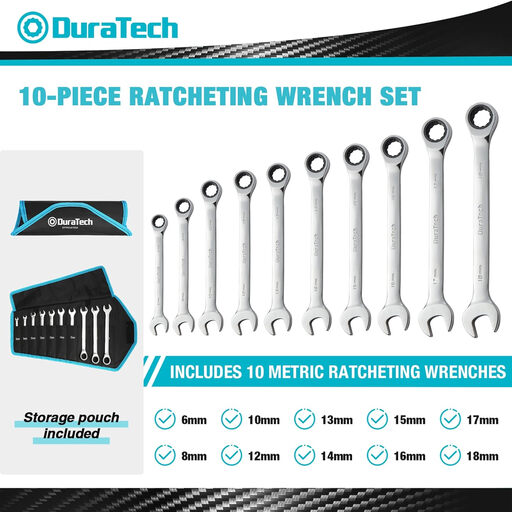
Why This Fits Their Persona: A compact option for home garages, occasional servicing and beginner DIY mechanic tools, with commonly used metric sizes and a roll-up pouch.
The listed 6–18 mm range makes coverage easier to assess, while 72-tooth ratcheting reduces repeated repositioning during suitable jobs.
Chrome vanadium steel, 12-point ring ends, size markings on both sides and a storage pouch.
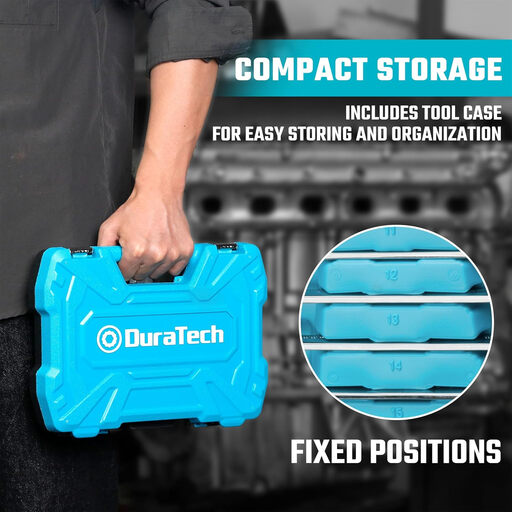
Why This Fits Their Persona: Suitable for users who value access and quick operation in automotive repairs, workshop maintenance and recurring mechanical tasks.
The stated 180-degree flexible head and 5-degree working swing arc address limited access more directly than a fixed-head design.
Drop-forged chrome vanadium steel, 72-tooth ratchet gears, 12 metric sizes and a protective storage case.
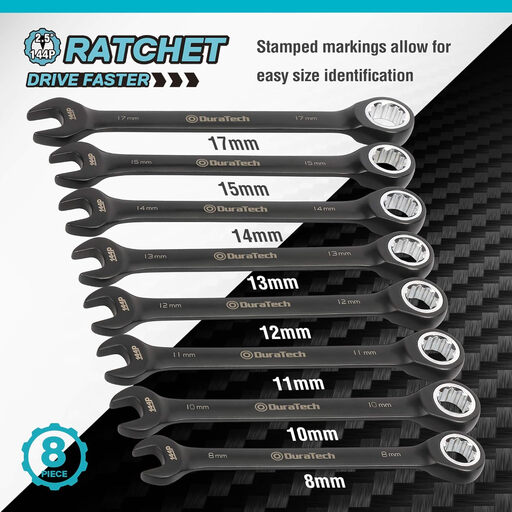
Why This Fits Their Persona: Designed for vehicle repair, machinery and household maintenance where very small movements are useful.
Its stated 2.5-degree working swing arc is relevant to restricted spaces, rather than relying only on general “slim” wording.
144-tooth ratchet mechanism, black chrome finish, eight metric sizes and an organiser pouch.
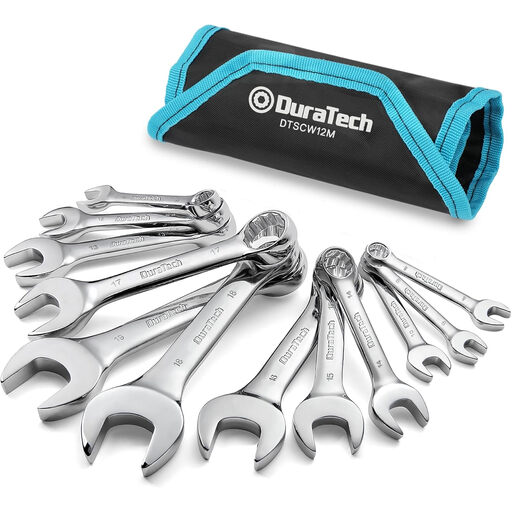
Why This Fits Their Persona: A practical choice for vehicle owners and DIY users working around crowded engine bays, brackets or shallow compartments.
The short-beam design is specified for restricted access, while the 15-degree offset creates additional clearance around the fastener.
Heat-treated chrome vanadium steel, 12-point ring ends, dual-sided markings and a roll-up carry pouch.
Many modern vehicles use metric fasteners, so an 8–19 mm set covers a range of commonly encountered sizes. However, the exact requirements vary by vehicle, manufacturer and component. Check the vehicle manual or existing fastener before buying, particularly if you maintain older or imported vehicles.
They can be useful when access is restricted and the specified swing arc is small. A flexible head also allows the handle to be positioned away from nearby components. For straightforward bench work, a fixed-head combination spanner may provide all the access required and can be simpler to control under load.
Service life depends on force, storage, corrosion, fastener condition and whether the tool is used correctly. Drop-forged, heat-treated steel with a protective finish can provide long-term workshop use, but no spanner is maintenance-free. Keep it dry, avoid impact misuse and replace any tool showing cracks, distortion or damaged ratchet movement.