People reheating one potato at a time
If reheating a previously cooked potato is the main job, focus on usable microwave controls, space for your everyday plate and straightforward cleaning rather than functions intended for larger meals.


For one previously cooked baked potato, choose a combination microwave with controls you will use for reheating and a grill or convection mode if you want to brown the skin afterwards. Check that your usual plate fits and that the appliance fits your worktop; an air-fry or inverter model makes more sense if you will regularly use its additional functions, not solely for this reheat.
If reheating a previously cooked potato is the main job, focus on usable microwave controls, space for your everyday plate and straightforward cleaning rather than functions intended for larger meals.
If microwave reheating leaves the skin softer than you would like, look for a grill or convection finishing mode. Which? describes these as functions that allow combination microwaves to brown and crisp food; the result still depends on the dish and how the mode is used.
If the microwave will also handle baking, grilling or air frying, compare the functions you will use with the appliance’s external dimensions. Capacity alone will not tell you whether it fits your worktop.
For a leftover baked potato, decide whether your main priority is heating the centre, finishing the skin, fitting the appliance into your kitchen or using it for other cooking tasks. The Food Standards Agency advises reheating food thoroughly until it is hot through the centre.
| Concern | What to check | Who this matters to |
|---|---|---|
| Heat the centre | Check microwave controls and power levels; follow the exact model’s reheating instructions rather than transferring timings between appliances. | I mainly want a previously cooked potato hot through the middle before considering its skin. Around 40% of consumers would put thorough reheating first. |
| Brown the skin | Confirm the exact grill or convection modes and the instructions for any rack or tray you plan to use. | If a soft skin spoils the leftover for me, I want a finishing step after reheating, even if it takes longer. Roughly 30% of consumers would make that crisping step their primary concern. |
| Fit the kitchen and plate | Compare external dimensions and manual-specified ventilation clearance with your worktop, and turntable diameter with your plate base. | My worktop is limited, and I need the plate I normally use to fit without choosing capacity I will rarely need. For about 20% of consumers, practical fit would come first. |
| Cook beyond potatoes | Identify the additional modes you will actually use and check any accessory or connected-control requirements. | If this appliance will also take on regular baking, grilling or air-frying tasks, those functions matter more to me than a simple reheat alone. Around 10% of consumers would prioritise wider cooking use. |
Microwave output is relevant to reheating, while grill or convection modes provide the option to brown the exterior. A wattage figure alone does not establish the skin texture you will get.
Check the exact cooking modes and their instructions; consider air frying if it is a function you expect to use regularly.
A litre rating does not show whether your plate fits or how much worktop the appliance occupies. Russell Hobbs lists one 25 L model, the RHM2574, as 51.3 cm wide and 49.8 cm deep.
Measure your plate base and intended location, then check the chosen model’s turntable, external dimensions and ventilation requirements.
Panasonic’s statements about inverter reheating and air-fry crisping concern its NN-CT54RW model. They do not establish the result for every potato or every combination microwave.
Use the claims to identify functions worth investigating, then check the exact manual and independent testing where available.
The Food Standards Agency advises that reheating means cooking food again, not merely warming its surface.
Follow the appliance’s instructions, allow any required standing time and check that the potato is hot through the centre.
Relevant if you want to compare inverter, grill, convection and air-fry functions on an exact model.
Relevant when the appliance will handle more than reheating, with functions varying between models.
Relevant if you want a microwave, grill and fan-assisted convection format.
Relevant if you want to compare a 25 L microwave, grill and fan-assisted-oven combination.
These combination microwaves offer different ways to approach one-potato reheating, including models named with convection or air-fry functions. Choose a finishing mode only after checking the exact model’s instructions, plate fit and worktop requirements.
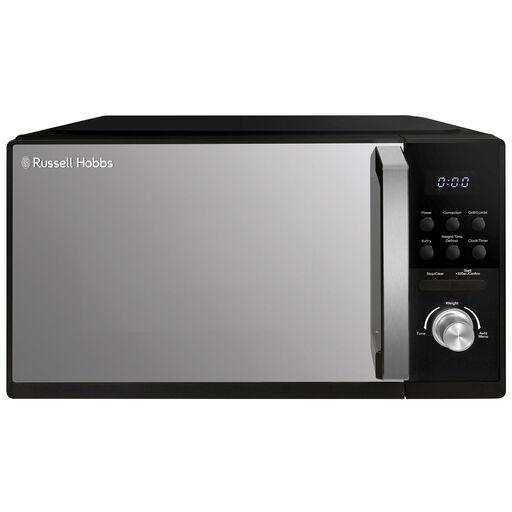 No image available
For a one-potato routine, check which of this model’s cooking modes you would use for reheating and finishing. It is a 25 L digital combination model; compare your usual plate and available worktop space with the exact measurements before ordering.
 No image available
Consider this model if you want an air-fry option alongside microwave reheating. Its product name lists 900 W microwave power and a 1,000 W grill; check its instructions for the finishing mode and confirm plate and worktop fit.
 No image available
If you will also use convection cooking, this model names that function alongside a 900 W microwave. For reheating a single potato, confirm that your plate fits and that the appliance’s dimensions suit your counter.
 No image available
This model is worth considering if an air-fry option would be useful after microwave reheating. Confirm the exact manual’s cooking modes before relying on a separate grill or convection setting, and measure for plate fit and counter clearance.
No, not if you only need to reheat it; a solo microwave can do that job. Choose a combination microwave if you also want access to grill or convection modes to brown the skin afterwards, and check the exact model’s instructions for using them.
It should be reheated thoroughly until hot through the centre, not merely warm outside. The Food Standards Agency advises that reheating means cooking food again; follow your appliance’s instructions and check the centre before eating.
Compare the diameter of your plate’s base with the exact model’s turntable diameter, then check the appliance’s external dimensions against your worktop. As model-specific examples, a 28.8 cm turntable is listed for the Kenwood K25CM26, while Panasonic lists 34 cm for the NN-CT54RW; capacity in litres cannot replace those measurements.
No; consider those functions if you will use them for other meals or regularly want an additional finishing option. For example, Samsung says the connected features on its MC32DG7646CKE3 have Wi-Fi, account and app requirements, so check those conditions if connected control matters to you.