Presenter prioritising clear speech
If a visible microphone is acceptable, you can hold one or speak into one on a stand to keep it close. Shure’s placement guidance makes distance particularly relevant in a reflective room.


Start with a close wired cardioid dynamic microphone if the presenter can hold it or use a stand: Shure explains that a microphone cannot fully separate speech from a hall’s reflections once both reach it. Choose a wireless lavalier when the presenter needs to be hands-free, or a boom-mounted shotgun when it can stay close and out of shot; either choice brings additional setup and connection checks.
If a visible microphone is acceptable, you can hold one or speak into one on a stand to keep it close. Shure’s placement guidance makes distance particularly relevant in a reflective room.
If you need to gesture or move without holding a microphone, a worn lavalier is worth considering. Plan its placement and, for a wireless system, how you will power and monitor the recording.
If the microphone must stay out of frame, a boom may let you position it close to the speaker. RØDE cautions that a shotgun microphone does not make distant audio sound close.
Choose when: The presenter can hold a microphone or use a stand, keeping it near their mouth in the reflective hall.
Trade-off: The microphone remains visible and needs a compatible wired recording connection; test close placement to avoid an unwanted increase in bass.
Choose when: The presenter needs their hands free, particularly if two speakers each need a microphone.
Trade-off: Wireless recording adds charging, monitoring and possible radio interference; a lavalier does not remove hall reverberation.
Choose when: A boom operator or fixed mount can keep the microphone close to the presenter but outside the frame.
Trade-off: It needs accurate positioning and suitable mounting, cabling and power; directionality cannot compensate for recording from across the hall.
| Concern | What to check | Who this matters to |
|---|---|---|
| Speech and room echo | Can the microphone stay close to the speaker? For a wired choice, check the recorder input. | When I need speech to stand out in a reflective hall, I can accept a visible microphone to keep it close; around 42% of consumers put close speech capture first. |
| Hands-free recording | Check the number of microphones and transmitters needed, the recording-device connection and a way to monitor audio. | If I need to gesture on camera or record two speakers separately, I want to do so without holding a microphone; around 33% of consumers make hands-free capture their primary need. |
| Microphone out of shot | Check whether a boom can stay close without entering the frame, and confirm mounting, cable and power requirements. | For a clean video frame, I can arrange a nearby boom rather than leave a microphone on a distant camera; roughly 25% of consumers prioritise out-of-frame capture. |
Shure explains that reflected speech cannot be fully separated from direct speech once both reach the microphone. RØDE also cautions that a shotgun microphone does not “zoom” audio.
Work out where the microphone can go before choosing one. If a shotgun cannot be boomed close, consider a worn lavalier or accept a visible handheld or stand-mounted microphone.
Close boom placement may require a pole, mount, cable or someone to position it.
Ofcom notes that licence-exempt radio bands are shared with other equipment, so interference remains possible. A wireless setup also depends on charged, correctly configured components.
Check the exact system’s operating band and applicable UK requirements. Charge and test it at the venue, monitor the audio where possible and use on-board recording if the chosen system provides it.
Connections and powering differ by model: Sennheiser says its MKE 600 can use phantom power or an AA battery, while wireless kits have their own receiver-output requirements.
Identify your camera or recorder input, required cable or adapter, available power and mounting arrangement before buying.
The chosen setup may also call for an interface, batteries or mounting hardware.
The SM58 is an example of a wired cardioid dynamic microphone for close speech.
Wireless PRO illustrates a two-transmitter lavalier setup; RØDE also provides placement guidance for shotgun microphones.
The MKE 600 is a wired shotgun microphone relevant to a close boom-mounted setup.
These lapel microphones relate to the hands-free introduction route. For either one, check the actual connection method and recording-device compatibility before choosing it for the hall; they are not substitutes for the close wired or boom-mounted setups discussed above.
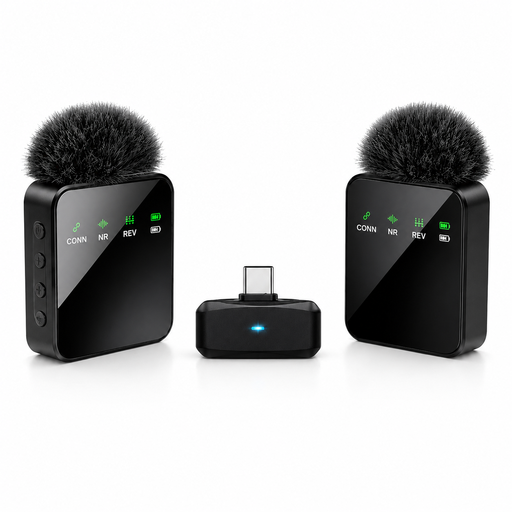 No image available
The lapel format is relevant if the presenter needs their hands free. The title specifies dual-mic and Type-C; confirm what is included, whether the connection is wireless and whether it works with your recording device.
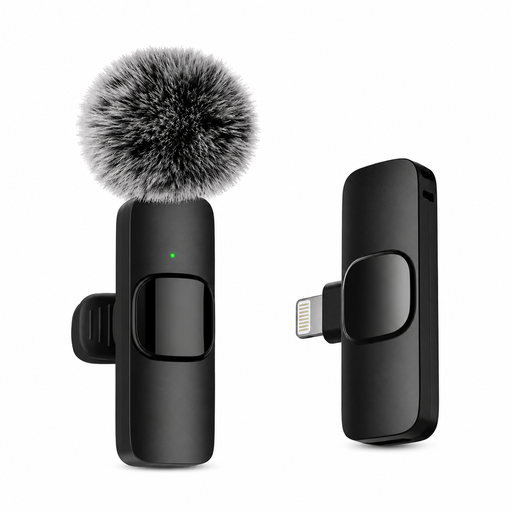 No image available
This single-mic lavalier format suits a presenter who wants to speak without holding a microphone. Confirm how it connects, whether a receiver is included and whether the listed iOS interface works with your specific recording device.
Use a microphone close to the speaker; a wired cardioid dynamic model is a straightforward starting point if it can be held or stand-mounted. Shure explains that a microphone cannot fully separate direct speech from the hall’s reflected speech after both reach it.
Not if the speaker is far from the camera and clear speech is the priority. RØDE cautions that a shotgun does not “zoom” audio; use a boom or another suitable mount to bring it close while keeping it out of shot.
That depends on its operating frequency and use. Ofcom lists 173.8–175 MHz, 863–865 MHz and 2400–2483.5 MHz as licence-exempt ranges subject to applicable requirements; the bands are shared, so check the exact system and expect possible interference. Other frequency arrangements may require a licence or coordination.
Check the documentation for the exact product variant and its intended destination. The UK Office for Product Safety and Standards describes the Radio Equipment Regulations 2017 for Great Britain as covering radio-equipment safety, electromagnetic compatibility and protection of the radio spectrum; provisions for Northern Ireland can differ.