Relevant microphone brands
These brands illustrate different recording routes, not a ranking of their ranges. Check the requirements of the particular model and variant you intend to use.
Shure
Its MV7X and SM7dB are relevant to close spoken-word recording when a visible microphone is acceptable.
- Shure describes the MV7X as an XLR dynamic microphone for spoken word, with rear rejection and a shock mount.
- The narrator still needs to work close to the microphone. The SM7dB’s internal preamp requires +48 V phantom power when active.
Deity
The S-Mic 2S offers a short, boom-oriented option for indoor narration or interviews that must be recorded out of frame.
- Deity describes the S-Mic 2S as an indoor-oriented short shotgun with a supercardioid pattern and XLR output.
- It specifies 24 V or 48 V operation, and its indoor positioning does not remove the need for close boom placement in a reflective hall.
RØDE
Wireless PRO is relevant when a moving narrator needs a body-worn microphone and a local recording option.
- RØDE lists two lavaliers, 2.4 GHz transmission, 32-bit float recording on the transmitters and timecode capability.
- Local recording does not prevent clothing noise or radio interference; mounting, monitoring and applicable UK radio-use conditions still need attention.
Sennheiser
EW-DP is a portable digital UHF route for crews planning a wireless filmmaking workflow.
- Sennheiser positions EW-DP as a camera-oriented digital UHF microphone system.
- Check the exact frequency variant, applicable UK use conditions and frequencies in use at the filming location before choosing a system.
Joybuy options for seated and moving narrators
These two options address different setups: a boom-arm microphone kit for narration near a fixed position, and a wireless kit with two transmitters for recording a moving speaker. Check the connections, placement and venue requirements against your recording plan.
 No image available
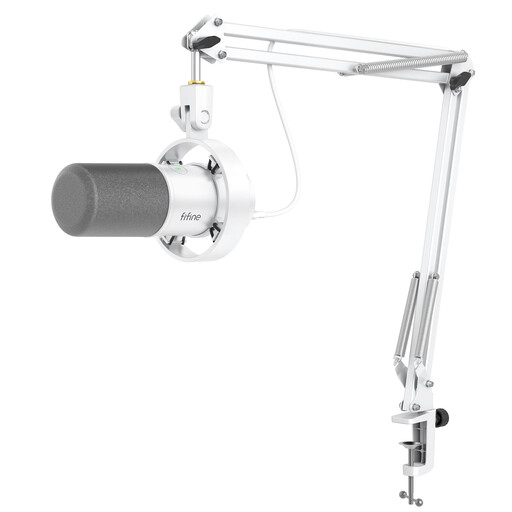
FIFINE K688CTW White dynamic microphone kit with boom arm
Consider this kit if the narrator can stay near a microphone positioned on a boom arm. Its title specifies a dynamic microphone with XLR and USB ports and a headphone jack. Check the connection and cable needed for your recorder or interface, and keep the microphone close rather than relying on its pickup pattern to remove hall reflections.
View on Joybuy
 No image available
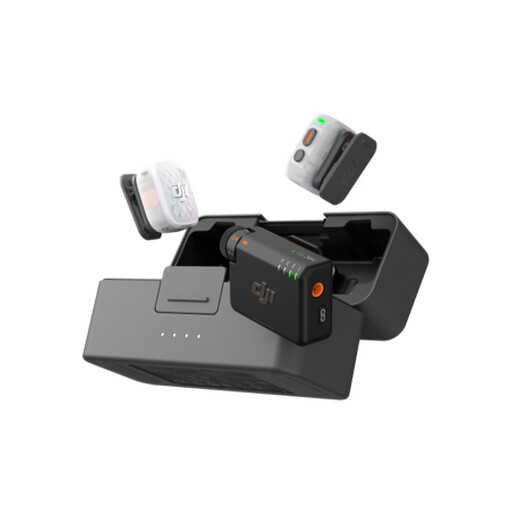
DJI Mic Mini 2S (2 TX + 1 RX + Charging Case)
Consider this wireless kit when the narrator needs to move during filming. The named bundle has two transmitters, one receiver and a charging case. Confirm how the receiver connects to your recording device, the kit’s exact radio band and UK variant, and how you will monitor the recording at the venue.
View on Joybuy
Questions about hall narration microphones
Will a shotgun microphone remove echo in a community hall?
No. Shure’s placement guidance explains that a microphone cannot separate reflected speech from direct speech once both reach it, while Sound On Sound cautions that shotgun microphones have limitations in highly reverberant rooms. Keep the microphone close to the narrator, whether it is on a boom or a visible stand.
When should I choose a close dynamic microphone rather than a boom?
Choose a close dynamic microphone when the narrator can maintain a short speaking distance and a visible microphone is acceptable. If the shot must remain clear, a boom-mounted microphone is an alternative only if it can still be positioned close to the speaker.
Does a narration microphone need phantom power?
Check the exact model and how you intend to use it. Shure says the SM7dB needs +48 V phantom power when its internal preamp is active, while Deity specifies 24 V or 48 V operation for the S-Mic 2S. Confirm that your recorder or interface supplies what your chosen microphone requires.
Can I use a wireless microphone licence-free in the UK?
You can use a system licence-free only if the exact equipment and use meet Ofcom’s conditions for an applicable licence-exempt band. Ofcom identifies 173.8–175 MHz, 863–865 MHz and 2400–2483.5 MHz as licence-exempt ranges subject to requirements; these shared bands can experience interference. Check the system’s frequency variant and the applicable conditions before purchase.
Is an onboard recording feature enough to protect an important wireless take?
No. Onboard recording can give you a local copy when the chosen system provides and enables it, but you still need to monitor the take and check mounting, batteries and available recording capacity. RØDE says each Wireless PRO transmitter supports internal 32-bit float recording; that feature does not establish how another wireless kit records.


