Small-kitchen batch cooks
People making several hard-boiled eggs for breakfasts, lunches or snacks who need the cooker to fit their available worktop.


Choose an egg cooker by the dry worktop space it needs and the number of hard-boiled eggs you normally make, rather than by a compact label alone. A water guide and end alert may make cooking easier to manage, but egg size and water quantity can affect results; extra trays offer more uses while taking up storage space.
People making several hard-boiled eggs for breakfasts, lunches or snacks who need the cooker to fit their available worktop.
People who would rather use a water measure and timer or ready alert than continually watch a saucepan.
People who may use poaching or omelette trays as well as the boiling rack, provided the accessories have somewhere to go afterwards.
Measure your usable dry worktop space first, then weigh your usual batch size against the controls and accessories you will actually use.
| Concern | What to check | Who this matters to |
|---|---|---|
| Worktop and storage space | Compare width, depth and height with the space available; allow room to lift the lid and put away any trays. | If my worktop is crowded, I need the cooker and its parts to fit when in use and when stored. Around 45% of consumers put space first. |
| Hard-boiled results and controls | Look for a water guide, a ready alert and the model's instructions on egg size; check whether it has automatic shut-off. | For breakfasts, I want a clear way to measure the water and know when cooking has finished. Roughly 36% of consumers prioritise this need. |
| Capacity and extra uses | Match the stated boiling capacity to your usual batch and check which poaching or omelette trays come with the exact model. | If I regularly cook several eggs or would use another cooking mode, those functions need to justify the parts I must store. About 19% of consumers place capacity and versatility first. |
The base dimensions alone may not leave room to lift the lid, manage steam or store accessories.
Measure the usable dry worktop and cupboard space against the exact model's width, depth and height.
A rack for several eggs may be unnecessary if you normally cook only one or two, particularly when additional trays also need storage.
Choose capacity around your usual batch, not the largest batch you might occasionally make.
Salter's EK6213 instructions say cooking times can vary with egg size and the water used.
Follow the water guide for your exact model and adjust only as its instructions direct.
Hot steam, a sharp egg-piercing pin and a poorly positioned lead all call for care in a tight kitchen.
Set the cooker on a stable, dry surface away from the sink, handle the lid cautiously and check that the lead reaches a suitable socket without strain.
Tower's T19023 gives buyers a specified seven-egg model to measure against a small worktop.
Salter has egg-cooker models for boiling and poaching, but their stated capacities and controls differ.
Duronic's EB35 BK is an option to assess if batch boiling and omelette accessories would both get used.
This egg cooker is a choice to assess for hard-boiled eggs in a small kitchen; check its fit and electrical compatibility for your own worktop before buying.
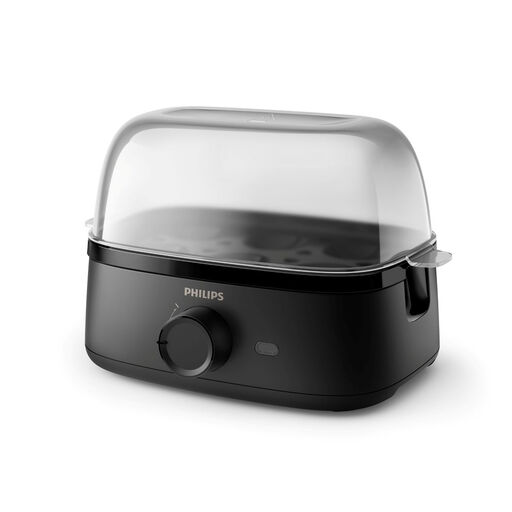 No image available
For hard-boiled eggs where worktop space is limited, measure the available dry area and check how much clearance the lid needs. Check the plug type and that the lead can reach a suitable socket before choosing it.
Measure the model's width and depth, then allow room to lift its lid and position its lead. For a concrete reference, Tower lists the T19023 at H15.5 × W16.0 × D18.0 cm; Electrical Safety First advises keeping sockets and switches a safe distance from the sink.
Not necessarily: Salter's EK6213 instructions say cooking times can vary with egg size and water quantity. Follow the water guide for your exact cooker rather than assuming one setting suits every batch.
No. Automatic shut-off does not remove the need to place the cooker safely and remain able to respond while it operates; keep it on a dry, stable surface and take care when opening a hot lid.
Food Standards Scotland says hard-boiled eggs can be kept in the fridge for up to two days. Plan your batch size around how many you expect to eat within that period.