
24/7 Customer Support

Free returns

Same-day & Next-day Delivery

Quality Guaranteed

Unlock Your Welcome Offers: FREE Delivery | Up to 80% OFF | Free 30-day JoyPlus trial
Download the APP
As a parent in the UK, you know that space is often a luxury. From the kitchen to the dining room, every square foot counts. A traditional, bulky highchair can quickly become a cumbersome obstacle, especially in a modern flat or a cosy terraced house. Finding a compact foldable highchair that is practical, safe and doesn't clash with your home's style can feel like a monumental task.
I'm Joy, your Product Recommendation Officer at Joybuy. My role is to help you navigate the market and find products that genuinely solve problems. Today, we're looking at highchairs and cutting through the marketing clutter to focus on what truly matters for families in smaller homes. Let's start by identifying the common pitfalls that lead to buyer's remorse.
To ensure you choose a highchair that works for your home and lifestyle, focus on these non-negotiable features.
The primary function of a space saving highchair is its ability to disappear when not in use. Look beyond the marketing claims and check the specifics. A true flat-fold design is ideal. Before purchasing, always verify the folded dimensions (height, width and depth). A slim profile of under 25cm is generally a good benchmark for easy storage behind a door or alongside kitchen cabinets. A lightweight highchair is also easier to move and store daily without hassle.
Mealtimes are messy. An easy to clean highchair is essential for hygiene and your sanity. Look for models with a fully removable and washable seat pad. For the tray, a two-part design where the top layer can be detached and placed in the dishwasher is a significant advantage. Smooth, non-porous plastic surfaces are preferable to textured ones where food can get trapped.
In the UK, highchairs should comply with the safety standard BS EN 14988. This ensures the product has passed stability, structural integrity and entrapment hazard tests. A 5-point safety harness is crucial for securing your child safely, preventing them from slipping or attempting to climb out. Also, check the recommended age and weight limits. A good highchair should serve you from when your baby can sit up unaided (typically a highchair from 6 months) until they are around 3 years old (or 15kg).
Based on these practical criteria, here are a couple of recommendations that match distinct needs for UK families.
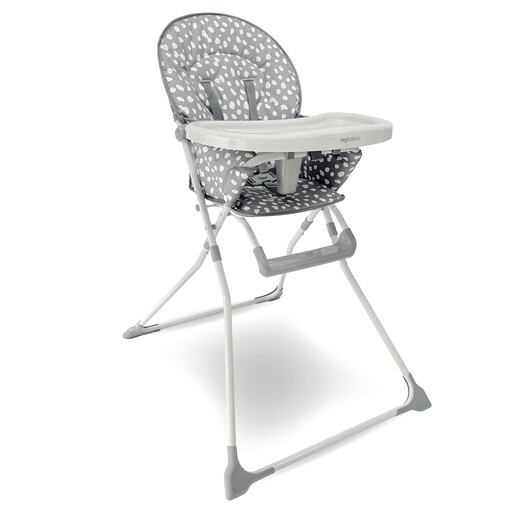
Why This Fits Their Persona: This is an excellent choice for parents in city flats or homes where every inch matters. Its ultra-lightweight frame (only 5kg) and simple fold-flat design make it genuinely easy to put away after each meal, reclaiming valuable kitchen space. The stylish Dalmatian print also adds a modern touch.
It directly counters the "difficult fold" pitfall. Its straightforward folding mechanism and light weight mean you are far more likely to actually store it away, unlike heavier, more complex models. The surfaces are designed for simple wipe-downs.
Ultra-lightweight at only 5kg for effortless handling and storage. Features a simple and quick flat-fold mechanism ideal for daily use.
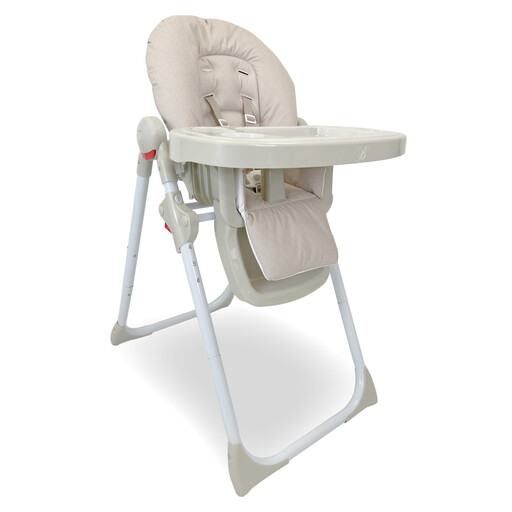
Why This Fits Their Persona: For those who want versatility without sacrificing style. This **My Babiie highchair** offers multiple height and recline settings, allowing it to adjust to your table for family meals and provide comfort after eating. It's a long-term investment that grows with your child.
This model tackles the "wipe-clean nightmare" head-on. Its two-part removable tray is dishwasher-safe and the padded seat is removable, making deep cleaning much more manageable. It also folds to a free-standing position for neat storage.
Highly adjustable with 6 height and 3 recline settings for maximum versatility. Features a two-part, dishwasher-safe tray for superior cleaning convenience.
We have compiled a complete, real-time list of products that fully satisfy these strict selection criteria and UK safety regulations.
Most highchairs are designed for use from approximately 6 months, or whenever your baby can sit up confidently on their own. It's important to always refer to the manufacturer's specific guidelines, which will state the suitable age range and a maximum weight limit, typically around 15kg (or 3 years of age).
The key is choosing a model designed for easy disassembly. After each meal, wipe down all surfaces. For a more thorough clean, regularly remove the harness straps and seat cover, washing them as per the care instructions. Crucially, ensure every component is completely dry before you reassemble the chair to prevent any moisture build-up and mould growth in crevices.
Not necessarily. A well-designed lightweight highchair that meets UK safety standards (BS EN 14988) will have been tested for stability. Safety is determined by the design, such as a wide base and secure locking mechanisms, not by weight alone. The lighter frame is a significant benefit for portability and daily storage, as long as it is used on a flat, stable surface as intended.