
24/7 Customer Support

Free returns

Same-day & Next-day Delivery

Quality Guaranteed

Unlock Your Welcome Offers: FREE Delivery | Up to 80% OFF | Free 30-day JoyPlus trial
Download the APP
Compact gaming mechanical keyboards can free valuable desk space without removing the controls you use most. However, a smaller footprint does not automatically mean better performance. UK buyers need to compare layout, switch technology, connectivity and software support carefully, particularly when choosing between a conventional mechanical model and a magnetic switch keyboard.
An 8000Hz polling rate keyboard can report input more frequently than a 1000Hz model, but this figure is only one part of the system. Your game, USB connection, computer and monitor also affect how responsive the setup feels. A high polling rate may be more relevant to competitive FPS players using high-refresh-rate displays than to office users or casual gamers.
Also check whether the keyboard actually supports the advertised rate in its required mode. Some models reach their highest polling rate only when connected by USB rather than Bluetooth or 2.4GHz wireless.
A 60% gaming keyboard saves substantial space but usually omits dedicated arrow, function and navigation keys. These may still be available through Fn shortcuts, although that can be inconvenient for programming, spreadsheets or creative software.
A 65% or 68-key keyboard normally retains arrow keys while remaining compact. A 75% mechanical keyboard adds a function row and offers a more familiar arrangement. If you use a number pad, consider a 96% mechanical keyboard, which keeps more full-size functionality in a condensed frame.
Bluetooth is convenient for tablets and office devices, but it is not always the preferred connection for fast-paced gaming. A tri-mode wireless keyboard typically offers Bluetooth, 2.4GHz wireless and USB-C wired modes, allowing you to select convenience or a direct connection.
Check battery capacity, receiver storage, charging method and whether lighting affects battery life. A large battery can be useful, but it also adds weight and does not remove the need for sensible charging and safe battery handling.
Traditional mechanical switches use physical contacts and are available in linear, tactile and clicky styles. A hot-swappable keyboard allows compatible switches to be replaced without soldering, making it practical to alter the typing feel later.
A Hall Effect gaming keyboard uses magnetic sensing instead of conventional contact-based actuation. Compatible software may allow adjustable actuation, where you choose how far a key travels before registering. A Rapid Trigger keyboard can detect the key moving back upwards and reset the input without requiring a complete release. This can suit counter-strafing and repeated inputs, but it requires careful calibration to avoid accidental key presses.
For UK users, a UK layout gaming keyboard normally uses ISO positioning, including a larger Enter key and a different left Shift arrangement. Several products in this selection use US QWERTY, so check the product listing before purchasing if physical UK legends are important.
PBT keycaps generally resist surface shine more effectively than ABS keycaps, although the result also depends on keycap thickness and usage. Cherry-profile keycaps can make replacement shopping easier, but compatibility should still be checked against the keyboard’s switch and stabiliser design.
Gasket mounts and internal foam can reduce hollow resonance and create a softer typing feel. They do not make a keyboard silent, so consider your surroundings if you share a home office or work in an open-plan space.
Useful practical features include N-key rollover, detachable USB-C cables, onboard profiles, RGB controls and a volume knob. RGB mechanical keyboard lighting is mainly an aesthetic and visibility feature; it should not outweigh layout, connection stability or switch suitability.

Why This Fits Their Persona: A practical choice for students, first-time enthusiasts and home workers who want a compact layout with wireless flexibility.
The 75% arrangement keeps arrow and function keys, avoiding the shortcut-heavy experience of many 60% boards. Tri-mode connectivity also avoids relying on Bluetooth alone.
4000mAh battery, full-key hot-swap sockets, PBT keycaps, RGB lighting and a media control knob.

Why This Fits Their Persona: Suited to competitive players and enthusiasts who prioritise adjustable magnetic control, a UK ISO layout and a refined wired setup.
Its 65% UK layout retains arrow keys, while adjustable actuation and Rapid Trigger provide more control than a fixed mechanical switch.
0.1–4.0mm adjustable actuation, 8000Hz polling, five-layer dampening and dual USB-C connectivity.
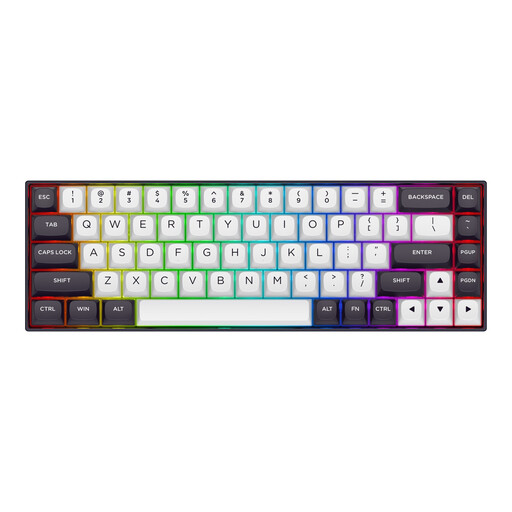
Why This Fits Their Persona: Designed for FPS players who want a compact 68-key board with wired magnetic-switch controls and rapid input adjustment.
The product specifies adjustable 0.2–4.0mm actuation and Rapid Trigger support, rather than offering only a headline polling-rate figure.
68-key layout, linear Hall Effect switches, aluminium top plate, detachable Type-C cable and RGB lighting.

Why This Fits Their Persona: A useful option for programmers, office users and gamers who need arrow keys, a number pad and multi-device wireless connections.
The 96% layout avoids the productivity compromises of smaller boards, while wired, Bluetooth and 2.4GHz modes offer flexible use.
99-key compact layout, 8000mAh battery, hot-swappable 3-pin and 5-pin support, PBT keycaps and onboard profiles.
We have compiled a complete, real-time list of products that fully satisfy these strict selection criteria and UK safety regulations.
Yes, provided the layout suits your workflow and the switch noise is acceptable. A 75% or 96% board is usually more convenient for documents and spreadsheets than a 60% model. Foam, gasket construction and linear switches may reduce perceived noise, but no mechanical keyboard should be assumed to be silent.
It can help with repeated inputs and games requiring quick directional changes, but it is not essential for general typing. If you mainly write, code or work in spreadsheets, a comfortable switch, reliable connection and suitable layout may offer more practical value.
Battery use depends on capacity, connection type, RGB brightness and lighting effects. RGB normally consumes more power than unlit operation. Connecting by USB-C removes the need to rely on the internal battery during long sessions, while Bluetooth can be convenient for lower-intensity multi-device use.