Small-desk icon creators
You need space for a mouse or pen tablet, but regularly use arrows, function keys or application shortcuts. A smaller keyboard is useful only if its key arrangement still works for those commands.


For inventory-icon work on a small desk, start with a 75% keyboard if you need dedicated arrow and function keys alongside room for a mouse or pen tablet. A 65% layout gives up the dedicated function row for a smaller footprint; consider 60% only if you are comfortable using key layers for arrows and function commands. Check the exact key arrangement against the shortcuts you use before choosing.
You need space for a mouse or pen tablet, but regularly use arrows, function keys or application shortcuts. A smaller keyboard is useful only if its key arrangement still works for those commands.
You repeat editing commands or want to assign them to different keys. Adobe documents shortcut customisation in Illustrator, while Keychron lists VIA remapping for the K3 Max; check the software and keyboard you actually plan to use.
You work in a shared room or switch between a computer and other devices. Logitech describes quiet low-profile keys and switching among three compatible devices for its Pebble Keys 2 K380s.
Choose a layout around the keys your icon software uses most often; then check whether its connection and typing style suit the rest of your desk.
Choose it when: you want dedicated arrows and a function row for mixed icon and desktop work.
Trade-off: it takes more desk width than a 65% or 60% layout and typically has no numeric keypad.
Choose it when: mouse room matters more, but you still want dedicated arrow keys.
Trade-off: function-key commands generally move to a key layer; check how the particular board handles them.
Choose it when: desk space is especially tight and layered commands already suit your workflow.
Trade-off: Logitech G’s layout guide notes that 60% boards lack dedicated arrows and a function row.
| Concern | What to check | Who this matters to |
|---|---|---|
| Space and direct key access | Check the board’s dimensions and whether arrows and function keys have dedicated positions. | I need room to move a mouse or use a pen tablet, but reaching editing keys through layers would interrupt my work; around 46% of consumers put direct key access first. |
| Shortcut customisation | Check remapping support for the exact keyboard and whether it works with your operating system and application shortcuts. | Repeated commands are easier for me to manage when I can place them on keys that suit my workflow; roughly 36% of consumers prioritise customisation. |
| Quiet use and device switching | Check the available connections, compatible devices and whether the key action suits a shared room. | I share a workspace or move between a computer and another device, so noise and switching matter more to me; about 18% of consumers put those needs first. |
A 60% board has no dedicated arrows or function row, according to Logitech G’s layout guide. Commands that rely on those keys may require more layered key presses.
Note the navigation and shortcuts you use in your icon software. If direct arrows or function keys matter, compare the exact 65% and 75% key arrangements before ordering.
Compact keyboards can be offered in different layouts, including UK-ISO and US QWERTY. The retailer’s location does not identify the selected variant.
Read the variant name and inspect the key-layout photographs if familiar UK key placement matters to you.
Adapting to unfamiliar key positions can take time.
A narrower board alone does not determine where your mouse, screen or arms sit. The Health and Safety Executive advises keeping the screen and keyboard central, with the mouse close and in line with the elbow.
Check the whole desk arrangement, including keyboard height and mouse position, rather than choosing by width alone.
Its compact range includes low-profile keyboards aimed at desktop work and device switching.
Its K3 Max range is relevant if you want a compact mechanical keyboard with a UK-ISO option and configurable keys.
Its Huntsman V3 HE Magnetic Mini is a compact, gaming-oriented option with a UK-layout variant.
These 75% and 65% options address different small-desk priorities. Compare their exact layouts and shortcut access rather than treating the layout label alone as a guarantee of the keys you need.
 No image available
Consider this 75% option if you want a compact wireless board for a desk shared with a mouse or pen tablet.
The product name identifies a wireless keyboard and a UK variant. Confirm the exact key layout, dimensions and access to your application shortcuts before buying.
 No image available
Consider its 65% format when desk width is tight and you are willing to check how function-key shortcuts work.
The product name specifies an analog gaming keyboard and UK layout. Confirm the precise key arrangement and operating-system compatibility for your setup.
 No image available
This 75% option is worth checking if switching between devices matters alongside a compact desk setup.
The product name specifies 78 keys, 2.4 GHz and Bluetooth connections, and support for four devices. It specifies a US QWERTY layout; check whether that layout, the physical dimensions and the exact arrow and function-key positions suit you.
 No image available
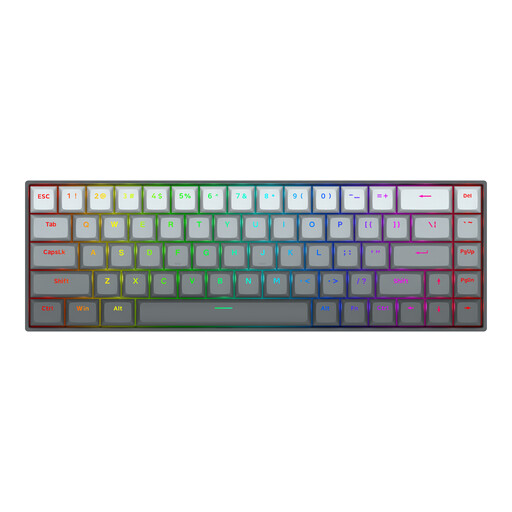
Consider this compact board if mouse space matters more than a dedicated function row, subject to checking the keys used by your icon software.
The product name specifies 68 keys, magnetic switches and a US layout. Its gaming features do not establish an advantage for icon work; confirm arrow-key and function-command access before choosing it.
Choose 75% if dedicated arrows and a function row matter to your workflow; choose 65% if you need more mouse room but still want arrows. A 60% layout makes the most sense when you are comfortable using layered commands for both arrows and function keys.
Choose UK-ISO if you want to keep the key placement you already use on a UK-ISO board. A UK retailer may also list US or other variants, so check the selected layout and photographs rather than relying on the shop’s location.
Keep the keyboard central to the screen and the mouse close to your body. The Health and Safety Executive also advises positioning the keyboard just below elbow height and the mouse in line with the elbow; a narrower board does not replace those setup checks.
Check the selected key layout, switches, connection method and the seller’s applicable return and warranty terms. In particular, confirm how those terms apply to the variant you choose rather than assuming another listing has the same conditions.
Check whether a suitable electronics recycling or take-back route is available through your local authority or retailer. GOV.UK explains that UK waste electrical and electronic equipment rules are intended to reduce electrical waste sent to landfill.