Who needs which controls?
The right compact layout depends less on the word “compact” than on which editing actions you need to perform without interrupting your typing.
Shortcut-heavy parallel-text editors
If you repeatedly apply styles, add comments or move between passages, check access to function and navigation keys before giving up more keyboard space. Remapping may be useful when you have repeatable commands and are willing to configure them.
Small-desk document workers
If the keyboard competes with a mouse and printed pages for space, a compact layout can make the arrangement easier to plan. Check the board’s dimensions and key feel as well as its layout name, particularly if you type for long stretches.
Multi-device proofreaders
If you compare text on a desktop, laptop or tablet, a keyboard that switches between paired devices may save you from changing keyboards. Confirm that the particular model supports your devices and that its switching controls suit the way you work.
What to check when choosing
Decide which requirement would change your purchase: direct access to editing keys, the feel of sustained typing, or control of more than one device. Then check the exact layout and variant rather than relying on the keyboard’s size label alone.
| Concern |
What to check |
Who this matters to |
| Editing keys in a compact layout |
Inspect the exact model for a function row, arrows and convenient navigation keys; check whether familiar UK key placement matters for your shortcuts. |
If I use function keys and arrows throughout a formatting session, reaching those controls matters more than saving the last bit of desk space. Roughly 37% of consumers put access to editing keys first. |
| Typing feel and workspace fit |
Check the physical dimensions and the selected key or switch variant. If noise matters, assess that variant rather than assuming every mechanical keyboard sounds alike. |
For long sessions beside a mouse and documents, I want a board that fits the desk and feels comfortable to type on. Around 36% of consumers make typing feel and workspace fit their primary concern. |
| Device switching and customisation |
Confirm pairing capacity and operating-system compatibility; if you need remapping, check the required software and setup connection. |
When my texts are on different devices, changing keyboard control easily matters most; repeatable commands may also be worth configuring. Approximately 27% of consumers prioritise device switching or customisation. |
Relevant brands to consider
These examples show different keyboard approaches, not a judgement about every model a brand makes. Compare the exact layout, variant and setup requirements before applying a brand-level description to a product.
Keychron
Keychron’s K3 Max is a low-profile 75% option to examine if you want UK-ISO availability and configurable shortcuts in a compact layout.
- Keychron specifies wired, 2.4 GHz and Bluetooth connections, QMK/VIA remapping and Bluetooth pairing for up to three devices on the K3 Max.
- Check availability for the precise UK-ISO switch variant you want. Keychron says VIA configuration requires a wired connection, and the compact layout has no integrated numeric keypad.
Logitech
Logitech’s compact MX models are relevant if you want a productivity-oriented layout or a choice between non-mechanical and low-profile mechanical keys.
- Logitech describes the MX Keys Mini as a compact keyboard with programmable keys and illumination; the MX Mechanical Mini offers low-profile mechanical switch variants and switching among up to three devices.
- Neither compact MX model has the integrated numeric keypad of its full-size counterpart. If you enter numbers frequently, consider whether a separate keypad or a larger layout would suit your desk.
HP
The HP 960 is a different route for someone who wants a separate, movable number pad rather than the smallest keyboard body.
- The Joybuy listing describes a split keyboard with a repositionable wireless numeric keypad, programmable keys and pairing for up to three devices.
- Its split layout and wrist rest may need more desk depth than a slim compact board. Check its dimensions and key layout against the space available for your documents.
Compact keyboard options on Joybuy
These keyboards offer compact layouts for desk-based typing and editing, with different key layouts and connection options. For parallel-text work, compare the exact keys, language layout and customisation you need; a 75% label alone does not settle those questions.
 No image available
HyperX Alloy Rise 75 Wireless Keyboard UK
Consider this 75% wireless model if you want a compact editing setup and the UK-labelled version is important to you.
Check the selected variant’s key legends and the placement of your essential navigation keys. If a quiet typing environment matters, assess the specific keyboard rather than assuming its sound from the layout name.
View on Joybuy
 No image available
Rapoo E9050L 75% Wireless Membrane Keyboard, US layout, White
This slim 75% membrane model is worth considering if your small-desk work also involves moving between devices.
The product name specifies a QWERTY US layout, 2.4 GHz and Bluetooth connections, and support for four devices. Check whether the US key placement suits your punctuation and shortcuts; do not rely on its multimedia hotkeys for custom formatting commands without confirming they can be programmed.
View on Joybuy
 No image available
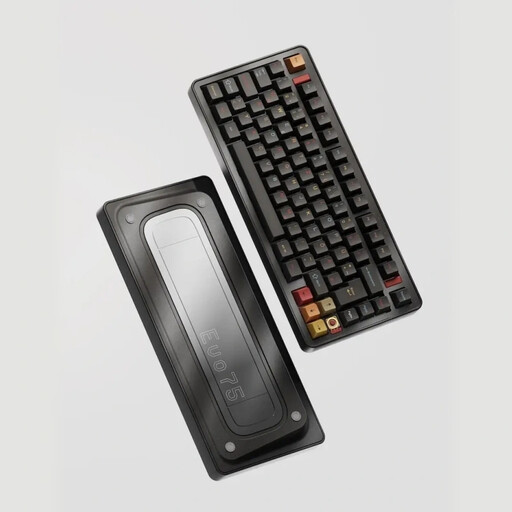
Ticktype EVO75 Mechanical Keyboard, Creamy Rye, Spray-coated Nebula
Consider this 75% model if configurable key assignments matter enough for you to check the setup requirements before buying.
Its product name identifies VIA compatibility, hot-swappable Creamy Rye switches, a US layout and Bluetooth, 2.4 GHz and USB-C connection options. Confirm that the US key placement works for you and that your operating system supports the remapping workflow you intend to use.
View on Joybuy
 No image available
AULA S75 Pro 75% Mechanical Keyboard, Star Vektor Switch
This 75% mechanical model may suit a compact typing setup if its actual key arrangement covers your formatting controls.
The product name specifies a display, a knob and hot-swappable Star Vektor switches. Check the precise key layout, function-row access and device compatibility before treating it as a fit for your editing routine.
View on Joybuy
 No image available
AULA F75 75% Wireless Mechanical Keyboard, US layout
Consider this compact mechanical keyboard if a US key layout works for your editing and you want a choice of wired and wireless connections.
The product name specifies QWERTY US layout, Bluetooth, 2.4 GHz and wired USB modes, plus PBT keycaps. Check the keys used by your shortcuts and confirm any custom-mapping or device-switching requirement separately.
View on Joybuy
Common questions
Is a 60% keyboard too small for formatting parallel texts?
A 75% layout is a more straightforward starting point if you regularly use function keys or arrows, though your preferred shortcuts determine whether a 60% board works for you. Logitech’s layout guide says 60% boards omit the function row and arrow keys, while 75% boards include function keys; inspect the individual model for its navigation arrangement.
Should I choose a UK-ISO keyboard?
Choose a confirmed UK-ISO variant if familiar UK key placement and legends matter to your typing or shortcuts. Keychron lists UK-ISO versions of the K3 Max, but you still need to select the exact variant rather than assume every K3 Max has that layout.
Can one compact keyboard switch between my computer and tablet?
Yes, if the specific keyboard supports pairing with both devices and provides a suitable switching method. Logitech says compatible Easy-Switch keyboards can pair with up to three devices, and Keychron specifies Bluetooth connections to three devices for the K3 Max; check operating-system compatibility for the model you choose.
Does configuring shortcuts on a Keychron K3 Max require a cable?
Yes, Keychron says the K3 Max must be connected by cable for VIA key and macro configuration. You can therefore assess its wireless connection options separately from the wired setup you would need for remapping.
How should I dispose of an old wireless keyboard?
Take an old keyboard to an appropriate electrical recycling point rather than putting it in household rubbish. GOV.UK also advises recycling batteries through an appropriate collection route; check the instructions for any removable battery before handling it.


