Small-desk scriptwriters
If your laptop, mouse and paper notes share a narrow surface, keyboard width matters because it affects where you can place everything else.


Start with a compact keyboard that leaves room for your mouse and script notes without hiding the keys you use to edit. Choose a flatter productivity keyboard or a mechanical model according to the key feel and sound you prefer, and check the exact layout and connection options before buying. A smaller keyboard still needs to sit comfortably within the whole workstation.
If your laptop, mouse and paper notes share a narrow surface, keyboard width matters because it affects where you can place everything else.
If you draft for an hour or more at a time, consider keyboard position alongside your screen, chair and mouse. The Health and Safety Executive advises placing the keyboard centrally and just below elbow height.
If you move a script between a computer, tablet and phone, check device switching, compatible shortcuts and the physical key layout rather than choosing on size alone.
Decide which editing keys must remain easy to reach, then weigh key feel and device connections against the space available on your desk.
Consider it when: You prefer flatter keys for dialogue drafting and want space beside the keyboard for a mouse and notes.
Trade-off: Check whether the particular layout puts frequently used navigation or function commands behind shortcuts.
Consider it when: You want a distinct switch feel; Keychron specifies UK-ISO K3 Max variants with wired, Bluetooth and 2.4 GHz connections.
Trade-off: Switch sound and feel vary by variant, so check the supplied switches if you write near other people or a microphone.
| Concern | What to check | Who this matters to |
|---|---|---|
| Desk space and editing keys | Measure the clear desk width; inspect arrow, navigation and function-key access. | I need my mouse and script notes beside the keyboard without slowing down revisions. About 42% of consumers put usable desk space and key layout first. |
| Key feel and sound | Check the exact switch variant and consider whether its sound suits your writing space. | If I draft for long stretches near other people or a microphone, key feel and noise matter throughout the session. For around 33% of consumers, low-distraction typing is the primary concern. |
| Devices and UK layout | Confirm the physical key layout, compatible devices and required connection modes. | I switch devices while editing and need familiar keys and shortcuts on each one. Device and layout compatibility comes first for about 25% of consumers. |
A narrow board can leave more mouse space while moving navigation or function commands behind key combinations.
Compare the exact layout with the keys you use for revisions, dictation and microphone controls before ordering.
A smaller board does not correct an awkward screen height or a mouse placed too far away. The Health and Safety Executive advises considering keyboard, screen and mouse placement together.
Place the keyboard centrally and just below elbow height. For prolonged laptop work, consider a separate keyboard and mouse so the screen can be raised.
Physical layouts and connection modes can differ between variants of compact keyboards.
Check the selected variant’s key legends, operating-system compatibility and whether it offers the wired or wireless connection you need.
Logitech offers Tactile Quiet, Clicky and Linear versions of its MX Mechanical Mini, each described with a different feel and sound.
If you write near colleagues, housemates or recording equipment, confirm the supplied switch variant and, where possible, try its sound for yourself.
Its MX Keys Mini and MX Mechanical Mini are compact productivity keyboards with different approaches to key feel.
The K3 Max is a low-profile mechanical option for writers considering a compact UK-ISO layout.
The 350 Compact is a wireless productivity model for writers who want standard-sized keycaps in a smaller board.
These keyboards include 75% layouts for desks where mouse space matters and a 96 model for writers considering a larger arrangement. Check each model’s stated layout and connections against your script-editing workflow.
 No image available
Consider this wireless model if you want a smaller keyboard beside your script notes and mouse.
Confirm the physical key layout and supplied switch variant before relying on it for familiar UK key positions or quiet typing.
 No image available
This compact option may suit a writer switching between devices, provided its US QWERTY layout works for the script’s punctuation and characters.
The product name specifies 78 keys, 2.4 GHz and Bluetooth 5.0/4.0 connections, and support for four devices. Assess its typing sound rather than treating a quiet-key description as a measured result.
 No image available
Consider this mechanical model if you want a compact board with a choice of connection methods for your writing setup.
The product name specifies wired, Bluetooth and 2.4 GHz modes, PBT keycaps and a US QWERTY layout. Check the supplied switch variant and whether its sound suits nearby recording.
 No image available
If you want to keep more keys within reach, measure your desk before choosing this model over a 75% board.
The product name identifies a wireless keyboard with a UK layout. Confirm the supplied switches and keycaps if their feel matters to your writing sessions.
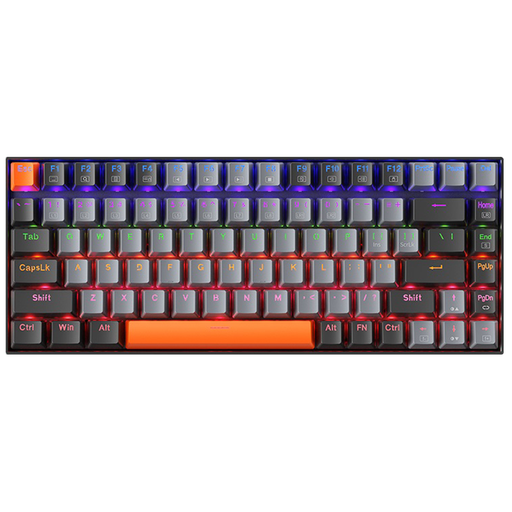 No image available
This compact wired option suits a desk where a USB connection is practical and wireless device switching is not a priority.
The product name specifies a 75% US QWERTY layout, Red Switch and LED backlighting. Check the key legends against your UK typing needs and assess switch sound for your workspace.
Choose a compact keyboard when desk width is the constraint, provided you can still reach the editing keys you use. A full-size layout may make more sense if a dedicated number pad matters more to you than space beside the keyboard.
A separate keyboard and mouse let you raise the laptop screen while keeping the typing position accessible. That follows Health and Safety Executive workstation guidance for prolonged laptop work; you still need to position the screen, keyboard and mouse together.
Check the sound of the exact switch variant in the space where you write, rather than assuming that all mechanical keyboards—or all keyboards described as quiet—sound alike. Logitech, for example, offers MX Mechanical Mini switches with different stated sound characteristics.
The Health and Safety Executive’s guidance focuses on the workstation, not a named consumer keyboard model. Its display screen equipment guidance addresses workers who use screens daily for continuous periods of an hour or more, so keyboard choice should be considered alongside screen position, furniture and working conditions.