Start with a compact keyboard that leaves room for the pointing device you use to place and adjust diagram elements. A 75% layout is worth considering if readily accessible navigation keys matter; a smaller layout may free more desk space, but check whether its shortcuts require awkward key combinations. Assess the keyboard alongside your mouse, screen, documents and work surface rather than treating its size as an ergonomic solution on its own.
Who this choice affects
Small-desk diagram makers
You need space beside the keyboard for a mouse or other pointing device, as well as notes or reference material. UK display screen equipment regulations describe a workstation as an arrangement that includes input devices and the work surface, not just the keyboard.
Shortcut-heavy science students
If you repeatedly move between labels, objects and software commands, check how easily you can reach navigation keys. Keychron lists its K3 Max UK-ISO model as a 75% keyboard with QMK/VIA key-mapping support, though useful mappings depend on your software and workflow.
Multi-device coursework users
If you switch between a computer and another device, connection options can matter as much as keyboard size. RS UK lists switching among up to three devices for the Kensington K75502UK; Logitech describes pairing compatible Easy-Switch keyboards with up to three devices.
What to check before buying
Measure the space needed for both keyboard and mouse, then check the keys your diagram software uses most often.
| Concern | What to check | Who this matters to |
|---|
| Desk space |
Compare keyboard width and depth with the space needed to move your mouse and keep notes nearby. |
If my mouse and notes compete with the keyboard for room, I need a layout that leaves space to work. Around 36% of consumers put desk clearance first. |
| Navigation and shortcuts |
Check access to arrow, navigation and function keys against the commands you use in your diagram software. |
When I repeatedly adjust objects or labels, layered key combinations could interrupt my work; around 29% of consumers prioritise direct access to controls. |
| Typing and workstation fit |
Consider the selected key feel and arrange the keyboard, mouse, screen and chair together. |
If diagrams also involve long stretches of labelling and revision, I want a key feel and desk arrangement I can use comfortably. Roughly 21% of consumers put this need first. |
| Device connections |
Confirm connection modes, compatible devices and whether switching requires a receiver. |
Moving between devices makes repeated cable changes inconvenient on my desk; for about 14% of consumers, connection flexibility is the primary concern. |
Buying pitfalls
-
Choosing the smallest layout without checking shortcuts
A reduced layout can free desk space but may put frequently used navigation commands behind key combinations.
List the commands you use to label and adjust diagrams, then compare their key access with the layout you are considering.
-
Treating a compact keyboard as the whole ergonomic solution
Mouse position, screen placement and available work-surface space also affect how a workstation is arranged. UK display screen equipment regulations address the workstation as a whole.
Check where the keyboard, mouse, screen, documents and chair will sit together before deciding that a smaller keyboard resolves a cramped setup.
-
Assuming every variant has the same keys and connections
A different layout, switch option or connection method can change whether a keyboard suits your devices and shortcuts.
Check the selected variant’s key legends, connection modes and device compatibility before ordering.
Relevant brands to consider
Logitech
The MX Keys Mini is a compact productivity option to consider when typing and device switching matter alongside desk space.
- Logitech describes the MX Keys Mini as space-saving with programmable keys; its Easy-Switch technology supports pairing compatible keyboards with up to three devices.
- Check the exact UK layout and whether you need the integrated number pad found on the full-size version.
Keychron
The K3 Max UK-ISO is relevant if you want a 75% low-profile mechanical layout and configurable keys.
- Keychron lists wired, Bluetooth and 2.4 GHz connection modes and QMK/VIA support for the K3 Max.
- Choose the switch variant deliberately; its feel and sound are matters of preference.
Kensington
The K75502UK is a compact option for people who switch between compatible devices.
- RS UK lists Bluetooth and 2.4 GHz connections with switching among up to three devices for this model.
- Check its dimensions and navigation-key positions against your desk and diagram shortcuts.
Bakker Elkhuizen
Its compact ergonomic-layout keyboards are relevant when keyboard-to-mouse reach is a concern.
- RS UK describes the BNEU950WUK listing as having an ergonomic key layout and reduced reach distance.
- That product description does not establish a personal health benefit; assess the complete desk arrangement and whether the layout suits you.
Joybuy keyboards for this setup
These compact keyboard choices cover different balances of desk space, key access and device connections for preparing science diagrams. Check each selected layout against your own shortcuts and available mouse space.
 No image available
HyperX Alloy Rise 75 Wireless Keyboard UK
Consider this compact wireless model if mouse space and ready access to navigation controls both matter. Check its dimensions, physical UK key placement and the selected switch feel before buying.
View on Joybuy
 No image available
ASUS ROG Strix Scope II 96 Wireless Keyboard, black, UK layout
Consider this model if you want more keys within reach, but measure the remaining mouse area before committing to its layout. The product name specifies a wireless keyboard in black with a UK layout; confirm which switch variant the selected item uses.
View on Joybuy
 No image available
Razer Huntsman V3 Pro Mini 60% Analog Optical Keyboard
Consider a 60% layout when clearing room for your pointing device takes priority over direct access to every control. This analog optical model requires a check of its arrow-key combinations, selected key layout and compatibility with your device.
View on Joybuy
 No image available
Rapoo E9050L 75% Wireless Membrane Keyboard, US QWERTY, white
Consider this model for switching devices at a compact desk if US QWERTY key placement suits your work. Its product name specifies 78 membrane keys, 2.4 GHz and Bluetooth 5.0/4.0 connections, and support for four devices; check its dimensions and navigation-key arrangement.
View on Joybuy
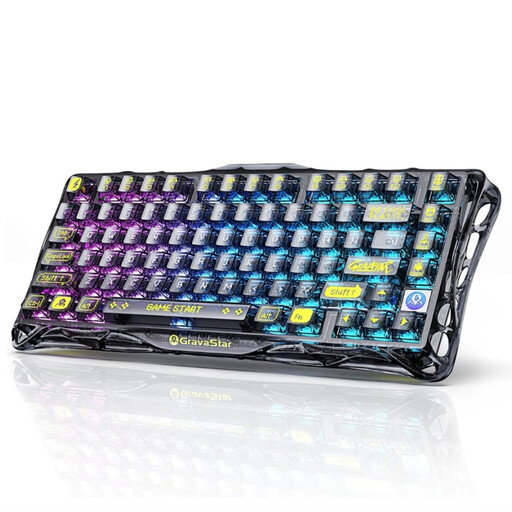 No image available
GravaStar Mercury K1 Lite 75% Keyboard, Chinese retail version, US QWERTY, black
Consider this compact mechanical model only after checking its key arrangement against your diagram shortcuts. The product name specifies hot-swap switches, Bluetooth 5.0, 2.4 GHz and USB-C connections; it identifies a Chinese retail version with a US QWERTY layout.
View on Joybuy
Frequently asked questions
Should I choose a 60%, 75% or full-size keyboard for science diagrams?
Choose by the space your pointing device needs and the keys your diagram software uses repeatedly. A 75% layout can be a useful compromise when navigation controls matter; check layered commands on a 60% board, or allow for a larger board if you regularly need a dedicated number pad.
Do I need a UK-ISO keyboard?
Choose a UK-layout variant if you want its physical key positions and legends for your usual typing and shortcuts. Keychron lists a UK-ISO K3 Max option, but check the exact variant you select; a compact board with US QWERTY keys may not place every key where you expect it.
Will an ergonomic keyboard resolve discomfort at a small desk?
A keyboard alone cannot establish whether the whole desk arrangement suits you. UK display screen equipment regulations address the workstation as an arrangement of equipment and work surface, so consider the mouse, screen, chair and available space alongside any keyboard-layout claim.


