Small-desk filter tester
If you repeatedly enter search terms and move between filters, the keyboard needs to share limited desk space with your mouse without making frequently used navigation keys awkward to reach.


For repeated search-filter testing on a small desk, start by considering a 75% keyboard: it preserves dedicated arrow and function keys while leaving more room for a mouse than a tenkeyless layout. Choose a smaller layout if desk space matters more than direct access to those keys, or a tenkeyless layout if you need a more conventional arrangement and can accommodate its width. Check the exact regional key layout and assess the keyboard as part of the whole workstation.
If you repeatedly enter search terms and move between filters, the keyboard needs to share limited desk space with your mouse without making frequently used navigation keys awkward to reach.
Repeated test flows make key remapping, macros or switching between a test machine and another device worth considering, provided the chosen keyboard works with your setup.
If the same keyboard serves filter-testing work and competitive games, check the work keys you need before weighing gaming-specific switch settings.
For search-filter testing, decide which keys you need to press directly before considering shortcut customisation or gaming controls.
| Concern | What to check | Who this matters to |
|---|---|---|
| Desk space and navigation | Compare keyboard width and check whether the arrows and function keys you use are dedicated keys or require an Fn combination. | If I move through fields and results repeatedly, I want room for my mouse without slowing down key navigation; around 50% of consumers would put that balance first. |
| Shortcuts and device workflow | Check remapping and macro options on the chosen variant, including any connection or software requirements; confirm device-switching support if needed. | When I repeat the same test flow across devices, I want shortcuts I can set up and use in that workflow; around 38% of consumers would make workflow control their primary concern. |
| Work and gaming | Check that the layout retains your work keys before considering adjustable actuation or other gaming controls. | If I use one small desk for testing and competitive games, I need the keyboard to serve both tasks; around 12% of consumers would prioritise that dual use. |
A 60% layout typically puts arrows, function keys and navigation commands behind an Fn layer, which can interrupt a workflow that uses them frequently.
Note the keys used in a typical filter-test pass. If arrows and function keys are frequent, compare a 75% layout before choosing 60% for its smaller footprint.
The Health and Safety Executive (HSE) considers the whole display screen equipment workstation, working conditions and routine when assessing risks; keyboard size alone does not settle those questions.
Check keyboard height alongside mouse, screen and chair positions and breaks. HSE guidance says employers must assess workstations and reduce identified risks for workers who use display screen equipment daily for continuous periods of an hour or more.
Compact keyboards come in different regional layouts, so a familiar model name does not establish the Enter-key and symbol positions of the selected variant.
Confirm the exact layout in the product configuration before buying rather than relying on a generic model name or photograph.
Remapping may require a particular connection mode or browser. Keychron says configuring the K3 Version 3 through Launcher requires wired mode and a current Chrome, Opera or Edge browser.
Check that the configuration method fits the computer and software you intend to use for testing.
Relevant to buyers considering a compact 75% layout with a UK-ISO option.
Relevant to buyers looking at compact productivity keyboards and device switching.
Relevant chiefly when the same desk and keyboard are used for testing work and competitive games.
These compact keyboards address different small-desk priorities, from a 75% layout to smaller gaming-oriented models. Check each model’s regional layout and direct-access keys against your filter-testing workflow.
 No image available
Consider this wireless keyboard if a compact layout and navigation access are priorities for your desk. Confirm the exact key placement if you need UK-ISO, and check whether its customisation options suit your test setup.
 No image available
Its 75% format is worth considering when desk width is limited. The title specifies wired, Bluetooth and 2.4G connection options and a US QWERTY layout; check the exact arrow and function-key arrangement before choosing it for repeated navigation.
 No image available
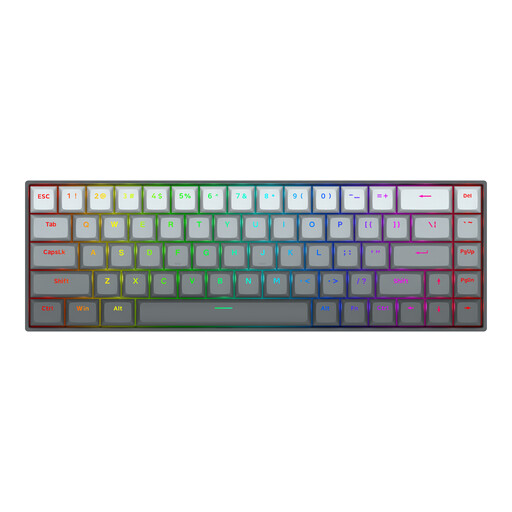
This 68-key model may appeal if mouse space and gaming use both matter. Its title specifies a US layout and magnetic switches; check direct function-key access and the selected switch variant before buying.
 No image available
Consider this compact gaming keyboard if UK key placement matters alongside desk space. Check whether function keys require a secondary layer and whether it is compatible with the device used for testing.
 No image available
This compact option suits a desk where keyboard space is a priority, provided its key arrangement fits the work. The title specifies Bluetooth 5.1 and wired USB-C modes with a US QWERTY layout; check direct arrow and function-key access.
A 60% keyboard can suit the task if mouse space matters more to you than direct access to navigation keys. It typically places arrow, function and navigation commands behind an Fn layer, so consider a 75% layout if you use those keys repeatedly.
Choose a UK-ISO variant if you want familiar UK key placement. Keychron lists UK-ISO versions of its K3 Version 3, but you should confirm the layout of the exact variant selected rather than assuming every listing uses it.
No particular compact, tenkeyless or full-size model is universally required by the HSE guidance described here. For workers using display screen equipment daily for continuous periods of an hour or more, HSE says employers must assess the whole workstation and reduce identified risks; suitability depends on the work and the individual setup.
HSE guidance advises placing the keyboard just below elbow height and keeping the screen and keyboard central so you do not twist your back. For prolonged laptop use, it also advises a separate keyboard and mouse so the display can be raised.