Editors short on desk space
If your keyboard crowds your mouse or notes, a compact layout may give you more room. Compare the keys you use for playback and navigation before choosing the smallest board that fits.


A 75% keyboard is a sensible starting point if you need more mouse space but still want a familiar range of keys for subtitle-editing shortcuts. Choose by checking your editor’s commands against the exact layout first, then consider remapping support and key feel; a smaller keyboard may save more space but require changes to your editing habits.
If your keyboard crowds your mouse or notes, a compact layout may give you more room. Compare the keys you use for playback and navigation before choosing the smallest board that fits.
Repeated timing and text corrections make shortcut access worth checking. Adobe Premiere has a visual layout for viewing and assigning shortcuts; keyboard remapping is a separate, model-specific feature.
Consider keyboard position alongside the rest of your workstation. The UK Health and Safety Executive identifies fatigue and upper-limb problems among the possible risks of prolonged or poorly arranged display-screen work; a smaller keyboard alone does not settle the wider setup.
Start with the physical layout and your most-used editing keys. Then check whether shortcut configuration works with your application and operating system, and whether the keyboard fits comfortably beside your mouse.
| Concern | What to check | Who this matters to |
|---|---|---|
| Desk space and layout | Compare the exact key map with your current keyboard, particularly function and navigation keys. Check the selected variant if you want UK-ISO. | If my desk is crowded, I want room to move the mouse without making editing controls awkward to reach; around 42% of consumers put desk fit and usable key access first. |
| Shortcut customisation | Check your editor’s shortcut settings and the keyboard’s model-specific remapping method and operating-system requirements. | When I make frequent timing or text corrections, I want my repeated commands within easy reach; roughly 33% of consumers prioritise shortcut customisation. |
| Long-session comfort and sound | Consider key feel and switch choice, then check how the keyboard, mouse and screen fit your working position. | During extended editing, I need a setup that feels workable and does not create unwanted typing noise; about 25% of consumers place comfort or distraction control first. |
A compact board may move familiar editing keys to different positions or layers. Keychron describes the K3 Max and V1 Max as 75% layouts, while Logitech lists 79 keys for the MX Keys Mini for Business; neither description tells you whether your own shortcut sequence will feel convenient.
List the playback, timeline and text commands you use most, then compare them with the exact layout and function-layer instructions before ordering.
Changing a shortcut in your editing application is different from remapping a key on the keyboard. Keychron describes VIA remapping for the K3 Max, while Logitech describes app-based customisation for the MX Keys Mini, with stated Windows and macOS support.
Confirm the configuration method and operating-system support for the precise model, as well as what your subtitle editor lets you assign.
A smaller board can change how much room remains for the mouse, but it cannot by itself address screen position, seating or prolonged display-screen use. The UK Health and Safety Executive advises considering risks across the workstation.
Check where the keyboard and mouse will sit on your desk and whether you can use both in a comfortable working position.
These brands offer different layouts and approaches to customisation; compare individual models and variants rather than assuming features apply across a brand.
A reference point for compact mechanical keyboards if you want to assess UK-ISO options and model-specific remapping.
Relevant if you prefer a compact, low-profile keyboard with app-based options to investigate.
An alternative to examine if programmable controls and an ergonomic layout matter more to you than minimising keyboard size.
These compact keyboards offer different sizes and layouts for a limited desk area. Compare each one with your subtitle editor’s shortcuts; a compact shape alone does not establish shortcut compatibility or long-session comfort.
 No image available
Consider this UK-labelled wireless model if you want a compact keyboard but need to check access to your regular editing keys.
Compare the exact key map and configuration requirements with your subtitle editor before relying on particular shortcuts.
 No image available
The 75% layout is relevant if desk width is the main constraint, but check whether the stated US QWERTY layout suits your typing and editing habits.
The product name specifies wired, Bluetooth and 2.4G modes, RGB backlighting and PBT keycaps. Check its exact key map before counting on familiar shortcut access.
 No image available
This 75% mechanical model is worth comparing if you want a compact layout with a knob and display. Confirm the physical key arrangement against your editing commands.
Its product name specifies tri-mode connectivity, a TFT display, a knob and hot-swappable Star Vektor switches; those features do not establish how your subtitle shortcuts can be configured.
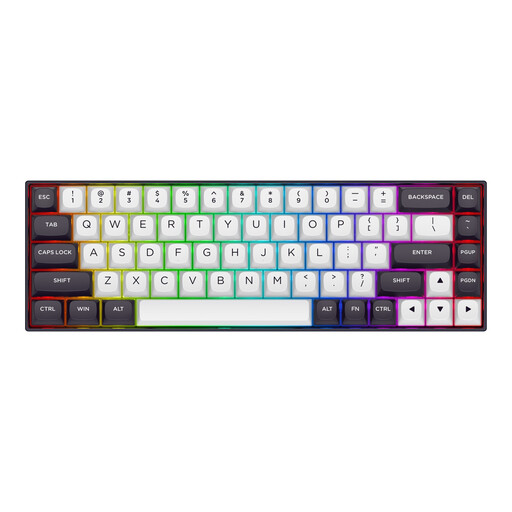 No image available
If space is particularly tight, compare this 68-key layout with the controls you use for timeline and text editing; fewer keys may change how you reach familiar commands.
The product name identifies magnetic switches and a US layout. Confirm that the physical layout and any configuration options fit your application and operating system.
 No image available
This UK-layout 65% keyboard may appeal if you want a smaller board, provided its key and function-layer arrangement works for your editing shortcuts.
The product name identifies an analog keyboard. Check the exact controls you need rather than assuming the smaller layout preserves your current workflow.
No. A 75% layout is one way to reduce keyboard size while keeping a more conventional set of controls than some smaller layouts, but the right choice depends on your shortcuts. Compare the exact key positions with the playback, timeline and text commands you use.
You may be able to configure shortcuts in the editor, on the keyboard, or both, depending on the software and model. Adobe says Premiere’s visual keyboard layout shows assigned and available keys; for hardware remapping, check the selected keyboard’s configuration method and operating-system support separately.
Do not assume wireless use means wireless configuration. Setup requirements differ by model, so check the instructions for the exact keyboard and its remapping tool before making that feature central to your choice.
Not on its own. The UK Health and Safety Executive advises considering the wider display-screen workstation and work pattern, so check keyboard and mouse placement alongside your screen and seating rather than judging comfort from keyboard size alone.