Small-worktop leftover reheaters
If a microwave must fit into a restricted kitchen space, its external width and depth matter more to the initial choice than its cavity rating. Check placement space separately from the room needed for a dish inside.


Start with a compact solo microwave if reheating cooked carrots and other leftovers is the main job; grill and convection functions need only enter the decision if you will use them. Measure the available worktop and check the model’s placement requirements, then make sure your usual bowl or plate can rotate inside. A smaller cavity rating does not necessarily mean a smaller appliance.
If a microwave must fit into a restricted kitchen space, its external width and depth matter more to the initial choice than its cavity rating. Check placement space separately from the room needed for a dish inside.
If you already have a favourite dish for cooked carrots, measure it before choosing a microwave. The turntable and the space around it need to let that dish rotate freely.
Simple timing controls can make small portions easier to manage, but they do not replace checking the food. GOV.UK advises heating reheated food until it is steaming hot all the way through.
For a microwave mainly used to reheat cooked carrots on a limited worktop, check placement space first, then dish fit and the controls you would use regularly.
| Concern | What to check | Who this matters to |
|---|---|---|
| Worktop footprint | Measure the intended spot against the microwave’s external width, depth and height; check its manual for placement and ventilation clearances. | I have very little worktop left and need the appliance to fit without crowding the space. Roughly 42% of consumers would put worktop fit first. |
| Dish fit | Compare your usual bowl or plate with the turntable and check that it can rotate freely. | If I already use a particular dish for leftovers, I want to keep using it rather than change how I serve the carrots. Around 33% of consumers would make dish fit their primary concern. |
| Reheating controls | Choose controls you can set accurately for a small portion, and follow food instructions for stirring or standing where applicable. | I want a repeatable routine without mistaking a warm surface for food heated throughout. About 25% of consumers would prioritise controls and the reheating routine. |
A lower capacity does not guarantee a smaller footprint. According to their manufacturers’ dimensions, the 17L Russell Hobbs RHM1731B is 452 × 355 × 262mm, while the 20L Panasonic NN-ST21QWBPQ is 440 × 324 × 258mm.
Compare external measurements with your worktop before using cavity capacity to narrow the choice further.
Capacity describes internal volume, not whether a particular dish can turn. Panasonic specifies a 255mm turntable for the NN-ST21QWBPQ; Russell Hobbs specifies a 24.5cm turntable for the RHM1731B.
Measure the dish you normally use and check that the chosen model leaves it room to rotate.
Reheated carrots need to be hot throughout, not just at the edges. GOV.UK advises reheating food until it is steaming hot all the way through; Food Standards Agency guidance also says to follow applicable microwave instructions for stirring and standing.
Use a microwave-safe dish, stir where practical, follow any relevant standing instruction and check the centre before eating.
A combination microwave can add grill and convection functions, but it also needs its own worktop space. Panasonic lists its NN-CT54 combination model at 520 × 395 × 310mm.
Consider those additional modes if you will use them; otherwise, compare solo models against the space and dishes you already have.
These model examples show why dimensions, dish fit and controls are more useful than a brand name alone when worktop space is limited.
Panasonic UK & Ireland lists the NN-ST21QWBPQ as a 20L, 800W solo microwave measuring 440 × 324 × 258mm, with a 255mm turntable.
Russell Hobbs describes the RHM1731B as a 17L, 700W manual solo microwave with two dials, five power levels and a 24.5cm turntable.
Toshiba Lifestyle UK lists 20L solo models with different control options, including the 800W MM-MM20P and MM2-EM20PF.
These solo microwaves are options to compare for reheating leftovers. The larger-capacity models may be relevant if dish space takes priority, but measure each appliance and check its placement requirements before choosing one for a restricted worktop.
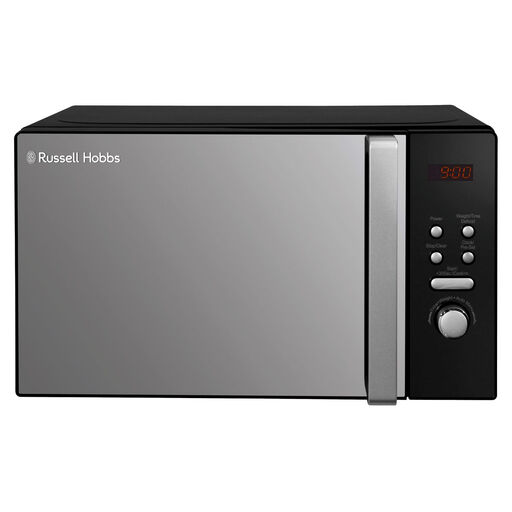 No image available
Consider this solo model if you want digital controls for routine leftover reheating. Compare its size with your available worktop, measure your usual dish against the turntable and check the required ventilation clearance.
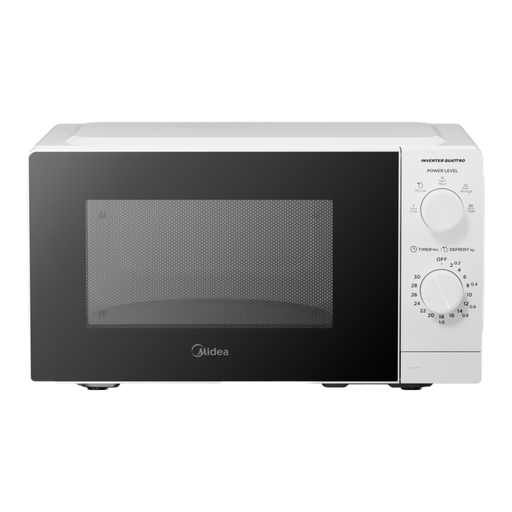 No image available
Consider this model if you prefer manual controls for reheating. Check its exact external measurements and ventilation clearance, and confirm that your usual bowl will rotate inside.
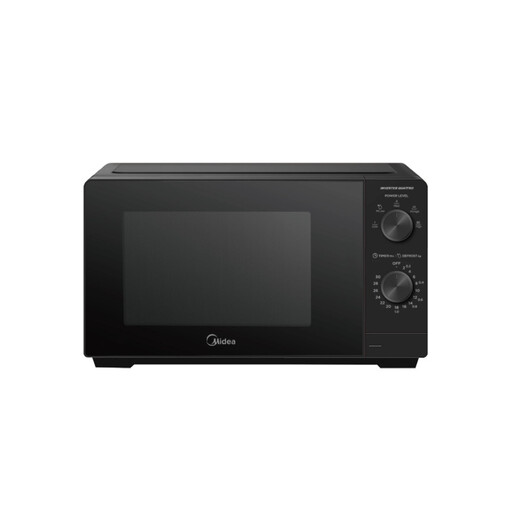 No image available
Consider this model for small-portion reheating if its size suits your worktop. Confirm the controls and timer for this exact variant before choosing it, as well as dish fit and placement clearance.
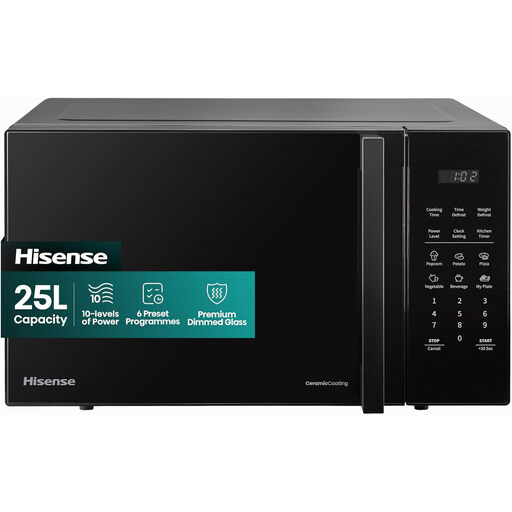 No image available
Consider this model if accommodating a larger dish matters more than minimising the appliance’s size. Measure the worktop carefully and check both dish clearance and the model’s placement requirements.
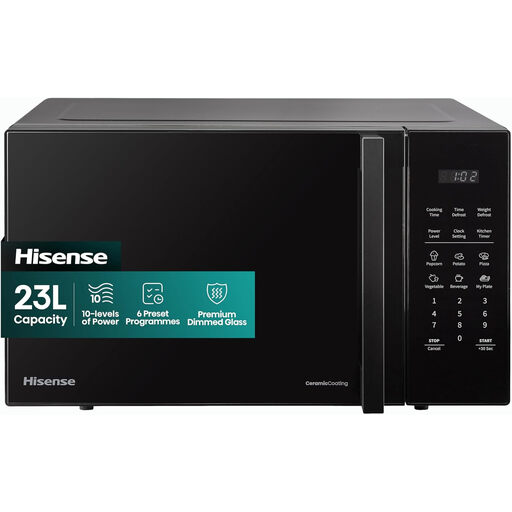 No image available
Consider this model if you need to check a larger dish against the cavity as well as the appliance against your worktop. Confirm the controls for this exact model before purchase, and allow for its required placement clearance.
Compare external dimensions first when worktop space is the constraint, then check whether your dish fits. Panasonic UK & Ireland specifies its 20L NN-ST21QWBPQ at 440 × 324 × 258mm; Russell Hobbs specifies its 17L RHM1731B at 452 × 355 × 262mm. Allow for the chosen model’s placement requirements too.
A solo microwave is sufficient for this reheating task; consider a combination model if you will also use its grill or convection functions. For a sense of the space involved, Panasonic lists its NN-CT54 combination model at 520 × 395 × 310mm.
Check that the carrots are steaming hot all the way through, including at the centre. GOV.UK gives this advice for reheated food, while Food Standards Agency guidance says to follow applicable microwave instructions for stirring and standing.
Plan to reheat only the portion you intend to eat. GOV.UK food-hygiene guidance for businesses advises reheating food only once and heating it until it is steaming hot throughout.