Rehearsal organisers with small desks
If one printer needs to handle A4 schedules as well as copying or scanning, check its operating dimensions and the room needed to load and collect paper before placing it on a home, studio or production desk.


For occasional rehearsal schedules, a compact wireless A4 printer with copying and scanning may cover your needs; for repeated multi-page handouts, look for automatic two-sided printing and enough paper capacity for each batch. Measure the space the printer needs while operating, not just its closed dimensions, and check its ink-plan terms and cartridge restrictions before choosing.
If one printer needs to handle A4 schedules as well as copying or scanning, check its operating dimensions and the room needed to load and collect paper before placing it on a home, studio or production desk.
If you regularly issue call sheets, cast schedules or revised running orders, automatic two-sided printing and a larger paper supply can reduce page handling and tray refills.
If you mainly print last-minute PDFs from a phone, tablet or laptop, check that the printer’s wireless method works with your device and the network available where you rehearse.
Start with the space the printer needs while in use, then decide whether your schedule batches justify automatic duplex printing and a larger paper supply.
| Concern | What to check | Who this matters to |
|---|---|---|
| Working footprint | Compare the available desk space with the exact model’s dimensions and its paper-loading, output and access clearances. | If the desk is already crowded, I need to load and collect schedules without moving the printer each time. Around 31% of consumers put working-space fit first. |
| Multi-page output | Confirm that A4 two-sided printing is automatic rather than manual, and check the input-tray capacity. | When several people need revised schedules, I want to print the pack without turning sheets or repeatedly refilling the tray. For around 31% of consumers, smoother batch printing is the primary need. |
| Mobile printing | Check device compatibility, the available Wi-Fi network and whether a direct wireless connection is needed. | If a schedule changes just before rehearsal, I want to send the PDF from the device holding it without moving files by cable. That flexibility comes first for around 23% of consumers. |
| Print volume and ink | Compare a busy month’s page count with the model’s usage guidance; check ink-plan terms and cartridge restrictions. | When I print only occasionally, I need the printer’s usage guidance and ink arrangements to suit that pattern. Around 15% of consumers prioritise those conditions. |
A printer can fit on a desk when closed yet leave too little room to load paper, collect schedules or reach its cartridges.
Measure the intended spot and compare it with the exact model’s operating dimensions and clearance guidance.
Brother lists manual two-sided printing for the DCP-J1260W, while its DCP-J1460DW and Epson’s XP-3200 and XP-5200 list automatic two-sided printing. Manual printing requires you to reinsert sheets for the reverse side.
If you frequently print multi-page rehearsal packs, look for an explicit automatic duplex specification; otherwise, plan to handle the sheets yourself.
HP positions the DeskJet 2922 for up to 100 pages a month and states that its dynamic security can block cartridges using modified or non-HP circuitry. That matters if your busiest rehearsal periods involve many reprints or cartridge choice is important to you.
Count the pages you expect in a busy month, check the exact model’s cartridge policy and read any optional ink-plan terms before enrolling.
An optional ink plan is an ongoing commitment rather than a permanent supply of ink without conditions.
Brother’s DCP-J1260W and DCP-J1460DW are A4 inkjet all-in-ones for printing, copying and scanning in a compact workspace.
Epson’s Expression Home XP-3200 and XP-5200 are compact A4 multifunction inkjets with wireless printing options.
HP’s DeskJet 2922 is a wireless print, copy and scan option that HP positions for up to 100 pages a month.
These printer choices are relevant to rehearsal schedules in a tight workspace. Compare each model’s duplex mode, paper handling and operating footprint against the batches you print and the space you have.
 Image unavailable
If you print repeated schedule handouts, check whether the MAXIFY GX6150’s duplex settings and paper handling suit your batch size.
Allow room for paper loading, output and access when assessing its place on the desk.
 Image unavailable
For several A4 schedules at once, check whether the EcoTank ET-5150’s duplex operation and paper handling suit your routine.
Confirm the space it needs while operating and the terms that apply to its ink arrangement.
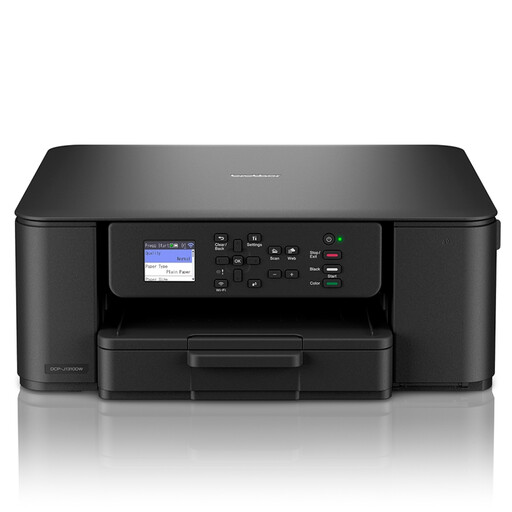 Image unavailable
If schedules arrive on different devices, check that the DCP-J1310DW’s wireless options work with your setup.
Confirm its duplex operation and leave room to feed and collect paper on your desk.
Automatic duplex is worth considering if you regularly print multi-page schedules or several copies and want to avoid turning sheets by hand. For occasional jobs, manual two-sided printing can still work if you are comfortable reinserting the paper in the correct order.
HP recommends 50 to 100 pages a month for the DeskJet 2820e series. That is guidance for that series, not a monthly limit for every compact printer; compare your busiest rehearsal month with the guidance for the model you choose.
Do not assume every alternative cartridge will work in the DeskJet 2922. HP states that its dynamic security can block cartridges using modified or non-HP circuitry, so check its current cartridge policy if refilled or third-party cartridges matter to you.
Take an old printer to an appropriate electrical recycling collection point rather than putting it in household rubbish. GOV.UK also provides guidance on retailer take-back when you buy a replacement; check the arrangements for your purchase.