One- or two-portion soup cooks
If carrot soup is usually for you or one other person, compare a small bowl with the amount you actually cook. Lakeland and Morphy Richards position their 1.5L models for one or two people.


For one or two portions of carrot soup, start with a 1.5L slow cooker whose external dimensions you can check against your worktop: Morphy Richards lists its 460300 at L20.3 × H23.9 × W21.2 cm. Consider 2.4L for more room in the bowl, or a timed 3.5L model for several portions, but check its footprint, lid clearance and cable route before giving up worktop space.
If carrot soup is usually for you or one other person, compare a small bowl with the amount you actually cook. Lakeland and Morphy Richards position their 1.5L models for one or two people.
If you want several lunches from one batch, balance bowl capacity against the space the whole cooker occupies. Measure the place where it will stand rather than judging fit from its litre capacity.
If you plan soup around a particular mealtime, compare the controls as well as the bowl size. A timer or keep-warm setting may matter more to you than choosing the smallest capacity.
Choose when: You usually make one or two portions and need to check a cooker against a particularly tight space; Morphy Richards publishes external dimensions for its 460300.
Trade-off: The smaller bowl leaves less room for extra portions, and manual controls do not provide a countdown timer.
Choose when: You cook for one or two but want more bowl capacity; Crock-Pot positions its CSC046 for that serving size and smaller kitchens.
Trade-off: Check the CSC046’s external measurements before deciding whether it fits your particular worktop.
Choose when: Several portions and a set cooking duration matter more; Crock-Pot’s CSC113X has a 30-minute to 20-hour timer and switches to keep-warm after cooking.
Trade-off: A 3.5L bowl may be more capacity than a one- or two-portion routine calls for, so check where the cooker will stand and be stored.
| Concern | What to check | Who this matters to |
|---|---|---|
| Worktop fit | Compare external width, depth and height with the available space; allow room to lift the lid and route the cable safely. | If my worktop is crowded, the whole cooker needs to fit where I can use it, not just squeeze into storage. Around 46% of consumers would put footprint first. |
| Soup portions | Compare the bowl capacity and the manufacturer’s serving guidance with your recipe and plans for leftovers. | When I normally cook for one or two, I want enough soup without choosing a bowl mainly for batches I rarely make. Portion size would be the main concern for around 36% of consumers. |
| Timing and clean-up | Check the timer and keep-warm controls you need, plus whether the removable bowl and lid are dishwasher-safe. | If supper needs to fit around my schedule, I value a defined cooking time and manageable washing-up. Roughly 18% of consumers would make those conveniences their priority. |
A litre figure describes the bowl, not the space needed for the housing, handles, cable and an open lid.
Measure your available surface and overhead clearance, then compare them with the exact model’s external dimensions. Morphy Richards lists L20.3 × H23.9 × W21.2 cm for its 460300.
A 3.5L bowl may suit planned leftovers or household meals, but extra capacity does not by itself resolve a shortage of worktop space.
Decide how much carrot soup you usually make before moving beyond the 1.5L or 2.4L options positioned for one or two people.
A removable, dishwasher-safe bowl is not necessarily suitable for a stick blender.
Check the exact cooker’s instructions before blending in its bowl; otherwise, transfer the soup to a suitable blending container.
A small cooker still needs a safe place to operate. Electrical Safety First advises against leaving electrical appliances on and unattended.
Keep the appliance and lead in good condition, position them away from the sink and hot surfaces, avoid overloaded sockets and follow the model’s operating instructions.
These model ranges offer different ways to balance soup portions, controls and available space; check the specifications of the particular cooker you are considering.
Its 460300 gives one- or two-portion cooks a 1.5L option with published external dimensions.
Its cited models span a 2.4L option for one or two people and a 3.5L option with programmable timing.
Lakeland positions its 1.5L slow cooker for smaller portions and one or two people.
These two 3.5L Tower cookers are choices to consider if several portions or batch cooking justify the space. For a tight worktop or a routine of one or two portions, check their full footprint before choosing either over a smaller-capacity cooker.
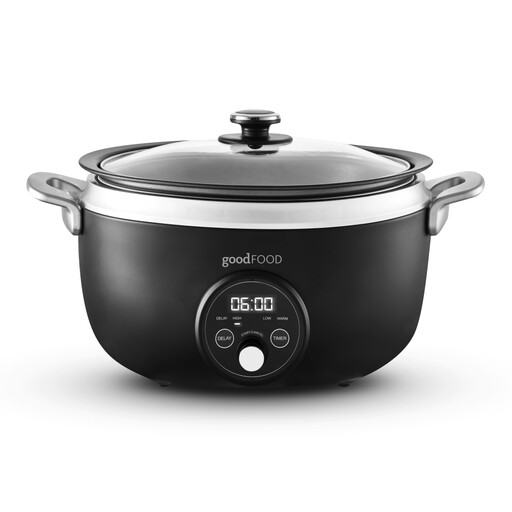 No image available
Consider this model if you want several soup portions and controls for scheduling cooking. Its stated features include a removable aluminium pot, a timer, a delay function, an LED display and 170W power.
Check its external dimensions, lid clearance and cable route against your worktop. Consult the model instructions before using a stick blender in the pot.
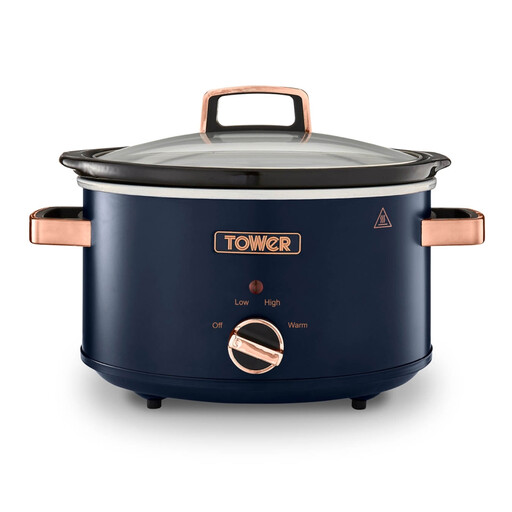 No image available
Consider this model if you plan to make more than one or two portions and prefer a cooker with three heat settings. It has a removable pot and cool-touch handles.
Check its external dimensions, lid clearance and cable route before assigning it worktop space. Consult the model instructions before blending soup in the pot.
A 1.5L model is a sensible starting point for one or two portions: Lakeland and Morphy Richards position their 1.5L cookers for that serving size. Crock-Pot also positions its 2.4L CSC046 for one or two people if you want more room in the bowl. Check your recipe volume and planned leftovers as well as the cooker’s external dimensions.
Do not assume that unattended use is suitable for your cooker or kitchen setup. Electrical Safety First advises against leaving electrical appliances on and unattended; follow your model’s instructions and check that the appliance, lead and socket position are safe.
Follow the recipe’s cooking guidance and check that the food is properly cooked before serving. GOV.UK advises cooking food for the correct length of time and at the correct temperature to address harmful bacteria.