Small-kitchen enriched-dough bakers
If you make brioche, buns or milk bread in a restricted work area, check more than whether the mixer fits in its storage spot. You also need room to access the bowl and use the supplied dough tool.


Choose a stand mixer by the space it needs during use, the stated dough or flour limit for your usual recipe, and the tools supplied with the exact variant—not by wattage alone. A compact model is worth considering for modest batches if it meets those checks; a larger format makes more sense when regular, bigger batches matter more than easy storage. Published capacities do not establish how different machines will handle the same enriched dough.
If you make brioche, buns or milk bread in a restricted work area, check more than whether the mixer fits in its storage spot. You also need room to access the bowl and use the supplied dough tool.
If you make the same medium-sized batch repeatedly, compare its flour weight and finished dough quantity with the exact model's stated limits. Bowl volume or motor wattage alone cannot make that comparison for you.
If the mixer may eventually do jobs beyond dough, consider where additional attachments would go. Check compatibility and what comes in the box for the precise model before counting on an advertised accessory range.
Start with the space available for both storing and operating the mixer, then check your usual recipe against its stated capacity and supplied tools.
| Concern | What to check | Who this matters to |
|---|---|---|
| Footprint and clearance | Measure the worktop or storage space in three dimensions. For a tilt-head model, allow room above it with the head raised. | If cupboard space is tight, I need to get the bowl and tools in and out without moving the mixer each time. Around 39% of consumers would put usable space first. |
| Capacity for your batch | Compare your recipe with the exact model's stated flour or dough limit, keeping those two measures distinct; check the in-box tools. | When I make a regular batch of enriched dough, I need to know that its size fits the machine's stated limit. Roughly 38% of consumers would prioritise batch capacity. |
| Accessories and support | Confirm which attachments fit and which are supplied. Read the applicable warranty and seller terms for the exact purchase. | If one appliance must cover other preparation jobs, I need compatible attachments that I can also store. About 23% of consumers would make versatility and support their primary concern. |
Capacity figures describe different things. Bosch lists yeast-dough limits for its Series 4 and Series 6, while the Kenwood Prospero+ KHC29.A0SI listing gives a flour limit; a dough weight cannot be substituted for a flour weight.
Note your usual recipe's flour weight and finished yield, then compare each with the corresponding limit for the exact model.
A tilt-head mixer can fit under a cabinet when closed yet leave too little room to raise its head for adding ingredients or removing the bowl.
Measure the available width, depth and height where you will use it, including operating clearance. KitchenAid describes a bowl-lift format with a stationary head, but its bowl movement and overall fit still need checking.
A brand's attachment range is not necessarily the contents of an individual box. Smeg, for example, identifies optional accessories alongside the supplied tools for SMF05CRUK.
Check the exact variant's in-box list and confirm compatibility before planning to use pasta, grinding or other attachments.
Kenwood offers compact Go and Prospero+ options as well as larger Chef-family machines.
Bosch publishes dimensions and dough capacities across several stand-mixer families.
KitchenAid offers tilt-head and bowl-lift formats, making access and available space important parts of the choice.
Smeg's SMF05CRUK is a tilt-head option with stated bowl, flour-capacity and tool information.
These stand mixers offer compact and medium-sized routes to consider for enriched dough. Check the exact model's batch guidance and working clearance against your recipe and kitchen before choosing.
 No image available
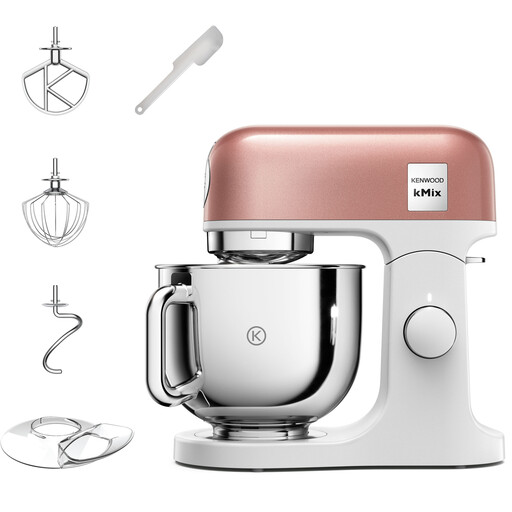
Consider this model if you know your usual flour weight and want a stated limit to compare it with.
The Joybuy listing describes a 4.3L bowl and a limit of up to 1.2 kg of flour for heavy doughs. That is a flour figure, not a finished-dough weight; also check the space needed to operate the mixer.
 No image available
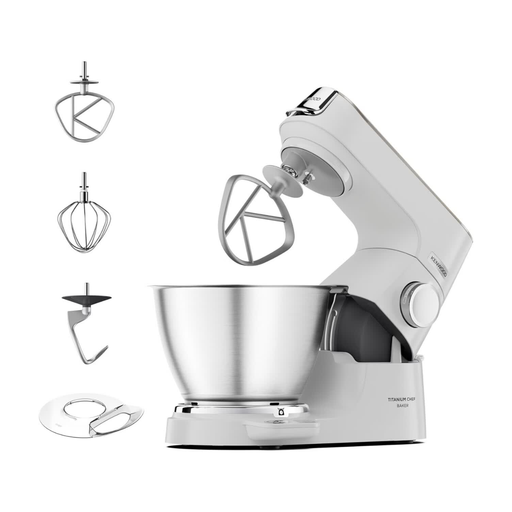
For a regular batch, compare your enriched-dough recipe with this model's guidance for dough rather than choosing on bowl appearance.
Allow enough room to operate its tilting head, and check the exact bundle's tools before ordering.
 No image available
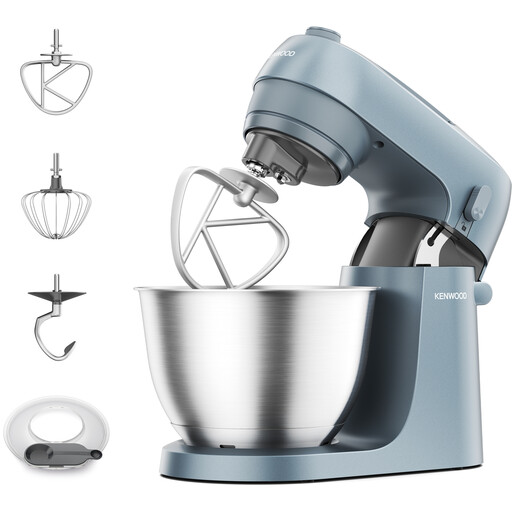
If you make recurring batches, check this model's dough limit against your finished recipe quantity.
Plan where the mixer will remain during use, including space above it for access to the bowl; a stated dough limit is not automatically an enriched-dough limit.
 No image available
If limited worktop or storage space drives your choice, measure the intended spot and the room needed to use this model.
Check its exact-model dough guidance against your usual enriched-dough batch; bowl size alone will not establish a suitable batch limit.
No: wattage alone does not tell you how the exact mixer will handle your recipe. Compare its stated flour or dough limit with your usual batch and check the supplied dough tool; keep flour-weight and finished-dough figures separate.
Measure the space with the head raised as well as the mixer's parked dimensions. KitchenAid explains that a tilt head lifts back for access to the bowl and tools, so a machine that fits below a cabinet when closed may still need another place to operate.
No; check the in-box list for the exact model and bundle. Kenwood lists a dough tool for the Go KZM35.000RD, while KitchenAid lists a dough hook for 5KSM175PS and Smeg for SMF05CRUK, but those listings do not establish the contents of other variants.
Start by contacting the seller and keeping your order confirmation, model details and correspondence. GOV.UK directs consumers seeking advice on faulty goods to Citizens Advice in England and Wales, Advice Direct Scotland in Scotland, or Consumerline in Northern Ireland.