
24/7 Customer Support

Free returns

Same-day & Next-day Delivery

Quality Guaranteed

Unlock Your Welcome Offers: FREE Delivery | Up to 80% OFF | Free 30-day JoyPlus trial
Download the APP
Choosing the right computer desk is the foundation of a productive and comfortable workspace. Whether you're working from home, studying for exams or setting up a gaming station, the desk you choose needs to fit your space, support your equipment and match your style. With so many options available, finding a desk that is stable, stylish and straightforward to assemble can be a challenge.
This guide is designed to help you navigate the choices. We'll cover the key factors to consider when buying a new desk and highlight a few recommendations that balance form, function and value.
Before you start browsing, thinking about a few key points can help you narrow down your search for the perfect study desk or workstation desk.
The first step is always to measure the area where your desk will go. Consider not just the width and depth of the desk itself, but also the space needed for your chair and for you to move around comfortably. A compact simple desk around 80 cm wide is often sufficient for a laptop and a notebook. However, if you use multiple monitors or need space for printers and other peripherals, a larger surface of 160 cm or more will be necessary to avoid a cluttered workspace.
A wobbly desk is a constant distraction. Look for desks built with a robust steel frame, as this provides a solid foundation. Features like crossbars, triangular supports and thick legs (e.g., 5 cm x 5 cm) significantly enhance stability. Another crucial feature, especially for older UK homes with uneven floors, is adjustable feet. These small levellers ensure your desk remains steady and protects your flooring from scratches.
Your desk is a significant piece of furniture, so it should complement your room's decor. A black computer desk offers a classic, versatile look that fits well in most settings. For a more contemporary feel, a modern office desk with clean lines and a minimalist design is an excellent choice. Desks that combine a wood-effect top with a black metal frame are popular for creating a warm, industrial aesthetic that is both stylish and professional.
Here are our recommendations for desks that offer great functionality and style for different needs and spaces.

Why It Stands Out: This desk is the definition of efficient design. Its compact footprint and minimalist aesthetic make it a superb choice for smaller rooms, student accommodation or as a secondary workspace in a living area.
The combination of a particleboard top and a reinforced steel frame provides a reliable surface for daily tasks. Assembly is designed to be quick and intuitive, with clearly marked parts and simple instructions, letting you set up your new workspace without any fuss.
Pros:
Who is it for? This desk is perfect for students, remote workers with a simple laptop-based setup or anyone needing a functional and stylish desk for a bedroom or small flat.
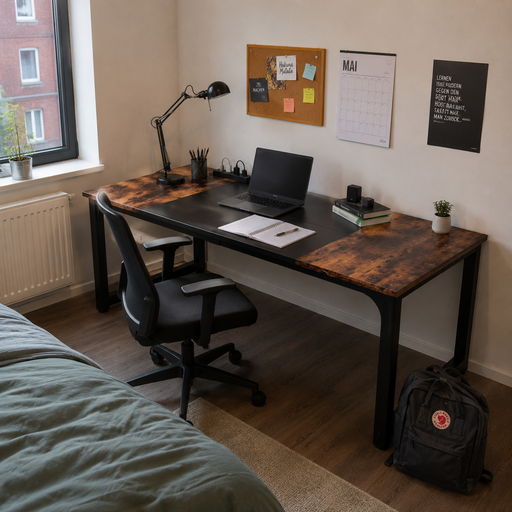
Why It Stands Out: If space is what you need, this desk delivers. With a huge 180 x 80 cm tabletop, it offers an expansive workspace suitable for dual-monitor setups, large-scale projects or even as a shared desk for two people.
Its modern industrial design, featuring a rustic brown top and a black steel frame, adds a touch of character to any home office. The frame is constructed from 5 x 5 cm thick steel tubes, ensuring excellent stability with a stated maximum load capacity of up to 260 kg. Please note that for easier shipping, the tabletop arrives in four panels.
Pros:
Who is it for? This is an excellent choice for professionals, creatives or gamers who require a large, uninterrupted surface. It also functions well as a conference table or a spacious shared workstation desk.
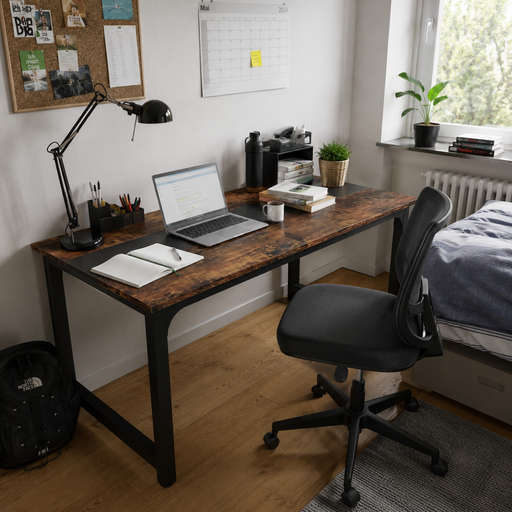
Why It Stands Out: This desk is engineered for superior stability. While offering a generous 160 x 80 cm platform, its main feature is the heavy-duty construction. The powder-coated steel frame is reinforced with two additional steel supports and a triangular connection design.
This robust build gives it an impressive stated load capacity of up to 400 kg, making it one of the most solid options for users with heavy computer towers, multiple large monitors or other weighty equipment. The adjustable leg pads ensure this solid foundation remains level on any surface.
Pros:
Who is it for? This desk is highly recommended for serious gamers, video editors, programmers or anyone whose setup includes heavy or multiple pieces of equipment and for whom stability is the top priority.
If these selections aren't quite the right fit for your specific needs, there are many other styles, sizes and finishes to explore. From corner desks to minimalist writing tables, finding the perfect piece of furniture is about matching it to your unique space and workflow.
Explore our full collection of home computer office desks to find your perfect match.
A good size depends entirely on your needs. For simple tasks with a laptop, a desk around 80-100 cm wide is usually sufficient. For a setup with one or two monitors, look for a width of 120-160 cm. For extensive multi-monitor setups, large projects or shared use, a desk that is 180 cm or wider is ideal. Always measure your room first to ensure a comfortable fit.
The most effective solution is to choose a desk with adjustable feet. These are small levellers on the bottom of the legs that can be screwed in or out to compensate for uneven flooring, eliminating any wobble and ensuring a perfectly level surface. All the desks recommended in this guide include this feature.
The terms are often used interchangeably. Historically, a study desk was a simple table for writing, while a computer desk might have included features like keyboard trays or cable management holes. Today, most modern desks are designed to be versatile. A good simple desk can serve equally well for studying, working on a computer or even as a crafting table. The key is to choose one with a durable, stable surface that suits your primary activities.