
24/7 Customer Support

Free returns

Same-day & Next-day Delivery

Quality Guaranteed

Unlock Your Welcome Offers: FREE Delivery | Up to 80% OFF | Free 30-day JoyPlus trial
Download the APP
A condenser tumble dryer can make wet-weather laundry far easier, particularly in homes without outdoor venting. However, choosing by drum size or a prominent “smart” label alone can lead to disappointing results. The most suitable appliance depends on installation space, household load, drying controls, maintenance and running costs.
This guide highlights common buying pitfalls, explains the specifications that matter and matches selected models to different UK household needs.
A larger drum is useful, but a 10kg condenser tumble dryer may be unnecessary for a couple who normally washes smaller loads. An oversized appliance can take up more space and may be less economical if it is routinely used with only a few garments.
Conversely, families washing bedding, towels and school or work clothing may find an 8kg condenser tumble dryer restrictive. Repeated cycles can reduce the practical benefit of a lower purchase price. Match the dryer to your washing machine and typical weekly laundry volume rather than choosing the largest number available.
Unlike a vented dryer, a condenser appliance collects moisture in a tank. The tank must be emptied regularly unless the model supports a suitable drainage arrangement. Lint filters and condenser areas also require cleaning according to the manufacturer’s instructions.
A drawer-style collection system can make this routine simpler, but it does not remove the need for maintenance. Before buying, check the water tank position, filter access and whether the controls provide reminders or alerts.
A Wi-Fi tumble dryer can offer remote monitoring, cycle notifications and additional programme guidance. These features may be convenient, but they do not by themselves guarantee lower electricity consumption. Running costs depend on the programme, load size, moisture level, room conditions and frequency of use.
For practical efficiency, prioritise sensor dry technology, appropriate load sizes and a clearly stated energy class. A sensor dry tumble dryer can stop or adjust the cycle when the appliance detects that clothes have reached the selected dryness level, helping to avoid unnecessary continued heating.
Use these as general household planning points:
Drum capacity refers to the maximum dry laundry weight. Do not pack clothes tightly, as this can restrict airflow and lead to uneven drying.
A freestanding tumble dryer normally offers more placement flexibility than an integrated model, but it still needs adequate clearance, a stable floor and access to a suitable electrical supply. Condenser models do not require an external vent hose, which can simplify placement in a utility room, kitchen or other suitable indoor area.
Compare the appliance dimensions with your available space. For example, the Candy Smart Pro 10kg model measures 85 x 60 x 59cm, while the Hoover H-Dry 300 Lite 8kg model measures 85 x 60 x 53cm. That difference in depth may matter in a narrow utility area. Also check door clearance and whether the water tank can be removed comfortably.
The listed models below are B-rated tumble dryers, providing a straightforward comparison within this selection. The energy label should be checked before purchase, as actual electricity use depends on the programme and load.
Noise levels are also relevant for open-plan homes or night-time use. The supplied models are listed at 64dB or 68dB, so compare these figures rather than relying on descriptions such as “quiet”.
Useful controls include:
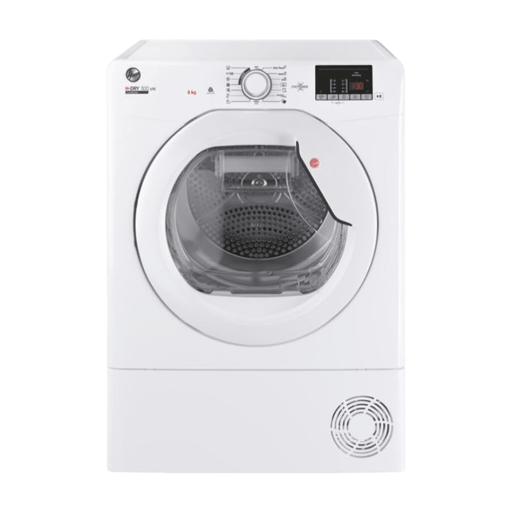
Why This Fits Their Persona: Its 8kg capacity and 53cm depth suit couples, individuals and smaller UK homes looking for a straightforward white tumble dryer without app connectivity.
It uses a front-accessible water tank and avoids unnecessary smart features for shoppers who prefer simple operation and routine maintenance.
Listed features include 12 programmes, four dryness levels, a 24-hour delay timer and a 64dB noise rating.
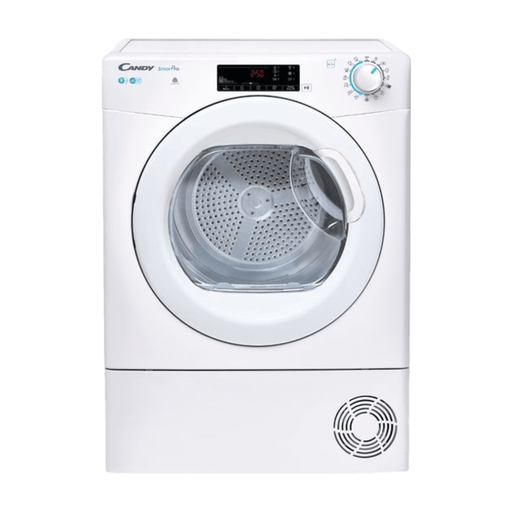
Why This Fits Their Persona: This 9kg model is aimed at households wanting app control, programme variety and added cycle guidance alongside a generous everyday capacity.
Its sensor dry system and Kilo Detector address the risk of choosing cycles without considering moisture level or load weight.
It offers Wi-Fi and Bluetooth connectivity through the hOn app, 15 programmes, a 68dB rating and listed B energy class.
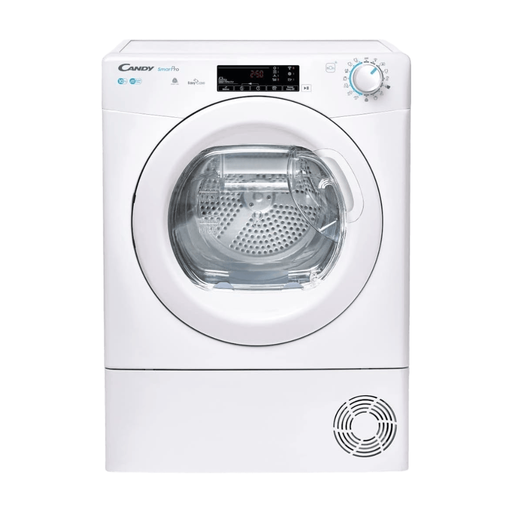
Why This Fits Their Persona: The 10kg drum is designed for large families and shared households managing frequent bedding, towel and clothing loads.
The Easy Case drawer system makes collected water and lint more accessible, while sensor drying helps avoid relying only on fixed timed cycles.
It provides 10kg capacity, 16 programmes, Wi-Fi app control, a 24-hour delay start and an anti-crease function.
We have compiled a complete, real-time list of products that fully satisfy these strict selection criteria and UK safety regulations.
No. A condenser tumble dryer collects moisture from the air inside the appliance, placing it in a removable tank. This allows more flexible indoor installation than a vented model. You still need suitable ventilation around the appliance, a level floor and access for emptying the tank and cleaning filters.
Running cost varies according to the appliance’s energy class, programme, load size, fabric moisture and electricity tariff. Sensor drying, full but not overloaded drums and suitable cycles can help avoid unnecessary operation. Check the energy label and manufacturer information rather than relying only on the “energy-efficient tumble dryer” wording in an advert.
Lifespan depends on build quality, frequency of use, loading habits and maintenance. Regularly clean the lint filter, empty the water tank and follow the care instructions. Before purchase, compare the warranty, replacement-part information, dimensions and service arrangements as carefully as the headline capacity.