Conference organisers serving mixed groups
Plan a recognisable no-added-sugar cola alongside other drinks. Check pack counts for registration, breaks and lunch, and decide whether a separately labelled caffeine-free choice belongs on the order.


For unattended conference breaks, 330ml cans make individual self-service straightforward; at staffed drinks stations, 2-litre bottles allow shared pouring if cups and chilling are arranged. Coca-Cola GB and Pepsi UK list 0g sugars per 100ml for standard Coca-Cola Zero Sugar and Pepsi Max, but both contain caffeine. If a caffeine-free choice is needed, order an explicitly labelled variant and check the delivered pack for its ingredients and phenylalanine statement.
Plan a recognisable no-added-sugar cola alongside other drinks. Check pack counts for registration, breaks and lunch, and decide whether a separately labelled caffeine-free choice belongs on the order.
Choose individual cans where attendees take their own drinks, or shared bottles where someone can manage pouring. Keep the delivered labels accessible when setting out dietary information.
Keep caffeine-free choices distinct from standard zero-sugar cola. Check phenylalanine statements on the supplied packs rather than assuming that a no-added-sugar drink suits every attendee.
Set the serving format and caffeine choices first, then confirm the exact products and pack counts against the event plan.
| Priority | What to check | Your needs |
|---|---|---|
| Sugar declaration | Read sugars per 100ml and the name of the exact variant. Coca-Cola GB and Pepsi UK list 0g sugars per 100ml for standard Coca-Cola Zero Sugar and Pepsi Max; Tesco lists less than 0.1g per 100ml for its 2-litre Diet Cola. | I need the drinks delivered to match a no-added-sugar brief, without accidentally substituting a similarly named cola. |
| Caffeine | Check the product designation and ingredient list. Standard Coca-Cola Zero Sugar and Pepsi Max contain caffeine; their separately named caffeine-free variants are different choices. | For a late session or attendees avoiding caffeine, I want an explicitly labelled caffeine-free cola available alongside the standard option. |
| Ingredients | Read the delivered pack for sweeteners and any phenylalanine statement. Do not use a caffeine-free designation as evidence of suitability for someone with phenylketonuria (PKU). | I need ingredient information at the serving point so attendees can identify the product they are being offered. |
| Serving format | Compare 330ml can counts with the number of servings planned. For 2-litre bottles, arrange cups, pouring and chilled service; check the label for instructions after opening. | Cans work for a dispersed, self-service break. At a staffed station, I can plan shared bottles around the expected use and available facilities. |
Standard Coca-Cola Zero Sugar and Pepsi Max list caffeine despite declaring 0g sugars per 100ml, according to their UK brand pages.
If caffeine avoidance matters for the event, order a variant explicitly labelled caffeine-free and check the supplied pack.
The Coca-Cola and Pepsi zero-sugar variants described on their UK brand pages carry phenylalanine statements. A caffeine-free label does not remove the need to check ingredients.
Keep the supplied ingredient information available and avoid presenting these drinks as suitable for every dietary requirement.
Large bottles need someone to plan pouring and opened-bottle handling. Tesco instructs buyers to consume its 2-litre Diet Cola within three days of opening.
Use cans where attendees need to take a portion quickly; plan shared bottles for a station where pouring can be managed.
Shared service also needs cups and enough capacity to chill the drinks before serving.
Tesco advises that formulations and product information can change, so a listing may not match the packs delivered for an event.
Before putting out dietary signs, check the received product name, ingredients, nutrition panel, caffeine designation, best-before date and pack count.
These product-line examples help distinguish sugar, caffeine and serving-format choices; check the exact pack before adding it to a conference order.
Coca-Cola Zero Sugar has a standard version and a separately named Caffeine Free version.
Pepsi Max and Pepsi Max No Caffeine provide distinct choices when planning caffeine options.
Tesco Diet Cola is an own-label, no-added-sugar option in a 2-litre bottle for planned shared service.
These packs cover individual cans for conference breaks, caffeine-free can choices and a shared-bottle option for staffed service. Check the exact variant and delivered label when planning dietary signs.
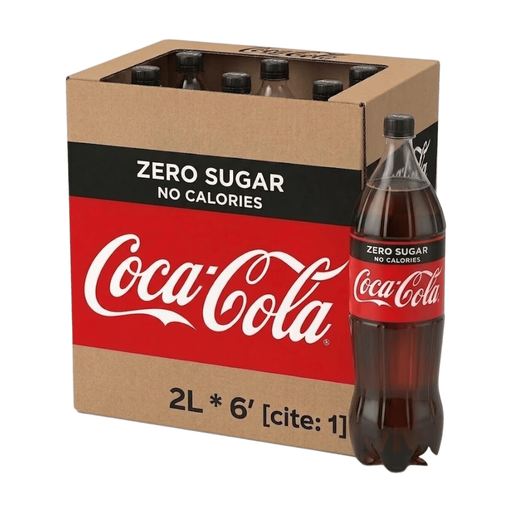 No image available
Six 2-litre bottles suit a staffed station where cups and pouring are planned. Coca-Cola GB lists 0g sugars per 100ml for Coca-Cola Zero Sugar; its standard version contains caffeine and carries a phenylalanine statement. Check the delivered pack before preparing ingredient information.
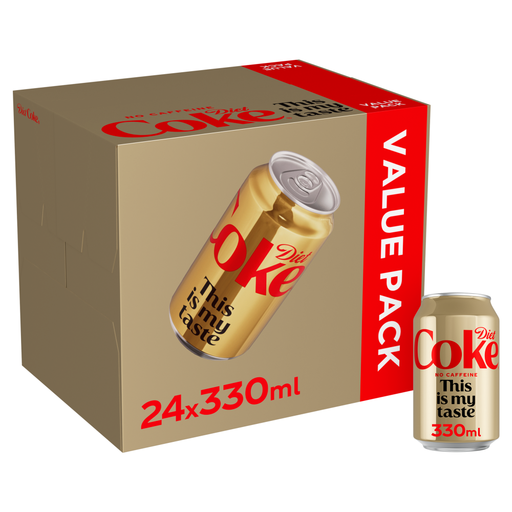 No image available
Individually portioned cans offer a caffeine-free choice for self-service. Check the delivered pack’s sugar declaration, ingredients and any phenylalanine statement against the event brief.
 No image available
This caffeine-free can pack provides individual portions for a conference break. Check the received pack’s sugar and ingredient information, including any phenylalanine statement, before labelling the serving point.
 No image available
The 24 individually portioned cans suit attendee self-service. Pepsi UK lists 0g sugars per 100ml for standard Pepsi Max, which contains caffeine and carries a phenylalanine statement; check the supplied pack when setting out ingredient information.
 No image available
The 24-can format allows individual distribution at registration or refreshment breaks. Coca-Cola GB lists 0g sugars per 100ml for standard Coca-Cola Zero Sugar, which contains caffeine and carries a phenylalanine statement; check the delivered label before making dietary signs.
No. Coca-Cola GB and Pepsi UK list caffeine in standard Coca-Cola Zero Sugar and Pepsi Max, even though both declare 0g sugars per 100ml. For a caffeine-free choice, order an explicitly named variant and check the supplied label.
No. The Coca-Cola Zero Sugar and Pepsi Max product pages carry phenylalanine statements, which matter when handling PKU-related dietary enquiries. Make the delivered pack’s ingredient information available and do not assume that removing caffeine removes other ingredient considerations.
Choose 330ml cans for individual self-service; use 2-litre bottles where pouring, cups and chilling can be managed. Plan how opened bottles will be used: Tesco instructs buyers to consume its 2-litre Diet Cola within three days of opening.
Check the exact product name, pack count, sugar declaration, ingredients, caffeine designation and any phenylalanine statement before preparing signs. Tesco warns that formulations and product information can change, so use the delivered label rather than relying solely on an online listing.