Organisers with an organic catering brief
If the menu or event communications will describe the dried fruit as organic, choose products with an appropriate organic label rather than treating “natural” or “dried” as equivalent.


Choose dried fruit labelled organic when the conference brief or menu calls for organic food; UK organic labelling rules require eligible products and suppliers to meet certification requirements. Retail packs let organisers check individual products for a smaller event, while a business supplier may suit repeat or larger ingredient orders. Whichever route you use, check the exact pack’s ingredients and allergen information separately from its organic claim.
If the menu or event communications will describe the dried fruit as organic, choose products with an appropriate organic label rather than treating “natural” or “dried” as equivalent.
If dried fruit is an ingredient for repeated events or larger orders, compare retail packs with a supplier’s pack formats, delivery minimums and product specifications.
When several products are offered to attendees, keep the current ingredients and allergen information for each one, including any sulphite or nut-related statements.
Settle the menu claim first, then choose a pack format and check the information that attendees will need when the food is served.
| Priority | What to check | Your needs |
|---|---|---|
| Organic claim | Check the exact product’s organic label and supplier documentation. The Department for Environment, Food & Rural Affairs says UK organic food claims are subject to production and certification rules. | Our conference menu says “organic”, so I need a product that can legitimately carry that description. If the event has made no organic promise, conventional dried fruit remains an option. |
| Order format | Compare the required quantity, pack size and preparation work. Whitworths says its business supply includes organic ingredients, fixed-price contracts and pallet options; confirm the specification for the exact line. | For a smaller break, I can check and set out individual retail packs. For repeated or larger catering orders, I need to establish whether ingredient supply fits the event. |
| Ingredients and allergens | Read each current pack’s ingredients, regulated allergens and precautionary statements. The Food Standards Agency notes that sulphites are often used in dried fruit, including raisins, apricots and prunes. | Attendees need accurate information about what is being served. I cannot use an organic label as evidence that a product is free from sulphites or other allergens. |
| Serving information | Check the delivered packs before portioning or combining products. Record which ingredients are in each bowl or portion, particularly if dried fruit is mixed with nuts. | If I put several fruits on a shared table, I need to describe the final mix accurately rather than label everything simply “dried fruit”. |
Organic production rules do not establish whether a dried-fruit pack contains sulphites or carries other allergen statements.
Check organic status and allergen information separately, and retain the current label or supplier specification for every product served.
Ingredients and allergen information can change. Marks & Spencer advises customers to read the product label rather than rely solely on its online information.
Check the packs delivered to the venue and update your ingredient record if a product or formulation has changed.
Adding nuts changes what is in the bowl, while individual dried-fruit products may also carry nut, peanut or sesame precautionary statements.
Keep products separate where practical and describe each mix using the ingredients and allergen information for the packs actually used.
Organic-ingredient supply capability does not establish the status, pack format or allergen details of a particular catering order.
Ask for the exact line’s organic documentation, specification, shelf life, pack size and delivery terms before committing.
Whitworths says it has Soil Association accreditation to supply organic ingredients through its business-to-business service.
Tesco’s dried-fruit catalogue lists Tesco Organic Medjool Dates 200G, providing an example of a labelled retail pack.
Marks & Spencer’s fruit-snack catalogue lists organic soft apricots, dates and prunes, as well as organic raisins and sultanas.
Sunsweet is a prune-focused brand to consider if prunes are part of the catering plan.
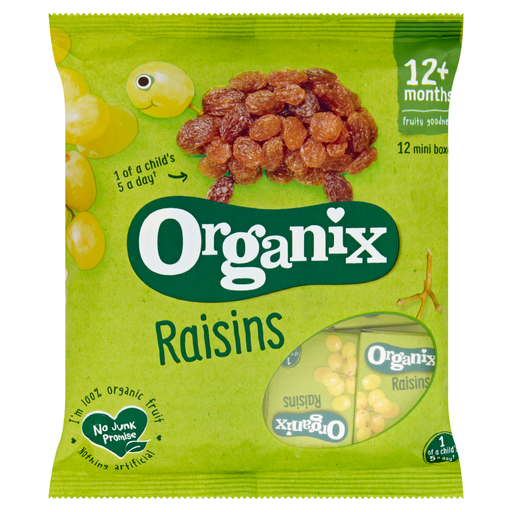
This raisin multipack offers small portions for a conference snack break. Check the exact pack’s organic claim before including it on an organic menu.
 No image available
The 12 × 14g format may suit individually portioned snack breaks. The 12+ months labelling is aimed at young children, so consider whether the presentation and portion size suit adult attendees. Check the delivered pack’s organic claim, ingredients and allergen statements before serving.
Use “organic” only for a product that meets the applicable organic production and certification rules. The Department for Environment, Food & Rural Affairs says the product and suppliers must be certified by an approved organic control body and at least 95% of a food product’s agricultural ingredients must be organic. “Natural” is not a substitute for an organic claim.
No: organic status and allergen information are separate checks. The Food Standards Agency notes that sulphites are often used in dried fruit, including raisins, dried apricots and prunes. Read the current ingredients and allergen statements for each exact pack.
First establish whether the portions fall under the UK rules for food prepacked for direct sale. For food that does, the Food Standards Agency and Food Standards Scotland state that, since 1 October 2021, labels must show the food name and a full ingredients list with the 14 regulated allergens emphasised. Keep source-pack details and recipes current if ingredients change.
Yes, provided you check the ingredients and allergens of every product used and can give attendees accurate information about the final mix. Take particular care when a fruit contains sulphites or when nuts are added. Food Standards Agency research identifies written ingredient and allergen information as one way non-prepacked food businesses communicate these details.
Retail packs suit an event where organisers can readily check and portion each product. Consider business supply for larger or repeated ingredient orders: Whitworths says it supplies organic ingredients and offers contract and pallet options. Before ordering, confirm the exact product’s organic status, allergens, pack format and delivery terms.