Conference menu planners
If you are offering different wrap bases, compare their ingredients and stated fibre figures, then use the pack counts to plan portions.


Choose white-and-wheat wraps when the conference menu calls for a blended-style base, but check the ingredients: products bearing similar descriptions do not necessarily contain the same flours. Wholemeal wraps suit a menu that calls for a wholemeal-labelled base and a stated fibre amount; plain wraps suit a menu that does not require either. Count portions by pack size, and assess allergens and storage for the finished wraps as well as the tortillas.
If you are offering different wrap bases, compare their ingredients and stated fibre figures, then use the pack counts to plan portions.
The fillings and preparation method affect allergen information and whether completed wraps need chilled storage or display.
Attendees who cannot eat wheat-containing wraps need a separately assessed product and a check of the complete filled wrap, including preparation.
Choose the wrap base first, then compare portions, pack instructions and the requirements of the finished buffet food.
| Priority | What to check | Your needs |
|---|---|---|
| Wrap base | Read the ingredient list rather than treating “white-and-wheat” as a fixed recipe. ASDA lists fortified and wholemeal wheat flours; Mission Wheat & White lists wheat fibre and wheat germ. | I want to describe the wrap accurately to attendees, whether the menu calls for a flour blend or another wheat-and-white formulation. |
| Fibre and size | Compare fibre per 100 g when wrap weights differ, then check the figure per wrap for the portion served. ASDA lists 3.7 g per White & Wheat wrap; Tesco lists 5.1 g per 61 g wholemeal wrap, and Ocado lists 4.5 g per 62 g M&S wholemeal wrap. | A stated per-wrap figure matters for my menu, but I do not want different-sized tortillas treated as identical portions. |
| Plain wraps | Check whether a plain wheat-flour base meets the menu brief. Old El Paso lists 0.7 g fibre per 41 g regular flour tortilla and 2.2 g per 41 g whole-wheat tortilla; both contain wheat. | For these fillings, I may prefer a plain base rather than specifying a white-and-wheat or wholemeal wrap. |
| Pack planning | Count wraps per pack and read the chosen pack’s after-opening instructions. Mission lists six Wheat & White wraps per pack; ASDA White & Wheat and Tesco Wholemeal are eight-packs. | I need enough portions for the event and a preparation schedule that follows the product I actually open. |
| Allergens and service | Check the tortilla, fillings and preparation for allergens. Assess chilled holding for the completed food rather than relying on an unopened tortilla’s storage instructions. | Some attendees need a separately assessed option, and filled wraps must be handled according to their ingredients during buffet service. |
ASDA’s White & Wheat listing includes wholemeal wheat flour, while Mission’s Wheat & White ingredient list identifies added wheat fibre and wheat germ. The descriptions do not establish the same formulation.
Check the exact product’s ingredients before describing its blend on a conference menu.
Old El Paso’s regular flour tortilla is listed at 41 g, while Tesco’s wholemeal tortilla is listed at 61 g. Their per-wrap figures refer to different-sized portions.
Use per-100 g declarations for a common comparison basis, then check per-wrap figures for the portions you plan to serve.
The Food Standards Agency identifies ready-to-eat foods including salads, cooked meats and sandwiches among foods that may need chilling. A tortilla’s unopened-pack instructions do not settle how its filling should be held.
Plan storage and buffet display around the completed wrap and the applicable food-safety guidance.
Fillings that require chilling may also require chilled holding arrangements during service.
Mission Wraps UK lists Wheat & White wraps in standard and mini formats.
ASDA lists an eight-pack of White & Wheat wraps made with fortified and wholemeal wheat flours.
Tesco lists a wholemeal tortilla eight-pack as an alternative to a white-and-wheat wrap.
Ocado lists M&S Wholemeal Tortilla Wraps for planners considering a wholemeal base.
Old El Paso UK lists regular flour, whole-wheat and separately labelled gluten-free tortillas.
Sainsbury's lists own-label plain and wholemeal wraps alongside Mission Wheat & White products.
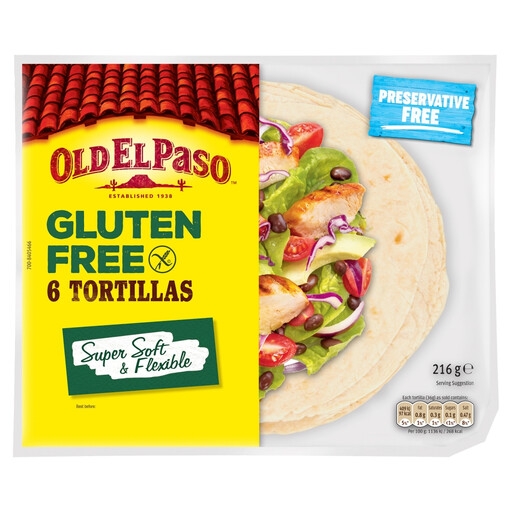
This gluten-free tortilla is an option to assess separately for attendees who need one; it is not a white-and-wheat, plain wheat or wholemeal wheat wrap.
 No image available
Consider this separately labelled gluten-free wrap for a conference dietary option, rather than as a substitute for the wheat-based menu choice.
216g pack. Check the physical pack’s ingredients and allergen information, and assess the fillings and preparation before serving.
No: assess storage and display for the completed wraps, not just the unopened tortillas. The Food Standards Agency identifies ready-to-eat foods such as salads, cooked meats and sandwiches among foods that may need chilling, so the fillings and finished food determine the service arrangements.
Follow the instructions on the product you use: ASDA’s White & Wheat listing says to refrigerate after opening and consume within 24 hours, while Tesco’s Wholemeal listing says to refrigerate and consume within two days. Neither tortilla instruction extends the storage time of a prepared filling.
Start with the number of wrap portions planned and the count on the selected pack. Mission lists six standard Wheat & White wraps per pack, while the ASDA White & Wheat and Tesco Wholemeal products discussed here are eight-packs; check the chosen size if you intend to serve smaller portions.
Check the complete recipe, including the tortilla and fillings, and manage allergens during preparation. Food Standards Agency guidance for England, Wales and Northern Ireland, and separate Food Standards Scotland guidance, require food businesses to provide allergen information for both prepacked and non-prepacked food.
No: individual packing alone does not determine whether a wrap is prepacked for direct sale; how and where it was packed and offered also matters. In Scotland, Food Standards Scotland says food that meets that classification must carry its name and an ingredients list with regulated allergens emphasised. Check the arrangement before deciding which labelling rules apply.