Start with the connection and power available at your relative’s entrance, then choose a doorbell with a suitable view, alerts and a recording method the household can manage. Fixed broadband is an option where Wi-Fi reaches the door or Ethernet and suitable power can be installed; a 4G or 5G router and data SIM require a test of the chosen network inside the property. An alert or clip can help check an expected arrival, but cannot establish that a care visit was completed or provide emergency monitoring.
Who is this for?
Families checking expected visits
You want an arrival alert and enough live or recorded doorway context to decide whether a planned visitor appears to have arrived. A doorbell does not assess the care provided or replace an emergency-response arrangement.
Homes without suitable fixed broadband
You are considering a 4G or 5G router and data SIM. Ofcom’s postcode coverage information can help you choose a network to test, but reception inside the property and connectivity at the door determine whether the arrangement is usable.
Households with a shared or exposed entrance
Your planned camera view may include a neighbour’s property, a pavement or a communal area. The Information Commissioner’s Office says UK data-protection law applies when a home camera captures those spaces, making camera position and control of recordings part of the choice.
What matters when choosing a setup?
Fixed broadband
Choose when: Home Wi-Fi works at the entrance, or Ethernet can reach a suitably powered doorbell.
Allow for: Wi-Fi dead spots or the wiring and equipment needed for a wired or PoE installation.
4G or 5G router and data SIM
Choose when: Fixed broadband is unsuitable and the selected mobile network passes an in-home test with the router in its intended position.
Allow for: Reception changes inside the building and data use that varies with viewing and recording settings.
| Concern |
What to check |
Who this matters to |
| Connection at the door |
Test Wi-Fi at the mounting point. For mobile broadband, use Ofcom’s postcode coverage information to shortlist networks, then test the router and SIM inside the property. |
If I cannot count on a connection at the entrance, I need to know whether alerts and live video will reach me from that spot. Around 36% of consumers put connection reliability first. |
| Visual confirmation and recording |
Check the view from the intended mounting position, available person alerts, where clips are stored and how an authorised family member can access them. Local recording still needs a working network path for remote live checks. |
When I check an expected arrival later, I need a useful doorway view or retained clip rather than an alert alone. For around 29% of consumers, visual confirmation and recording are the primary need. |
| Privacy at the entrance |
Inspect what the camera and microphone could capture. Check available angle, privacy and audio controls, plus access and retention settings; consult current ICO guidance if the view extends beyond the property. |
At a shared entrance, I need to see the visitor without unnecessarily capturing neighbours or passers-by. Privacy-led framing and access come first for around 21% of consumers. |
| Installation and upkeep |
Confirm the power arrangement and compatible wiring, then check which chime, hub, card or adapter the chosen setup requires and who will maintain it. |
If nobody can regularly recharge a doorbell at my relative’s home, I need a power arrangement we can maintain. Around 14% of consumers prioritise installation and upkeep. |
What can go wrong?
-
Buying a data SIM on coverage predictions alone
Ofcom cautions that postcode coverage is a guide: buildings, trees and conditions inside a home can change reception. A network that appears suitable on a map may not work well where the router will sit.
Compare the underlying networks available at the address, then test the intended router and SIM in position. Check that alerts and live video work at the door before relying on the connection.
-
Treating battery life as maintenance-free operation
TP-Link’s battery-duration claims for its doorbell depend on use and settings. Regular alerts and live viewing can change how often charging is needed.
Agree who will check and recharge a battery model. If that task is difficult to manage, assess whether compatible wiring or a PoE installation is practical instead.
Charging takes time, and remote checks may be interrupted if the battery runs flat.
-
Choosing the widest view without checking the surroundings
A camera aimed beyond the doorway can capture neighbours, public areas or communal space. The Information Commissioner’s Office says UK data-protection law applies when a home camera captures those areas.
Check the view from the proposed mounting point and use an appropriate angle or available privacy controls to limit capture to what is needed for checking arrivals.
-
Using a generic figure to choose a mobile-data allowance
Live-view time, event frequency and recording settings affect data use. Google Nest Help also notes that higher video-quality settings use more bandwidth.
Check guidance for the exact doorbell and recording mode, then monitor router data use during a representative trial before settling on a SIM allowance.
Brands to consider
Reolink
Relevant when comparing powered Wi-Fi and Power over Ethernet (PoE) doorbells with local recording.
- Reolink describes person detection and local recording on its UK wired Wi-Fi and PoE models; its PoE model uses one cable for network connectivity and power.
- The Wi-Fi model needs usable coverage at the door, while PoE requires a suitable Ethernet route and network equipment.
Tapo
Relevant when comparing a wired doorbell with a battery model and considering local storage.
- TP-Link describes a 4:3 view and microSD recording for the wired D130, and a battery and hub-based storage arrangement for the D230S1.
- Check the exact model’s card and hub requirements. Battery duration varies with use and settings.
eufy
Relevant if a view of both the visitor and the area immediately in front of the door would suit the entrance.
- A Joybuy listing describes the eufy E340 as a dual-camera doorbell with battery or wired operation.
- Check the exact package, storage method, wiring requirements and subscription terms before choosing this model.
Joybuy doorbell options
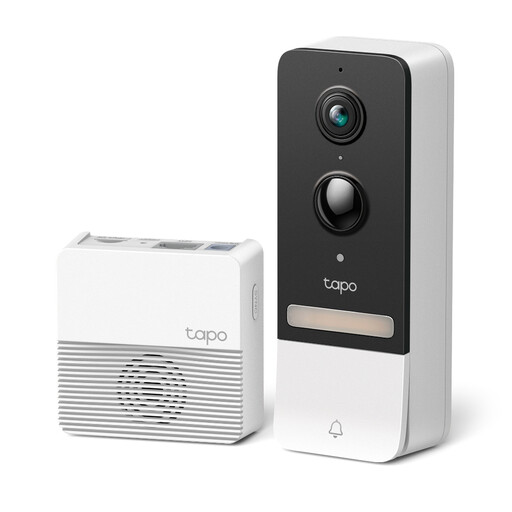
This battery doorbell is an option for checking expected arrivals when the household can maintain its charge and establish a working connection at the entrance. Its local-recording arrangement should be checked against the package being purchased.
 No image available
Tapo D230S1 Smart Battery Video Doorbell
Consider this battery doorbell if charging can be managed and you want to check expected arrivals remotely.
TP-Link describes hub-based local microSD storage for the D230S1. Confirm the hub and card requirements for the package, and test the connection at the intended mounting position.
Joybuy
Frequently asked questions
Does UK data-protection law apply to a doorbell facing my entrance?
It applies if the camera also captures another person’s property, a public area or a communal space, according to the Information Commissioner’s Office. Check the proposed framing and minimise capture beyond the entrance where possible.
Can I choose a 4G or 5G network from a coverage map?
Use a map to narrow down networks, not as the final test. Ofcom says local conditions can change actual reception, so try the selected SIM and router inside the property and check alerts and live viewing from the door.
Should I choose local or cloud recording?
Choose according to how the household needs to retain and access clips, then check the exact model’s arrangements. Local recording may require a card or hub and does not remove the need for connectivity for remote live checks; for cloud recording, check retention and subscription terms.
Can a doorbell show that a care visit was completed?
No. Depending on its setup, it can show a doorway alert, live view or recording that helps you check an expected arrival. It cannot assess the care delivered or serve as medical monitoring or an emergency-response guarantee.


