
24/7 Customer Support

Free returns

Same-day & Next-day Delivery

Quality Guaranteed

Unlock Your Welcome Offers: FREE Delivery | Up to 80% OFF | Free 30-day JoyPlus trial
Download the APP
A console table can add useful surface space without taking over a hallway, entrance hall or living room. However, attractive product photography can hide practical problems. A table that looks slim online may block a walkway, lack meaningful storage or feel unstable once assembled.
Before choosing a hallway console table or sofa table, look beyond colour and styling. The most useful checks concern dimensions, load limits, materials, stability and how you genuinely plan to use the furniture.
A slim console table may still be too deep for a small hallway. Measure the available area, then leave enough clearance for doors, radiators and everyday movement. A depth of around 26–36 cm may work against a wall, but the correct size depends on the room layout.
Remember to check the table’s assembled dimensions rather than relying on labels such as “space-saving” or “compact”. Also consider skirting boards, sockets and the clearance needed to clean underneath.
Open shelving can display books, baskets and decorative objects, but it does not conceal clutter. A console table with drawers is more suitable for keys, post, cables and smaller household items that you do not want on view.
Check the number of shelves, the distance between tiers and the stated load capacity. A multi-tier industrial console table may provide more display levels, but staggered shelves can be less convenient for larger storage boxes.
A slim, tall table has a relatively small footprint. Uneven floors, children, pets or heavy objects placed near the edge can increase the risk of tipping. Adjustable feet may help with minor floor variation, while some furniture must be secured to the wall using the supplied anti-tip device.
Treat the manufacturer’s load ratings as limits, not targets. Distribute weight evenly and follow the assembly instructions. For a wooden console table or engineered-wood design, check whether the stated capacity applies to the whole unit, tabletop, shelf or each drawer.
Width determines how much display space you receive, while depth affects movement around the furniture. Height matters when positioning a table behind a sofa, under a mirror or alongside other hallway furniture.
For a narrow console table, compare the product’s depth with your available passage. A 30 cm-deep table may suit many entrance areas, but the overall footprint can be greater once skirting boards or protruding handles are considered.
Particleboard with a paper veneer or melamine finish can offer a smooth, easy-clean surface at a lower price. An E1-rated board refers to a formaldehyde emissions classification for the panel; it is not a guarantee of unlimited durability or a substitute for checking the full product specification.
Solid wood, such as mindi or pine, may provide a different appearance and construction feel, although the finish, joints and care instructions still matter. Powder-coated metal is commonly used for industrial console tables and can create an open, lightweight visual effect.
Choose open shelves when you want books, plants, baskets or ornaments to remain accessible. Select drawers when the table will act as an entryway table for keys, post and small accessories. If the surface will hold a lamp, framed photographs or a vase, check the tabletop load rating and available width.
A living room side table positioned behind a sofa may need cable clearance, while a hallway table should leave enough room for people to pass comfortably.
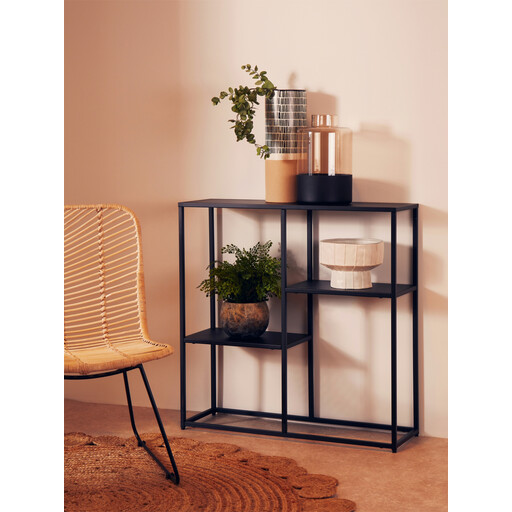
Why This Fits Their Persona: Its compact footprint suits tenants, flats and smaller entrance areas where a light, open design is preferable to a bulky cabinet.
The H81 x L26 x W80 cm dimensions are clearly stated, helping buyers assess whether it will fit a tight space rather than relying on vague “space-saving” wording.
Black powder-coated metal, multiple open shelves and a listed 7 kg product weight create a visually airy storage option.

Why This Fits Their Persona: The parquet-effect top and contrasting black X-frame suit homeowners seeking a distinctive piece for a hallway, living room or behind a sofa.
The specification identifies solid mindi wood, indoor use, self-assembly requirements and a 50 kg capacity, giving more useful information than appearance-led descriptions alone.
Its H80 x W99 x D35 cm profile provides a defined display surface, while the geometric base adds a clear industrial design feature.

Why This Fits Their Persona: The extra-long surface works well behind a larger sofa or along a wide hallway wall where display space is more important than enclosed storage.
The table provides exact width and depth measurements and states a maximum support figure of 136 kg. Buyers should still distribute weight evenly and confirm the current product instructions.
The 160 cm tabletop offers generous room for lamps, photographs and ornaments, while the country-style light-oak appearance adds warmth.
We have compiled a complete, real-time list of products that fully satisfy these strict selection criteria and UK safety regulations.
Leave a comfortable walking route between the table and the opposite wall, door or radiator. Measure the usable width after accounting for skirting boards and handles. If the passage feels restricted when carrying shopping or opening doors, choose a shallower design.
Yes. A sofa table can hold lamps, ornaments and charging accessories, provided its height and depth work with the sofa. Check that it does not obstruct reclining mechanisms, ventilation or sockets, and avoid placing unstable objects where they could be knocked down.
Lifespan depends on construction, weight distribution, humidity, cleaning and how often the table is moved. Correct assembly, wall fixing where appropriate and staying within the stated load limits can help preserve stability. Always check the product’s material, care instructions and warranty before ordering.